
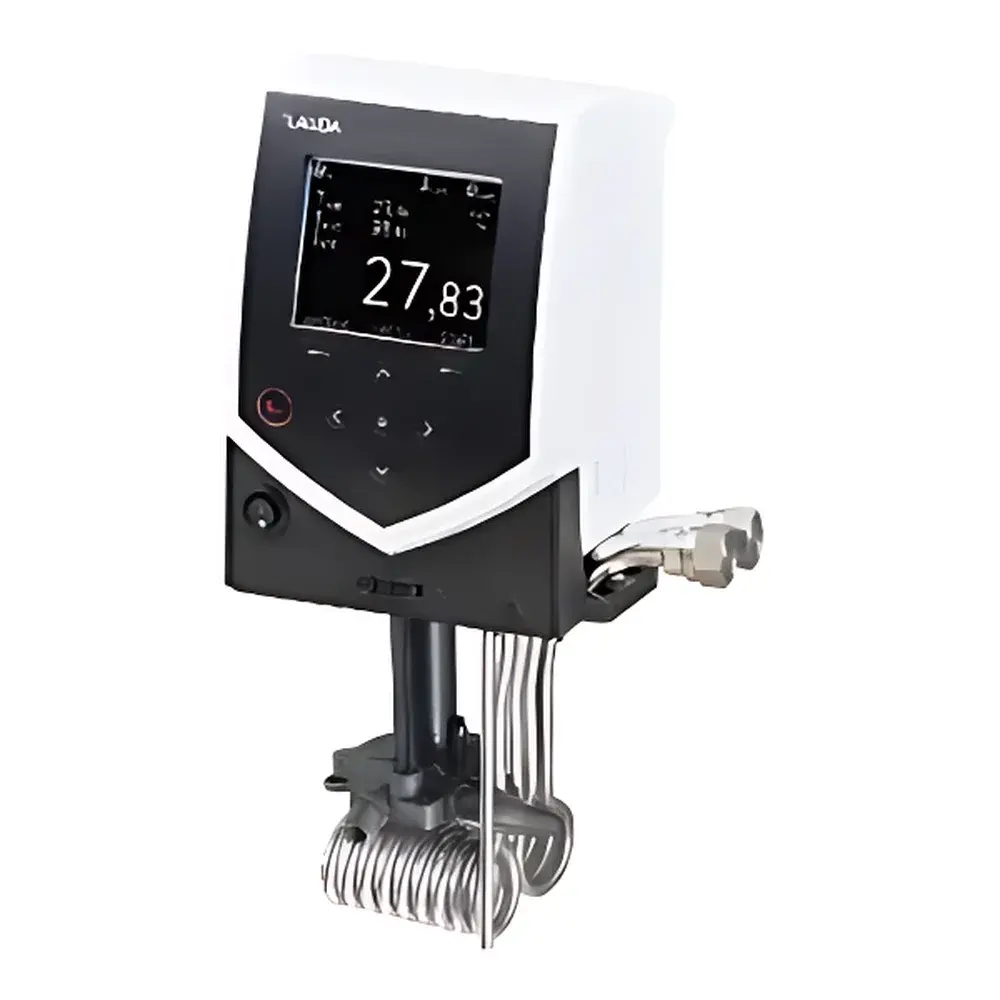
LAUDA ECO Immersion Circulator
| Brand | LAUDA |
|---|---|
| Origin | Germany |
| Model | ECO Silver / ECO Gold |
| Temperature Range | 20–200 °C |
| Display | Monochrome Graphical LCD (ECO Silver) or Color TFT LCD (ECO Gold) |
| Safety Class | Class III |
| Control Principle | Digital PID |
| Pump Type | Vario adjustable 6-stage circulation pump |
| Interface | Standard USB |
| Optional modules | Analog, Relay, RS232/485, PROFIBUS, Ethernet-USB, Pt100/LiBus |
| Mounting | Threaded clamp for baths with wall thickness ≤25 mm and depth ≥150 mm |
| Compliance | Suitable for flammable and non-flammable liquids |
| Certifications | CE, RoHS, IEC 61010-1 |
Overview
The LAUDA ECO Immersion Circulator is a precision-engineered temperature control instrument designed for laboratory-scale thermal regulation of liquid baths. Operating on the principle of forced convection via an integrated immersion-mounted circulation pump, the ECO series delivers stable, uniform temperature distribution across external vessels—enabling accurate thermal conditioning of samples, reactors, or analytical instrumentation. Its core architecture integrates a high-stability Pt100 sensor, digital PID algorithm, and microprocessor-based feedback loop to maintain setpoint accuracy within ±0.05 °C under typical load conditions. Designed for continuous operation in demanding environments—including pharmaceutical QC labs, chemical synthesis workflows, and life science incubation systems—the ECO circulator meets IEC 61010-1 safety requirements for laboratory electrical equipment and carries full CE and RoHS compliance documentation. The device is classified as Safety Class III per EN 61010-1, permitting safe use with both flammable solvents (e.g., acetone, ethanol) and aqueous media without additional enclosure requirements.
Key Features
- Dual-display configuration: ECO Silver features a monochrome graphical LCD; ECO Gold upgrades to a color TFT display with enhanced contrast and viewing angle for improved readability in ambient-lit or multi-user lab settings.
- Intuitive menu navigation with cursor keys and soft-touch function buttons—supports multilingual interface (English, German, French, Spanish) without firmware reflash.
- Dedicated Tmax safety key enables rapid activation of overtemperature cutoff, configurable between 50 °C and 210 °C in 1 °C increments—critical for GLP-compliant thermal validation protocols.
- Vario pump technology offers six discrete flow-rate levels (0–12 L/min), allowing precise optimization of heat transfer efficiency without mechanical throttling or external valves.
- Internal/external circulation mode switching performed entirely via front-panel menu—no physical reconfiguration or tubing disconnection required.
- Standard USB-B port supports direct connection to Windows/macOS workstations for real-time data logging, remote parameter adjustment, and firmware updates using LAUDA’s proprietary LabSoft software.
Sample Compatibility & Compliance
The ECO Immersion Circulator is validated for use with glass, stainless steel, and polypropylene bath vessels meeting minimum dimensional criteria: wall thickness ≤25 mm and immersion depth ≥150 mm. Its sealed, oil-free pump head prevents cross-contamination and eliminates maintenance associated with lubricated impellers. The unit complies with ISO/IEC 17025 calibration traceability requirements when used with certified Pt100 reference probes. For regulated environments, optional Pt100/LiBus interface module enables integration into centralized monitoring systems compliant with FDA 21 CFR Part 11 (audit trail, electronic signature support) and EU Annex 11 (data integrity). All models conform to GMP-relevant design principles—including non-shedding materials, smooth surface finishes (Ra < 0.8 µm), and absence of dead-legs in fluid pathways.
Software & Data Management
LabSoft v4.x (included) provides full bidirectional communication via USB or optional RS485/Ethernet modules. Key capabilities include scheduled ramp-soak profiles, real-time graphing of temperature vs. time, automatic export to CSV/PDF, and user-defined alarm thresholds. When deployed with the Ethernet-USB module, LabSoft supports TLS 1.2-secured remote access from institutional intranets—facilitating centralized fleet management across multiple lab sites. Audit trail functionality logs all parameter changes, user logins, and safety event triggers (e.g., Tmax activation), satisfying ALCOA+ data integrity criteria. Raw sensor data is timestamped at 100 ms intervals and stored locally on the host PC with SHA-256 hash verification.
Applications
- Pharmaceutical stability testing per ICH Q1A(R2) guidelines, where precise 25 °C/60% RH or 40 °C/75% RH chamber pre-conditioning requires calibrated liquid-bath thermal sinks.
- Catalytic reaction monitoring in organic synthesis, where exothermic Grignard or lithiation steps demand sub-0.1 °C bath stability over 72-hour runs.
- Enzyme kinetics assays requiring strict thermal control during UV-Vis spectrophotometric measurements (e.g., LDH activity at 37 °C).
- Calibration of thermocouples, RTDs, and infrared pyrometers against NIST-traceable reference standards immersed in silicone oil baths.
- Material science applications including polymer melt indexing (ASTM D1238), where consistent 190 °C bath temperature is critical for viscosity reproducibility.
FAQ
What is the maximum recommended bath volume for stable temperature control?
For optimal thermal homogeneity and response time, LAUDA recommends bath volumes between 2 L and 20 L. Larger volumes (>30 L) require ECO Gold with active external cooling integration.
Can the ECO operate unattended overnight?
Yes—when configured with Tmax limit, automatic restart after power failure, and LabSoft logging enabled, it meets 21 CFR Part 11 requirements for unattended operation in validated environments.
Is external PT100 probe support available without optional modules?
No—external sensing requires the Pt100/LiBus interface module, which provides galvanic isolation and 4-wire resistance measurement capability.
Does the Vario pump generate cavitation noise at low flow settings?
No—the brushless DC motor and optimized impeller geometry ensure silent operation across all six stages, verified per ISO 3744 acoustic emission standards.
How frequently should calibration be performed?
Annual calibration against a certified reference thermometer is recommended; however, daily verification using a traceable handheld probe satisfies ISO/IEC 17025 interim checks.



