
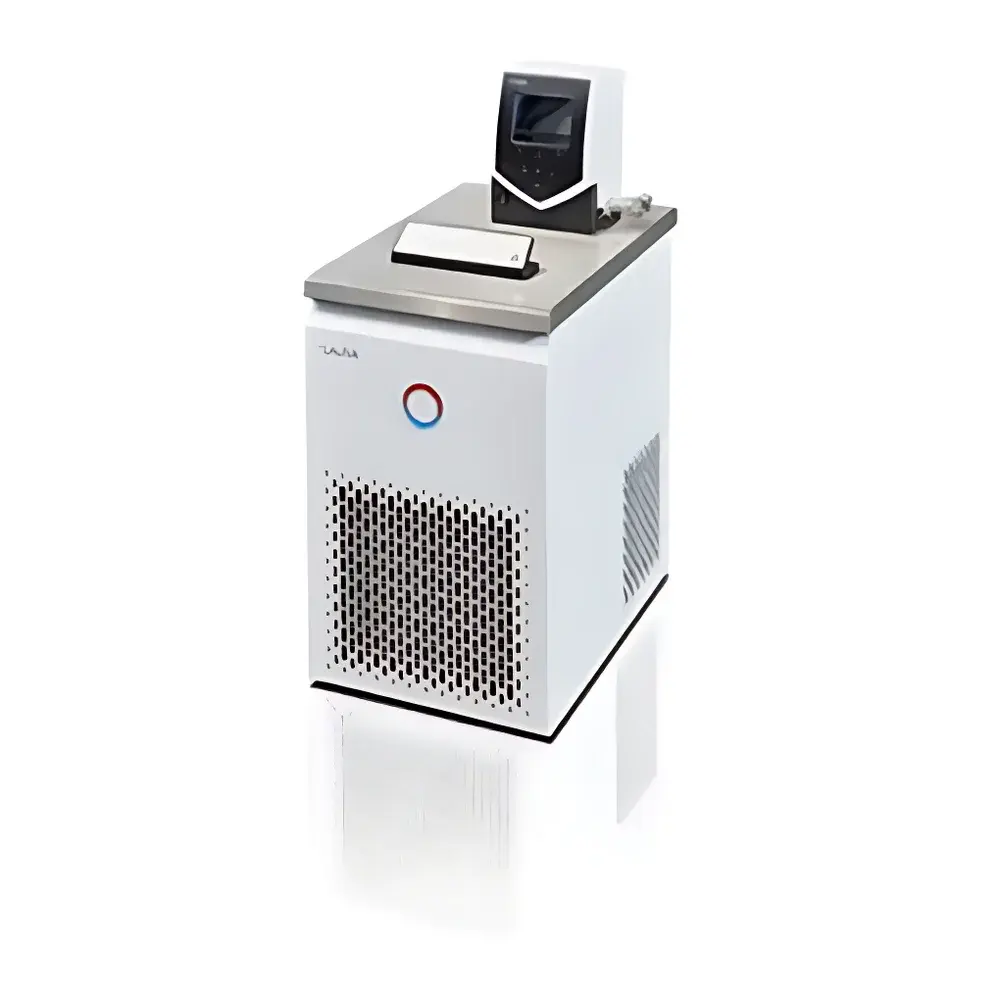
LAUDA ECO Series Heating and Cooling Circulating Bath
| Key | Brand: LAUDA |
|---|---|
| Origin | Germany |
| Type | Circulating Bath (Heating & Cooling) |
| Temperature Range | –50 °C to +200 °C (model-dependent) |
| Temperature Stability | ±0.01 K |
| Bath Volume | 3.5 L to 40 L |
| Circulation | Internal & External |
| Cooling Power | 180–700 W @ 20 °C |
| Controller Options | Silver (monochrome LCD) or Gold (color TFT) |
| Pump | 6-stage adjustable flow, front-mounted flow selector switch |
| Standard Interfaces | Mini-USB |
| Optional Modules | RS232/485, Profibus, Ethernet, EtherCAT, analog I/O, Pt100 L-Bus |
| Cooling Method | Air-cooled or water-cooled variants available |
| Refrigerant | Environmentally optimized natural refrigerants (e.g., R744, R290) compliant with F-Gas Regulation (EU) No 517/2014 |
| Compliance | CE, RoHS, EMC Directive 2014/30/EU, Low Voltage Directive 2014/35/EU |
Overview
The LAUDA ECO Series is a precision-engineered line of heating and cooling circulating baths designed for laboratory environments requiring high thermal stability, flexible fluid handling, and long-term operational reliability. Based on LAUDA’s proven thermoregulation architecture, the ECO platform employs a dual-mode heat transfer system combining resistive heating with vapor-compression refrigeration—enabling seamless transition between heating and cooling modes without manual intervention. Its core principle relies on closed-loop circulation of temperature-controlled fluid (water, water-glycol, or silicone oil) through an external process (e.g., jacketed reactor, viscometer, spectrometer cell) or internal bath chamber. The system achieves ±0.01 K temperature stability under dynamic load conditions—a performance benchmark validated per ISO 17025-accredited calibration protocols. All models integrate LAUDA SmartCool, a digitally regulated energy management system that dynamically modulates compressor speed and condenser fan duty cycle to minimize power consumption while maintaining setpoint fidelity across ambient fluctuations from 15 °C to 35 °C.
Key Features
- Two controller tiers: Silver (monochrome LCD with intuitive text-based menu navigation) and Gold (high-resolution color TFT display supporting multi-language UI, real-time trend graphs, and embedded programming logic)
- Independent front-panel flow control: Dedicated toggle switch enables on-the-fly selection between internal bath circulation and external process loop—no tooling or reconfiguration required
- 6-stage variable-speed circulation pump (up to 30 L/min at max stage), engineered for low pulsation and high head pressure to support extended tubing runs and elevated process vessels
- Standard stainless-steel bath tank with rear-mounted stainless steel drain valve; optional insulated lid included for all models to reduce evaporation and improve thermal efficiency
- Modular interface architecture: Top expansion slot accepts communication modules (RS232/485, Profibus DP, Ethernet TCP/IP, EtherCAT); bottom slot supports Pt100 L-Bus for distributed sensor integration
- Natural refrigerant variants (R744, R290) available across the ECO range—fully compliant with EU F-Gas Regulation and aligned with ISO 5149-2:2014 safety standards for refrigeration systems
- Energy-optimized design certified to DIN EN 16282-1:2021 for laboratory equipment, with standby power consumption <1.5 W and full-load efficiency exceeding 82% at nominal cooling output
Sample Compatibility & Compliance
The LAUDA ECO accommodates a broad spectrum of process fluids—including deionized water, 30–50% aqueous glycol solutions, and silicone oils up to 200 cSt viscosity—without degradation of pump seals or thermal exchange surfaces. Bath opening dimensions (130 × 105 mm to 613 × 300 mm) and depth (150–200 mm) are engineered to accept standard laboratory glassware (e.g., 1–5 L jacketed flasks, rotary evaporator condensers) and OEM-integrated instrumentation. All units conform to IEC 61010-1:2010 for electrical safety in laboratory equipment and undergo full electromagnetic compatibility (EMC) testing per EN 61326-1:2013. For regulated environments, optional audit trail logging (via Ethernet module) supports 21 CFR Part 11 compliance when integrated with validated LIMS or ELN platforms. Documentation packages include Factory Acceptance Test (FAT) reports, traceable calibration certificates (NIST-traceable Pt100 sensors), and Declaration of Conformity per EU Machinery Directive 2006/42/EC.
Software & Data Management
While the ECO operates autonomously via its embedded controller, digital integration is facilitated through multiple native protocols. The standard Mini-USB port enables direct connection to Windows/Linux hosts for firmware updates, parameter backup/restoration, and time-stamped log export (CSV format). Optional Ethernet or RS485 modules support Modbus TCP/RTU communication, enabling bidirectional setpoint control and real-time telemetry (temperature, pump speed, compressor status, error codes) within SCADA, LabVIEW, or custom Python-based automation frameworks. The Gold controller includes onboard data logging (up to 10,000 records) with timestamp resolution of 1 s and configurable alarm thresholds. When paired with LAUDA’s optional LabSoft software suite (sold separately), users gain access to advanced features including multi-segment ramp/soak programming, remote monitoring via web browser, and automated report generation compliant with GLP documentation requirements.
Applications
The LAUDA ECO serves as a primary temperature source in analytical, quality control, and R&D laboratories across pharmaceutical, chemical, food science, and materials engineering domains. Typical use cases include: precise thermal conditioning of viscometers (ASTM D445, ISO 3104), stabilization of UV-Vis and FTIR sample compartments, temperature control of HPLC column ovens (USP <621>), calibration of thermocouples and RTDs per ISO/IEC 17025, thermal cycling of polymer melt rheometers, and environmental stress screening of electronic components (JEDEC JESD22-A104). Its wide operating span (–50 °C to +200 °C), combined with sub-0.02 K short-term stability, makes it suitable for kinetic studies requiring tight thermal control over extended durations (e.g., Arrhenius modeling of reaction rates).
FAQ
What is the maximum allowable viscosity of fluid compatible with the ECO circulation pump?
The pump is rated for continuous operation with fluids up to 100 cSt at 20 °C. For silicone oils >50 cSt, we recommend using the ECO Gold controller’s low-speed pump stages to maintain laminar flow and avoid cavitation.
Can the ECO be operated in a fully unattended mode for overnight experiments?
Yes—when configured with the Ethernet module and LabSoft software, the unit supports scheduled start/stop, email alerts on deviation or fault, and automatic data archiving to network storage.
Is external chiller integration possible for applications requiring sub-ambient temperatures below –50 °C?
The ECO is not designed for cascade cooling. For temperatures below –50 °C, LAUDA recommends the PRESTO or ULTRA series, which support secondary refrigerant loops.
How often does the SmartCool system require maintenance?
No scheduled maintenance is required for SmartCool electronics. Compressor oil and refrigerant charge remain sealed for life per ISO 5149-2; only periodic inspection of condenser fins (for air-cooled units) and coolant level (for water-cooled variants) is advised annually.
Are replacement bath tanks available as spare parts?
Yes—stainless-steel bath tanks, lids, drain valves, and pump assemblies are stocked globally and supplied with full dimensional and material certification (EN 10088-1, AISI 316L).
Related Products



