
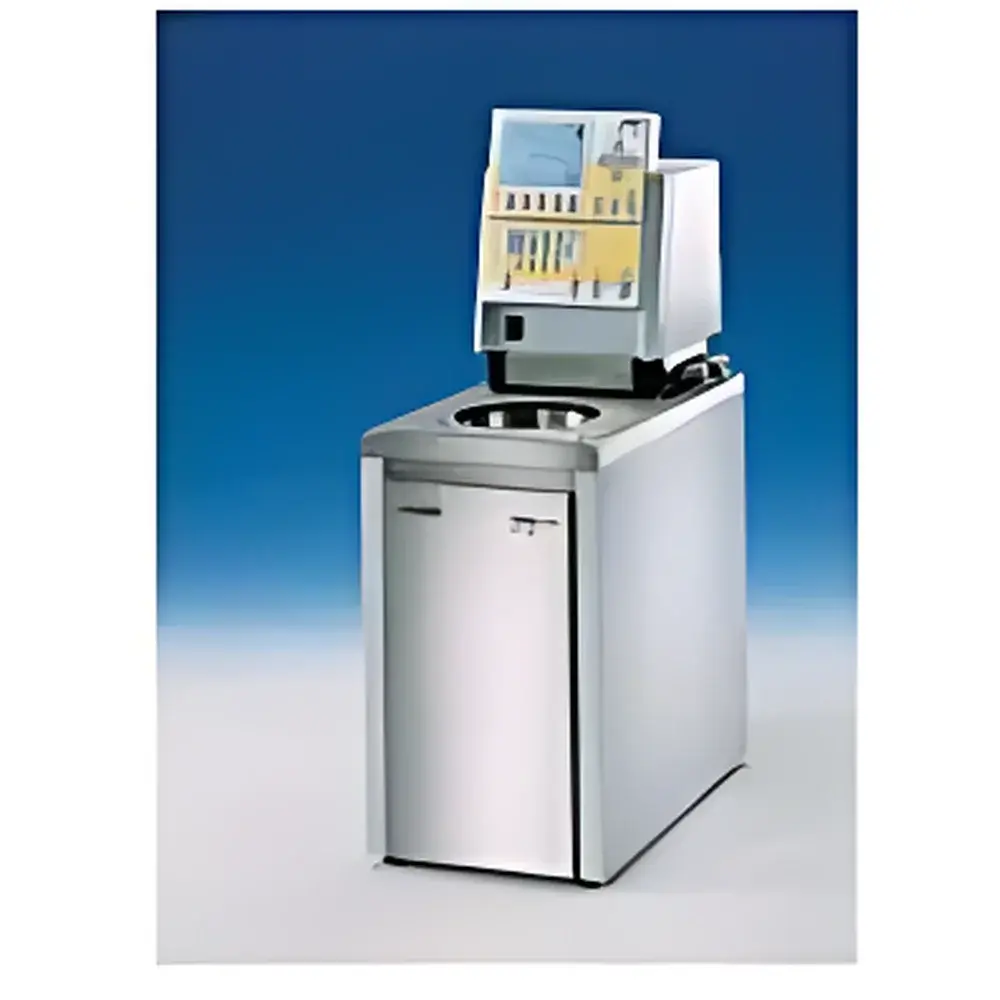
LAUDA Ecoline Star Edition Calibration Bath
| Brand | LAUDA |
|---|---|
| Origin | Germany |
| Model | Ecoline Star Edition |
| Temperature Control Type | Refrigerated/Heating Circulating Bath |
| Circulation Mode | Internal & External |
| Application | Primary Reference Standard for Thermometer and Sensor Calibration |
| Temperature Stability | ±0.01 °C (typical, dependent on model and operating conditions) |
| Temperature Range | –40 °C to +300 °C (model-dependent) |
| Bath Volume | 12–54 L |
| Pump Flow Rate | 12–25 L/min |
| Maximum Pump Pressure | 0.2–0.8 bar |
| Heating Power | 1.2–3.5 kW |
| Compliance | Designed for DKD/DAkkS-accredited calibration laboratories |
| Software Interface | RS232/RS485, optional Ethernet (via LAUDA TC software suite) |
Overview
The LAUDA Ecoline Star Edition Calibration Bath is a high-precision, dual-chamber temperature reference system engineered specifically for metrological traceability in accredited calibration laboratories. Unlike standard thermostatic baths, this instrument employs an overflow-level control principle—ensuring exceptional liquid surface stability across the entire operational temperature range. This design minimizes convective disturbances and thermal gradients within the bath medium, directly supporting the stringent requirements of ISO/IEC 17025, DKD-R 5–4, and EURAMET cg-18 for thermometer and sensor calibration. The system operates on a closed-loop refrigeration/heating architecture with independent PID-controlled cooling and heating circuits, enabling rapid thermal equilibration and long-term drift suppression. It serves as a primary or secondary temperature reference source for calibrating platinum resistance thermometers (PRTs), thermocouples (Types T, J, K, S, R, B), liquid-in-glass thermometers (including mercury and organic-filled), and digital temperature probes used in pharmaceutical, aerospace, and national metrology institutes.
Key Features
- Dual-chamber configuration with overflow-level stabilization for ultra-low vertical temperature gradient (<0.005 °C/m at 25 °C)
- Refrigerated/heating circulation system with simultaneous cooling and heating capacity—enabling precise setpoint maintenance without overshoot
- High-stability stainless steel bath vessel with optimized geometry for uniform heat distribution and minimal thermal stratification
- Adjustable external circulation port for integration with secondary calibration fixtures or custom probe holders
- Integrated pressure- and flow-regulated pump with adjustable output (12–25 L/min) and max. head up to 0.8 bar
- Comprehensive safety architecture including overtemperature cutoff, low-level detection, refrigerant leak monitoring, and dry-run protection
- Front-panel touchscreen interface with real-time display of setpoint, actual temperature, bath level, pump status, and alarm history
Sample Compatibility & Compliance
The Ecoline Star Edition accommodates a wide range of temperature sensors and reference standards—including 2-, 3-, and 4-wire PRTs (Pt100, Pt1000), thermocouple probes (with cold-junction compensation), glass thermometers (diameter up to Ø12 mm), and miniature RTD assemblies. Its bath geometry supports both immersion depth compliance per ITS-90 (minimum 150 mm immersion) and multi-probe simultaneous calibration setups. All models are constructed and tested in accordance with DIN EN 61000-6-2 (EMC immunity) and DIN EN 61000-6-3 (EMC emission) standards. The system meets mechanical and electrical safety requirements per DIN EN 61010-1 and is designed to support GLP/GMP audit readiness through configurable event logging and user-access controls. When operated with LAUDA’s TC software and connected to a certified reference thermometer (e.g., Hart Scientific 1590 or Fluke 1523), it fulfills traceability requirements under ISO/IEC 17025 Clause 6.5 and supports DKD/DAkkS accreditation scope for temperature calibration up to ±0.005 °C uncertainty (k=2).
Software & Data Management
The bath integrates seamlessly with LAUDA’s TC software suite (v5.2+), providing full remote operation, automated calibration sequences, and compliant data export. The software supports multi-point ramp-and-soak profiles, deviation tracking against reference standards, and automatic calculation of calibration uncertainties per GUM (JCGM 100). Audit trail functionality complies with FDA 21 CFR Part 11 requirements when configured with electronic signatures, role-based access, and immutable log archiving. Data export formats include CSV, PDF (with embedded metadata), and XML for LIMS integration. Optional Ethernet communication module enables secure TLS-encrypted connections and SNMP-based system health monitoring in centralized lab infrastructure environments.
Applications
- Primary calibration of industrial and laboratory-grade temperature sensors in DKD/DAkkS-accredited labs
- Verification and adjustment of thermocouple wire homogeneity and reference junction stability
- ITS-90 realization and interpolation validation for fixed-point cells (e.g., gallium, indium, zinc)
- Stabilization of reference materials during thermal characterization (e.g., NIST SRMs, CRM temperature standards)
- Temperature uniformity mapping of secondary calibration baths and environmental chambers
- Validation of thermal performance in medical device sterilization processes (ISO 11137, ISO 17665)
- Supporting ISO 9001 and IATF 16949 internal calibration programs with documented traceability
FAQ
What temperature ranges are supported across the Ecoline Star Edition model variants?
The series covers –40 °C to +300 °C depending on configuration: RE/PJ models operate from –30 °C to +300 °C; UB-series extends low-end to –40 °C and high-end to +300 °C using specialized heat transfer fluids and enhanced insulation.
Is external cooling water required for sub-ambient operation?
Yes—models with extended low-temperature capability (e.g., UB20F, UB20JL) require a chilled water supply (typically 10–20 °C) to enable efficient refrigeration below 0 °C. Standard RE/PJ models use integrated compressors only.
How is temperature stability verified and documented?
Stability is measured per DKD-R 5–4 using a calibrated reference thermometer (e.g., 4-wire Pt100 with 0.001 °C resolution) placed at multiple depths and radial positions. LAUDA provides factory verification reports with uncertainty budgets traceable to PTB.
Can the bath be integrated into automated calibration workflows?
Yes—via RS232/RS485 or optional Ethernet, the unit supports SCPI command sets and can be orchestrated via MET/Cal, LabVIEW, or Python-based calibration platforms using LAUDA’s open API documentation.
What maintenance intervals are recommended for long-term metrological reliability?
Annual recalibration of internal temperature sensors and pump performance verification are recommended. Bath fluid replacement depends on usage frequency and thermal range—every 12–24 months for silicone oil (–40 to +300 °C), every 36 months for water/glycol (–30 to +100 °C).



