
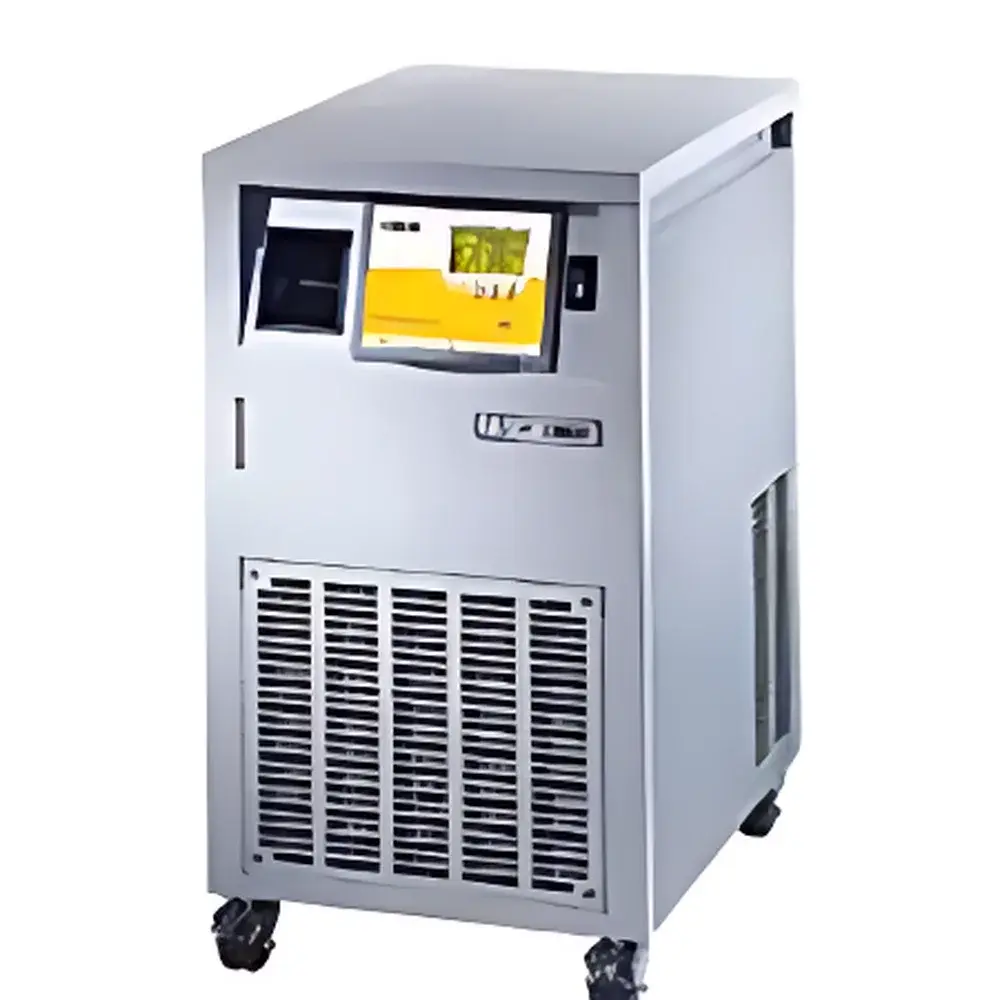
LAUDA Integral T1200 Process Circulating Chiller/Heater
| Brand | LAUDA |
|---|---|
| Origin | Germany |
| Model | T1200 |
| Temperature Range | −25 °C to +120 °C |
| Temperature Stability | ±0.2 °C |
| Heating Power | 2.25 kW |
| Cooling Capacity at 20 °C | 1.2 kW |
| Pump Flow Rate | 40 L/min |
| Maximum Pump Pressure | 3.2 bar |
| Bath Volume | 7 L |
| Dimensions (W×D×H) | 450 × 550 × 790 mm |
| Cooling Type | Air-Cooled |
| Circulation Mode | Internal & External Dual Loop |
| Control System | Microprocessor-Based with Programmable Ramp-Soak Profiles (5 Programs, 150 Segments) |
| Display | Dual-Line LCD (Setpoint & Actual Temperature) |
| External Sensor Input | Pt100 Compatible for Remote Temperature Control |
Overview
The LAUDA Integral T1200 is a high-performance process circulating chiller/heater engineered for precision temperature control in demanding laboratory and pilot-scale industrial applications. Based on LAUDA’s proven Integral platform, the T1200 integrates robust refrigeration and heating circuits within a compact, self-contained unit. It operates via a closed-loop thermofluid circulation system—typically using water, water-glycol mixtures, or silicone oil—enabling stable thermal management of external equipment such as reactors, spectrometers, calorimeters, or material testing rigs. Its dual-mode operation (heating and active refrigeration) delivers rapid thermal response across a wide operational range (−25 °C to +120 °C), with temperature stability maintained at ±0.2 °C under steady-state conditions. The unit employs a high-efficiency scroll compressor, optimized heat exchanger geometry, and a low-inertia circulation pump to ensure minimal thermal lag and high reproducibility in dynamic thermal protocols.
Key Features
- Integrated air-cooled refrigeration system with no requirement for external cooling water—ideal for facilities with limited utility infrastructure.
- Dual-circuit circulation architecture: independent internal bath recirculation and externally routed process loop, ensuring stable bath temperature even during high-flow external demands or flow interruptions.
- Microprocessor-based controller with intuitive front-panel interface; dual-line LCD displays setpoint and real-time bath temperature simultaneously.
- Programmable temperature profiling capability: up to 5 user-defined programs, each containing up to 150 ramp-and-soak segments—supporting complex thermal protocols required in polymer curing, reaction kinetics studies, or accelerated aging tests.
- Pt100 input port enables precise external temperature feedback control, allowing the unit to regulate based on sensor placement directly in the process vessel rather than bath fluid—critical for applications where bath temperature is not representative of sample thermal state.
- High-flow, high-pressure circulation pump (40 L/min at 3.2 bar) ensures compatibility with long tubing runs, restrictive heat exchangers, or multi-point distribution manifolds.
- Stainless steel reservoir and wetted components provide corrosion resistance and long-term fluid compatibility with common heat transfer media.
Sample Compatibility & Compliance
The T1200 is designed for use with non-hazardous, non-flammable heat transfer fluids—including deionized water, 30–50% aqueous glycol solutions, and silicone oils rated for continuous operation between −30 °C and +120 °C. It complies with IEC 61000-6-3 (EMC emission standards) and IEC 61000-6-2 (immunity). While not intrinsically safe, its construction meets CE marking requirements for laboratory and light-industrial environments. For regulated environments, the unit supports audit-ready operation when paired with validated software systems: its analog/digital I/O ports enable integration into LIMS or SCADA platforms compliant with 21 CFR Part 11 (when used with appropriate electronic signature and audit trail configurations). Routine calibration and maintenance align with ISO/IEC 17025 recommendations for temperature-controlled equipment used in testing laboratories.
Software & Data Management
The T1200 operates autonomously via its embedded controller but supports external monitoring and control through standard 0–10 V analog inputs/outputs and RS485 Modbus RTU communication. Optional LAUDA LabSoft software (Windows-based) enables remote configuration, real-time data logging, and export of time-stamped temperature and power consumption datasets in CSV format. All programmable profiles are stored in non-volatile memory and retain settings after power loss. Firmware updates are performed via USB interface, with version history traceable for quality documentation purposes. No cloud connectivity or proprietary subscription services are required—ensuring full data sovereignty and compatibility with air-gapped lab networks.
Applications
- Temperature control of jacketed glass reactors and pilot-scale stirred tanks in chemical synthesis and pharmaceutical process development.
- Thermal conditioning of analytical instruments including HPLC column ovens, FTIR accessories, and DSC sample stages.
- Material testing environments requiring precise thermal cycling: tensile testing machines, rheometers, and thermal expansion measurement rigs.
- Calibration laboratories performing temperature sensor verification (e.g., PRTs, thermocouples) across extended ranges.
- Electronics reliability testing—thermal shock simulation and burn-in staging where controlled ramp rates and dwell stability are critical.
FAQ
What is the difference between the T1200 and T1200W models?
The T1200 uses an air-cooled condenser, while the T1200W features a water-cooled condenser—offering higher cooling capacity (1.6 kW vs. 1.2 kW at 20 °C) and improved performance in high-ambient-temperature environments.
Can the T1200 maintain temperature stability during high-flow external circulation?
Yes—the dual-loop design decouples bath temperature regulation from process-side flow dynamics, ensuring ±0.2 °C stability even at maximum external flow rate (40 L/min).
Is external temperature control via Pt100 supported out-of-the-box?
Yes—the rear panel includes a dedicated Pt100 input channel; no additional hardware or firmware license is required.
What maintenance intervals are recommended for routine operation?
Compressor oil and refrigerant levels should be verified annually; pump impeller and seals inspected every 24 months; and heat exchanger surfaces cleaned quarterly in dusty environments.
Does the unit support GLP-compliant operation?
When integrated with validated third-party software that provides electronic signatures, audit trails, and change control, the T1200 meets functional requirements for GLP-compliant thermal control in non-clinical laboratory studies.



