
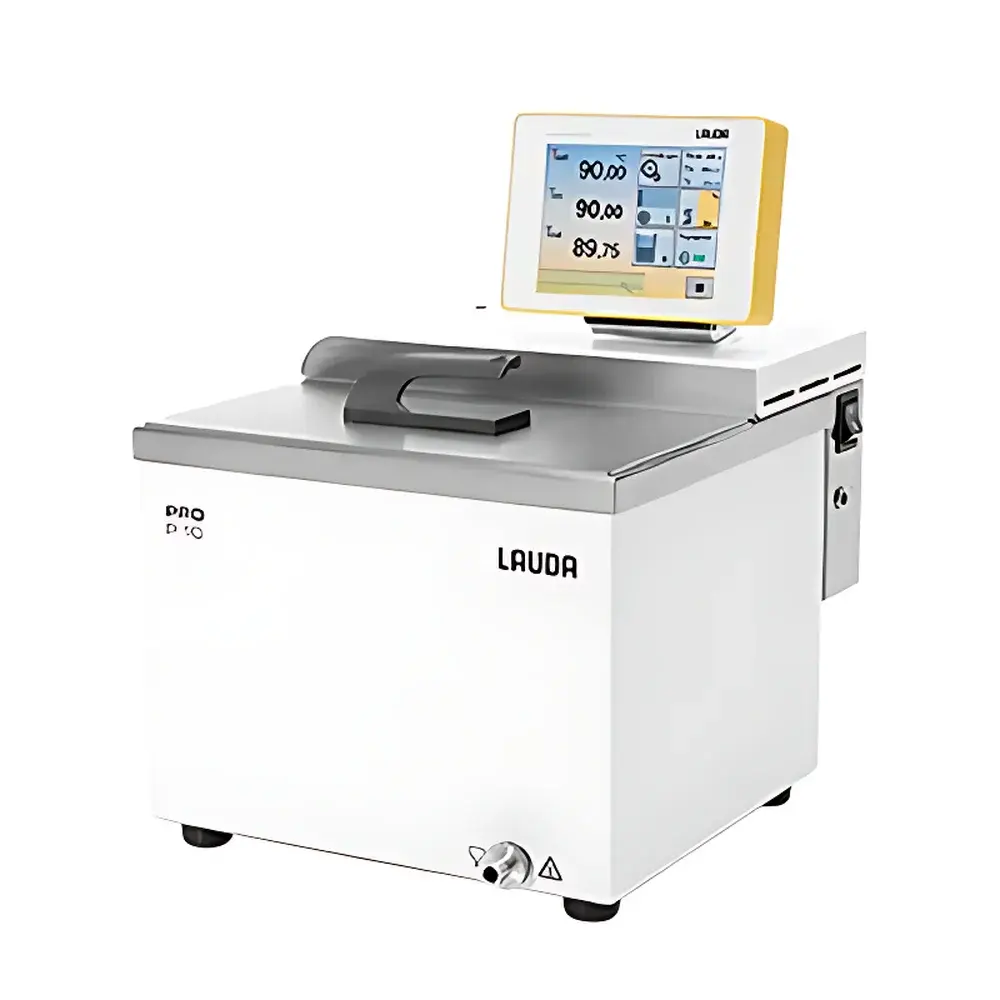
LAUDA PRO P10 Heating Circulating Bath
| Brand | LAUDA |
|---|---|
| Origin | Germany |
| Model | PRO P10 |
| Bath Volume | 10–28.5 L |
| Temperature Range | 30 °C to 250 °C |
| Temperature Stability | ±0.01 K |
| Circulation Type | Internal & External |
| Standard Interfaces | USB, Ethernet |
Overview
The LAUDA PRO P10 is a high-precision heating circulating bath engineered for demanding laboratory and industrial applications requiring exceptional thermal stability, rapid heat-up response, and seamless integration into automated workflows. Designed and manufactured in Germany, it operates on the principle of forced convection via an integrated circulation pump, delivering uniform temperature distribution throughout the bath medium—whether water, silicone oil, or other compatible heat-transfer fluids. Its robust stainless-steel bath chamber and thermally optimized housing ensure long-term dimensional stability and minimal thermal drift. The PRO P10 is specifically calibrated for operation across a wide working range (30 °C to 250 °C), making it suitable for high-temperature material testing, sensor calibration, reaction calorimetry, and process validation where traceable, repeatable thermal control is critical.
Key Features
- High-accuracy temperature regulation with ±0.01 K stability at setpoint—achieved through dual-sensor feedback, PID algorithm optimization, and low-thermal-mass heater design.
- Modular touch-control interface (Base + Command unit) detachable for remote mounting up to 50 m away via shielded cable—enabling flexible benchtop or integrated system placement.
- Integrated cooling coil standard—compatible with external chillers for hybrid heating/cooling configurations (e.g., when paired with LAUDA RE series refrigerated circulators).
- 3.5 kW heating power enables rapid ramp rates (e.g., ~1.8 °C/min from 30 °C to 200 °C with 10 L silicone oil), minimizing experiment downtime.
- 360° accessible bath geometry with reinforced rim and optional lid accessories—facilitating immersion of large or irregularly shaped samples, probes, or reactors.
- Standard communication interfaces include USB 2.0 and 10/100 Mbps Ethernet with TCP/IP and Modbus TCP support—enabling direct integration with LabVIEW, MATLAB, or SCADA systems for GLP/GMP-compliant data logging.
Sample Compatibility & Compliance
The PRO P10 accommodates a broad range of sample formats—including glassware (e.g., jacketed reactors, distillation apparatus), metal test specimens, electronic modules, and sensor arrays—within its 10 L nominal bath volume (expandable to 28.5 L with optional extension kits). Bath fluid compatibility extends to water, glycol-water mixtures, mineral oils, and silicone oils (viscosity ≤ 500 cSt at operating temperature). All wetted parts comply with EU Directive 2011/65/EU (RoHS) and are constructed from electropolished AISI 316 stainless steel and PTFE-sealed components. The unit conforms to IEC 61010-1:2010 safety standards for laboratory equipment and carries CE marking. For regulated environments, firmware supports audit-trail-enabled operation per FDA 21 CFR Part 11 requirements when used with LAUDA’s optional software suite.
Software & Data Management
The PRO P10 ships with LAUDA’s proprietary WinVisu software (Windows-based), offering real-time temperature profiling, multi-channel logging (up to 4 external PT100 inputs), and programmable ramp/soak sequences. Data export is supported in CSV, Excel, and PDF formats—with timestamped metadata including operator ID, instrument serial number, and environmental conditions. Optional cloud synchronization enables secure offsite backup and cross-laboratory data harmonization. Firmware updates are delivered via encrypted USB stick or HTTPS download, ensuring traceability and version control in ISO 17025-accredited laboratories.
Applications
- Calibration of temperature-sensitive instrumentation (RTDs, thermocouples, infrared sensors) under stable, homogeneous thermal fields.
- Thermal aging studies of polymers and composites per ASTM D3045 and ISO 2578 protocols.
- Controlled crystallization and polymorph screening in pharmaceutical development (ICH Q5C).
- Heat transfer coefficient determination in compact heat exchangers and microfluidic devices.
- Preconditioning of electronic assemblies prior to functional testing (JEDEC JESD22-A108).
- Supporting ASTM D445 (kinematic viscosity) and ISO 3104 measurements when integrated with rotational viscometers.
FAQ
Can the PRO P10 operate with silicone oil at 250 °C without degradation?
Yes—the bath chamber and sealing materials are rated for continuous operation at 250 °C with standard high-temperature silicone oils (e.g., Dow Corning 200 Fluid, viscosity grade 100 cSt). Oil life expectancy exceeds 12 months under typical lab usage with periodic filtration.
Is external chiller integration required for sub-ambient operation?
The PRO P10 is a heating-only unit; sub-ambient or precise cooling requires pairing with a compatible LAUDA refrigerated circulator (e.g., RE120 or RP200) via the standard cooling coil port.
Does the device support automatic liquid level detection?
No—level monitoring is manual; however, the bath features a calibrated sight glass and overflow protection to prevent dry-run operation.
What is the maximum permissible ambient temperature for continuous 250 °C operation?
For sustained 250 °C performance, ambient temperature must not exceed 30 °C, and adequate ventilation (≥ 300 mm clearance on all sides) is mandatory to dissipate waste heat from the 3.5 kW heater.
Can multiple PRO units be synchronized for multi-zone temperature control?
Yes—via Ethernet-based master/slave configuration using LAUDA’s NetVisu protocol, enabling coordinated ramping and interlock logic across up to 16 units in a single network segment.



