
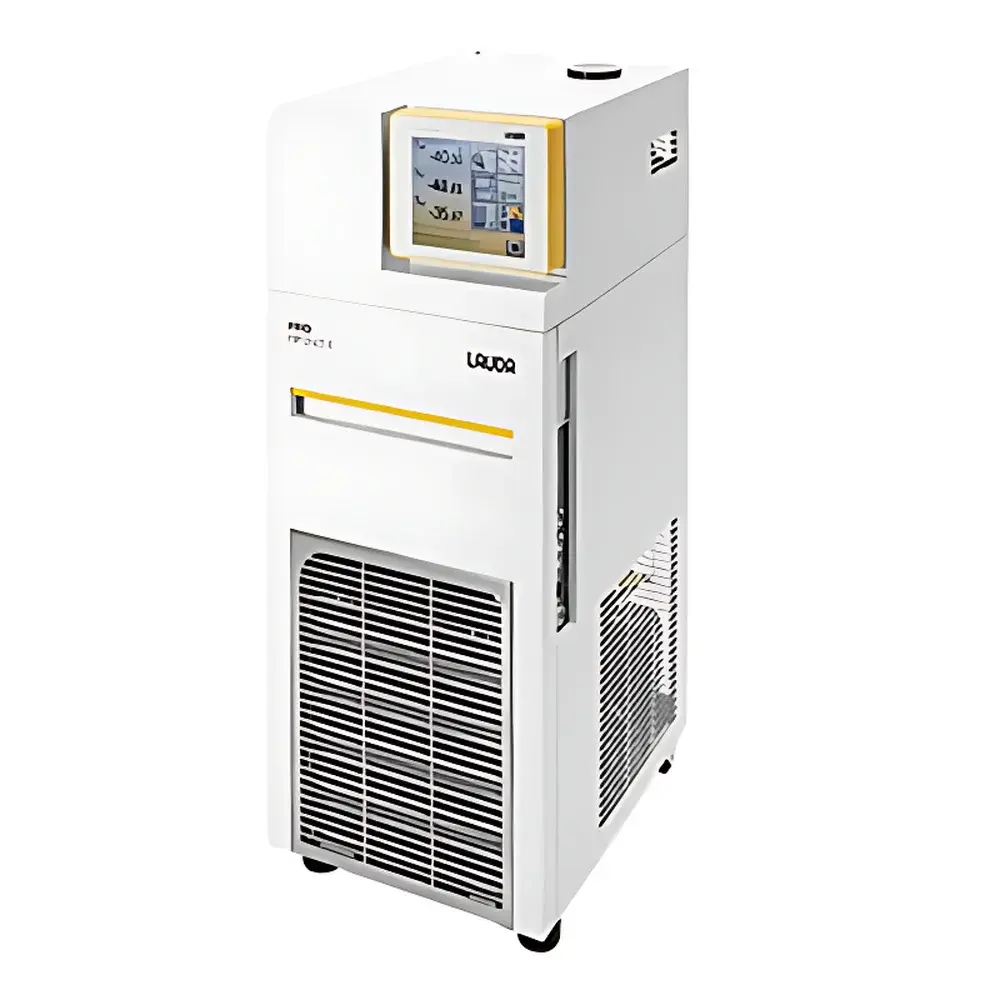
LAUDA PRO P2E Circulating Bath Chiller/Heater
| Brand | LAUDA |
|---|---|
| Origin | Germany |
| Model | PRO P2E |
| Instrument Type | Circulating Temperature Control Bath |
| Circulation Mode | Internal & External |
| Temperature Control | Refrigeration & Heating |
| Bath Volume | 4.4 L |
| Temperature Range | −40 °C to +250 °C |
| Temperature Stability | ±0.05 K |
| Interface Standard | USB, Ethernet, Pt100 |
| Pump Type | Varioflex® High-Performance Pressure/Draw Pump |
| Cooling Method | Hybrid (Ambient Air + Optional Water-Cooled Condenser) |
| Refrigeration Capacity | 0.6 kW / 0.8 kW (model-dependent) |
| Max. Remote Control Distance | 50 m |
Overview
The LAUDA PRO P2E is a high-precision, compact circulating bath chiller/heater engineered for demanding laboratory and pilot-scale applications requiring rapid, stable, and wide-range temperature control. Based on LAUDA’s proprietary thermodynamic architecture—combining dual-mode refrigeration (vapor-compression with hybrid condenser cooling), high-efficiency Varioflex® positive-displacement pump technology, and advanced PID+ algorithmic temperature regulation—the PRO P2E delivers exceptional thermal performance across an industry-leading operational range of −40 °C to +250 °C. Its 4.4 L bath volume and low fluid fill requirement (as low as 1.8 L for external loop operation) minimize thermal mass, enabling sub-minute ramp rates and high dynamic responsiveness in externally connected systems such as jacketed reactors, calorimeters, or optical benches. Designed and manufactured in Germany to DIN EN ISO 9001 standards, the unit complies fully with IEC 61010-1 for electrical safety and meets CE marking requirements for laboratory equipment used in EU member states.
Key Features
- Wide operating temperature range: −40 °C to +250 °C, validated per DIN 12876-1 for Class III circulation baths
- High thermal stability: ±0.05 K at setpoint (measured at bath sensor, steady-state, load-independent)
- Varioflex® pressure/draw pump delivering up to 3.5 bar max. pressure and 12 L/min flow rate with adjustable speed control
- Hybrid cooling system supporting both air-cooled and water-cooled condenser configurations—enabling optimized heat rejection in constrained lab environments
- Integrated Pt100 sensor port, standard USB 2.0 and Ethernet (TCP/IP, Modbus TCP) interfaces for seamless integration into LabVIEW, SCADA, or LIMS platforms
- Remote operation capability up to 50 meters via shielded Ethernet cable without signal degradation or latency
- Energy-efficient design: reduced refrigerant charge, low-power standby mode (<5 W), and intelligent compressor staging minimizing cyclic wear
- Robust stainless steel bath vessel with integrated drain valve and overflow protection
Sample Compatibility & Compliance
The PRO P2E is compatible with a broad spectrum of heat transfer fluids—including water, water-glycol mixtures, silicone oils (e.g., DC200 series), and synthetic hydrocarbons—within its specified temperature envelope. Fluid selection must conform to LAUDA’s Technical Bulletin TB-PRO-FLUID-2023 regarding viscosity limits (max. 100 mm²/s at operating temp) and flash point requirements (>110 °C for >150 °C operation). The device supports GLP-compliant workflows through audit-trail-enabled firmware (optional upgrade), time-stamped event logging, and user-access-level configuration controls aligned with FDA 21 CFR Part 11 principles. It is routinely deployed in ASTM E2877-compliant material testing setups and ISO 17025-accredited calibration laboratories for sensor traceability.
Software & Data Management
LAUDA’s proprietary WinPP software (v5.4+) provides full graphical control, real-time trend visualization, automated protocol sequencing, and CSV export of temperature, flow, pressure, and compressor status data. All communication protocols—including OPC UA (via optional gateway module)—are natively supported. Firmware updates are delivered via signed .bin files over HTTPS; cryptographic signature verification ensures integrity. Data logs include UTC timestamps, operator ID (when authenticated), and hardware checksums—supporting traceability under ISO/IEC 17025 clause 7.7 and GxP-regulated environments. No cloud dependency: all data remains on-premise unless explicitly routed via customer-configured network policies.
Applications
- Functional testing of electronic components under thermal stress (JEDEC JESD22-A104, MIL-STD-883)
- Dynamic mechanical analysis (DMA) and differential scanning calorimetry (DSC) thermal conditioning
- Calibration of RTDs, thermistors, and infrared sensors across extended temperature spans
- Exothermic/endothermic reaction control in chemical synthesis and biocatalysis
- Precision crystallization profiling in pharmaceutical development (ICH Q5C, USP <1031>)
- Thermal management of optical interferometers, laser diodes, and vacuum chamber feedthroughs
- Temperature validation of heat exchangers, distillation columns, and pilot-scale extraction systems
FAQ
What is the minimum recommended heat transfer fluid volume for external loop operation?
The PRO P2E supports external circulation with as little as 1.8 L of fluid when using the standard Varioflex® pump configuration and a closed-loop system with ≤10 m tubing length and ≤3 m vertical lift.
Can the unit operate continuously at 250 °C with ambient temperatures above 30 °C?
Yes—provided the optional water-cooled condenser kit (Order No. 9901234) is installed and supplied with ≤25 °C cooling water at ≥1.2 L/min flow rate. Air-cooled operation at 250 °C requires ambient ≤25 °C and unrestricted ventilation.
Is the Ethernet interface compatible with Modbus TCP for PLC integration?
Yes—Modbus TCP register mapping is documented in LAUDA Communication Protocol Specification CP-PRO-E-2024, available under NDA from technical support.
Does the device support 21 CFR Part 11-compliant electronic signatures?
The base firmware supports user authentication and audit trails; full Part 11 compliance requires WinPP v5.4+ with optional e-Signature Module (Order No. 9901187) and validated IT infrastructure.
What maintenance intervals are recommended for the refrigeration system?
Compressor oil and filter replacement every 24 months or 8,000 operating hours (whichever occurs first); annual calibration of Pt100 bath sensor traceable to DKD/DAkkS-certified standards.



