
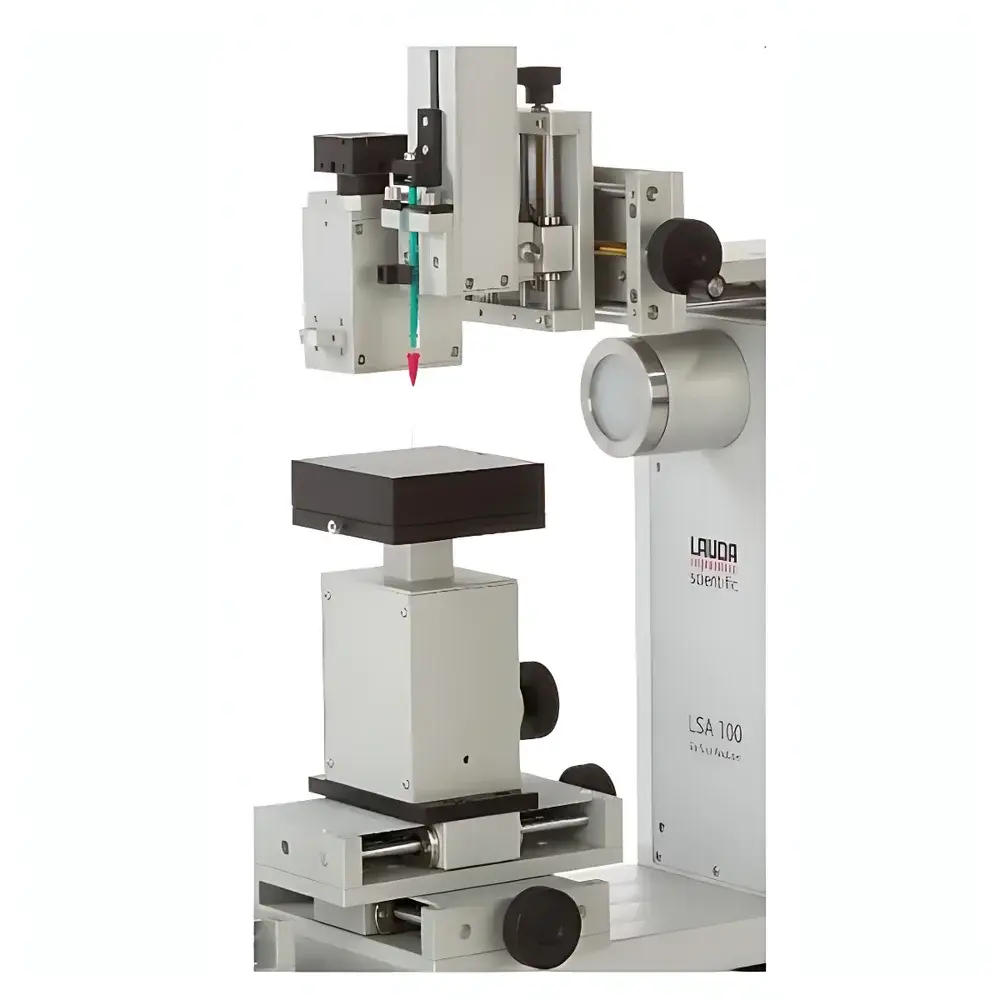
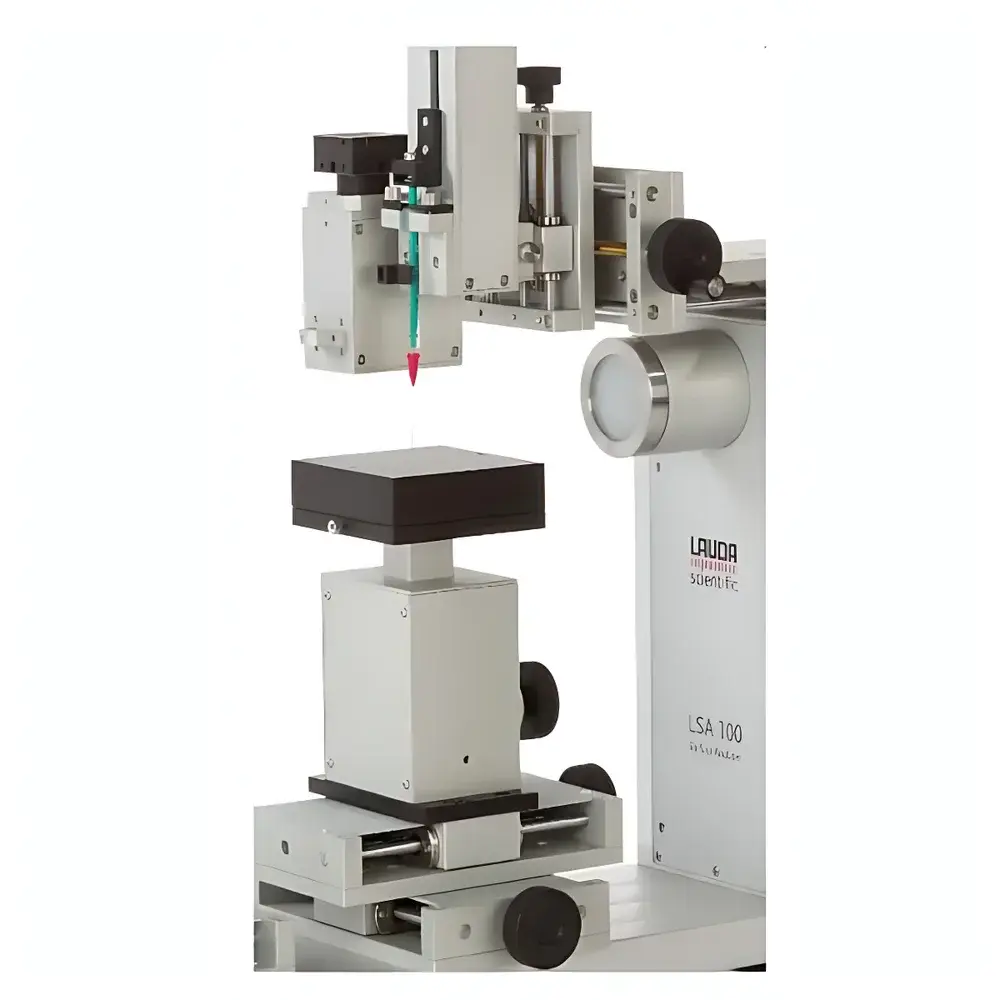
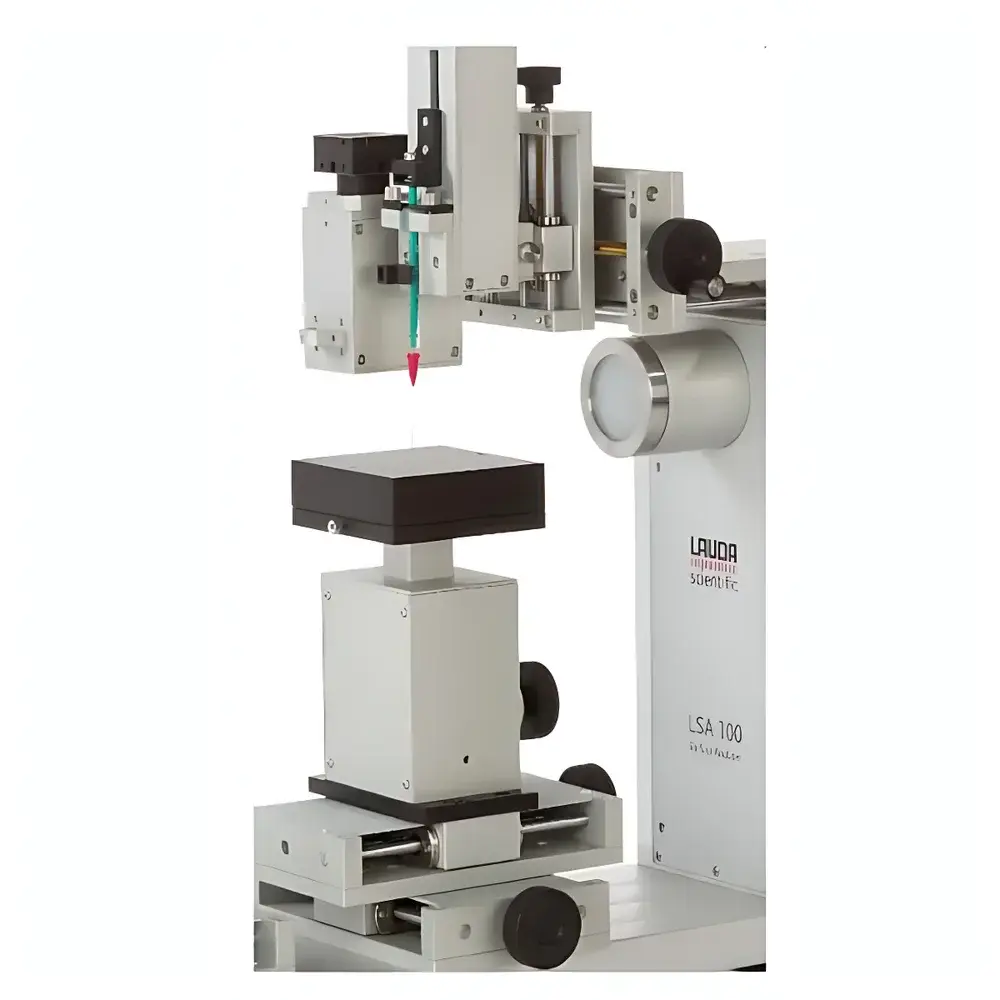
LAUDA Scientific LSA MOB-C Dual-View Contact Angle Analyzer
| Brand | LAUDA Scientific |
|---|---|
| Origin | Germany |
| Model | LSA MOB-C |
| Instrument Type | Benchtop Video-Based Optical Contact Angle Analyzer |
| Contact Angle Measurement Range | 0–180° |
| Contact Angle Accuracy | ±0.1° |
| Contact Angle Resolution | 0.1° |
| Surface/Interfacial Tension Measurement Range | 0.01–2000 mN/m |
| Surface/Interfacial Tension Accuracy | ±0.01 mN/m |
| Sample Stage Dimensions | 100 × 100 mm (fixed) |
| Maximum Sample Size | ∞ × 290 × 76 mm |
| Stage Load Capacity | 12 kg |
| Imaging System | High-resolution, low-distortion, high-speed industrial fixed-focus optical lens |
Overview
The LAUDA Scientific LSA MOB-C Dual-View Contact Angle Analyzer is an advanced benchtop optical instrument engineered for comprehensive, time-resolved characterization of solid–liquid interfacial phenomena. Unlike conventional single-view contact angle systems—whether side-view (profile-based) or top-view (area-based)—the LSA MOB-C integrates synchronized orthogonal imaging along two perpendicular axes: a high-fidelity side-view camera capturing the liquid–solid–vapor triple-line geometry and droplet profile evolution, and a co-aligned top-view camera simultaneously recording the dynamic wetting footprint, spreading diameter, and lateral asymmetry of the droplet on the substrate. This dual-perspective architecture enables concurrent quantification of both vertical (contact angle, droplet height, sessile volume) and horizontal (wetting area, contact diameter, radial expansion rate) parameters from the *same* droplet at *identical* time points—eliminating temporal misalignment artifacts inherent in sequential measurements. The system operates on the principle of digital image analysis of high-contrast, backlit droplet silhouettes, applying robust ellipse-fitting, Young–Laplace fitting, and tangent-based algorithms to extract contact angles with traceable metrological uncertainty. It is particularly suited for investigating heterogeneous surfaces, porous media, anisotropic substrates, and dynamic processes such as spontaneous spreading, absorption-driven penetration, and evaporation-induced receding behavior.
Key Features
- Dual-synchronized optical path: Independent, calibrated side-view and top-view imaging channels with real-time frame synchronization (≤1 ms temporal offset)
- High-precision mechanical stage: Rigid aluminum-alloy base with vibration-damped optical breadboard; motorized Z-axis focus adjustment with micrometer-scale repeatability
- Modular design: Compatible with LAUDA’s LSA100 and LSA200 platforms—upgradable via field-installable hardware kits without instrument recalibration
- Optimized illumination: Uniform LED backlighting with adjustable intensity and thermal stabilization to minimize thermal drift during long-term dynamic experiments
- Low-distortion optics: Fixed-focus industrial lenses (side: 0.7× magnification; top: 1.0×) delivering ≤0.3% geometric distortion across full FOV and >50 lp/mm spatial resolution
- Environmental adaptability: Optional enclosure integration for controlled humidity (10–95% RH) and temperature (15–60°C) operation per ISO 27448 and ASTM D7334 guidelines
Sample Compatibility & Compliance
The LSA MOB-C accommodates a broad range of sample geometries and material classes—including rigid wafers, flexible films, fibrous textiles, powders (via compressed pellet method), and irregularly shaped components—within its open-stage configuration (max. 12 kg load, ∞ × 290 × 76 mm envelope). The 100 × 100 mm fixed stage provides stable reference positioning for repeatable multi-point mapping. All measurement protocols adhere to internationally recognized standards: contact angle determination follows ASTM D7334 (Standard Practice for Surface Wettability of Coatings by Contact Angle Measurement), while surface tension calculations comply with ISO 1409 (Plastics — Determination of Surface Tension of Plastics by the Wilhelmy Plate Method) and ISO 6295 (Petroleum Products — Determination of Interfacial Tension Between Water and Hydrocarbon Liquids). Data acquisition and storage support audit-trail functionality compliant with FDA 21 CFR Part 11 requirements when paired with LAUDA’s SCA20 software in validated mode (GxP-ready configuration available).
Software & Data Management
Controlled via LAUDA’s SCA20 software suite (Windows 10/11, 64-bit), the LSA MOB-C delivers fully automated workflow execution—from droplet deposition (manual or integrated dispensing) through multi-frame capture, real-time parameter extraction, and post-acquisition statistical analysis. The software implements ISO/IEC 17025-aligned uncertainty propagation models for contact angle and surface tension values, reporting expanded uncertainties (k = 2) alongside each result. Time-series data are exportable in CSV, HDF5, and MATLAB .mat formats; image sequences are stored in lossless TIFF with embedded EXIF metadata (exposure, gain, lens ID, calibration timestamp). Raw video streams support third-party integration via GigE Vision SDK for custom algorithm development. Audit logs record user actions, instrument states, calibration events, and software version history—enabling full traceability for GLP/GMP-regulated environments.
Applications
- Dynamic wettability mapping of functional coatings (hydrophobic, oleophobic, anti-fog, self-cleaning)
- Penetration kinetics analysis in paper, nonwovens, and porous ceramics
- Surface heterogeneity assessment via contact angle hysteresis and advancing/receding angle asymmetry
- Quality control of plasma-treated or corona-activated polymer films
- Fundamental studies of surfactant adsorption dynamics at solid–liquid interfaces
- Validation of computational fluid dynamics (CFD) models for capillary-driven flow
FAQ
Can the LSA MOB-C measure contact angles on curved or textured surfaces?
Yes—the dual-view geometry allows independent focal plane alignment for both cameras, enabling accurate measurements on convex, concave, or microstructured surfaces up to 50 µm feature depth, provided sufficient optical access is maintained.
Is calibration traceable to national metrology institutes?
All factory calibrations are performed using NIST-traceable contact angle reference standards (e.g., PTFE, silicon wafer, glass slide sets) and certified tensiometer fluids (e.g., pure water, diiodomethane); calibration certificates include uncertainty budgets per ISO/IEC 17025.
What level of automation is supported for high-throughput screening?
With optional X-Y motorized stage and non-contact piezoelectric dispenser, the system achieves fully automated batch measurement of up to 96 samples/hour with programmable droplet volume, position, and dwell time sequencing.
Does the system support sessile drop, pendant drop, and tilting plate methods?
Sessile drop and tilting plate (dynamic advancing/receding) modes are natively supported; pendant drop analysis requires optional add-on module (LSA-PD) due to distinct optical path requirements.
How is data integrity ensured during long-term stability tests (e.g., 24+ hour evaporation studies)?
The system employs active thermal compensation algorithms, continuous focus tracking via contrast-based autofocus, and redundant environmental monitoring (integrated temperature/humidity sensor) to maintain measurement consistency over extended durations.



