
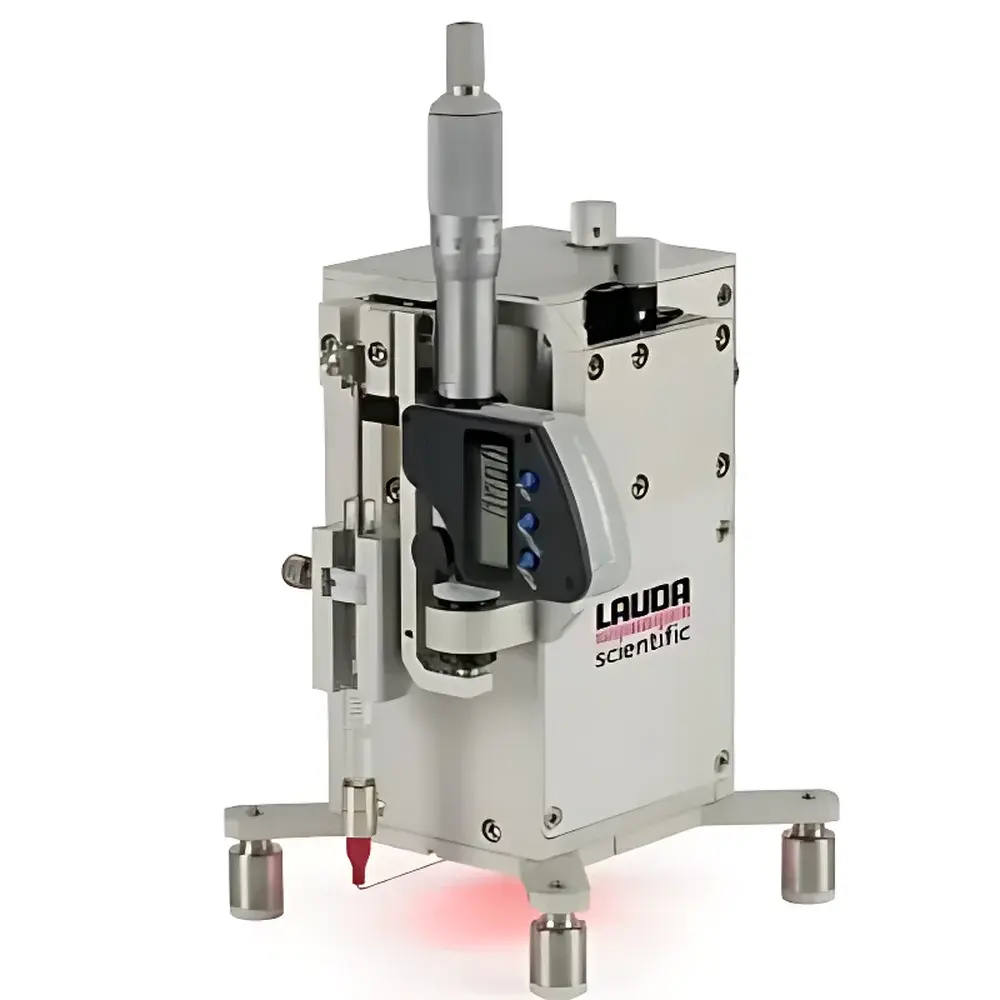
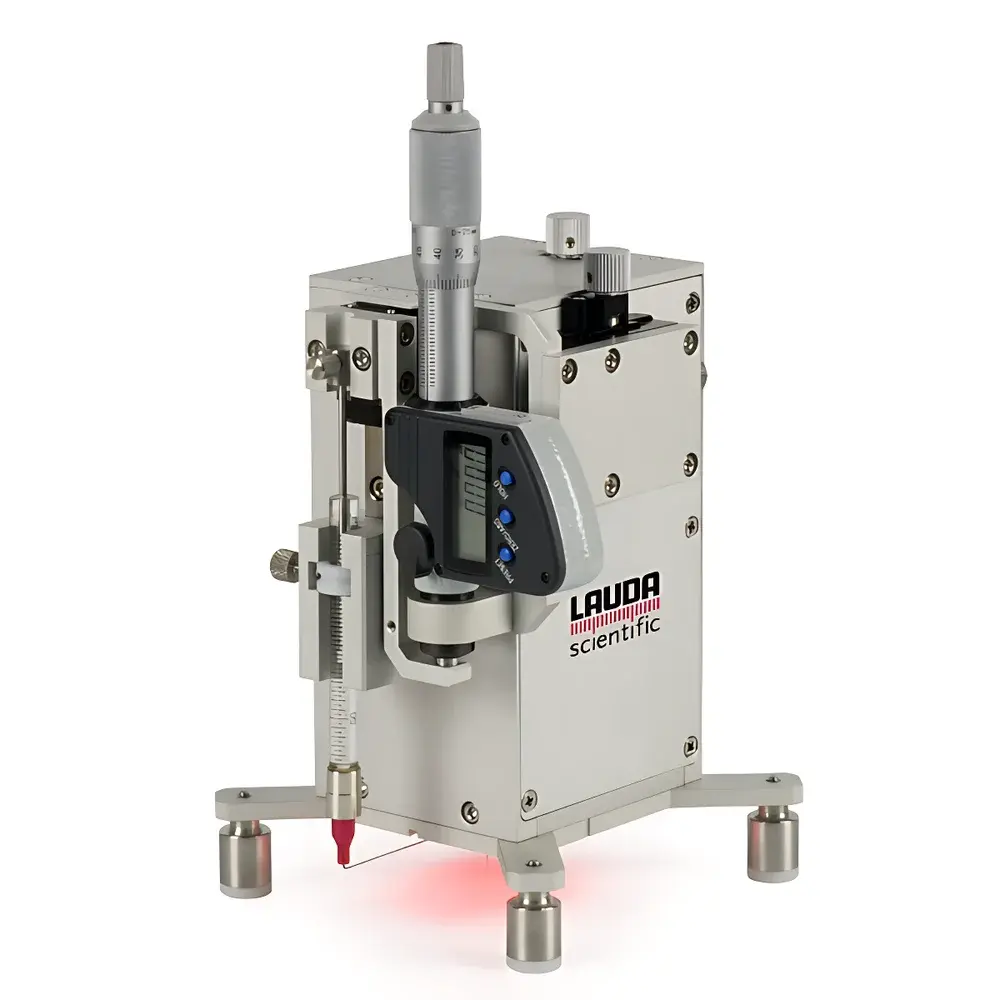
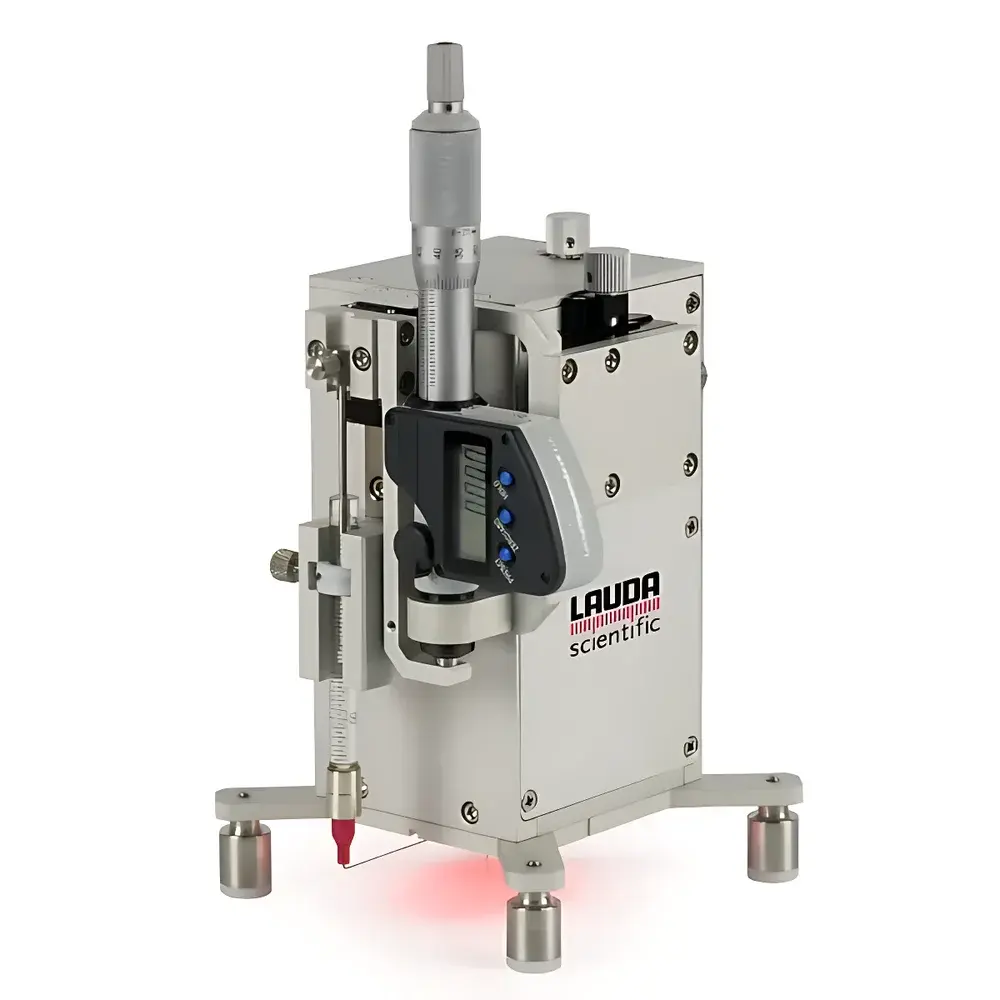
LAUDA Scientific LSA MOB-M Portable Contact Angle Analyzer
| Brand | LAUDA Scientific |
|---|---|
| Origin | Germany |
| Model | LSA MOB-M |
| Instrument Type | Portable Video-Based Optical Contact Angle Analyzer |
| Measurement Principle | Top-View Optical Imaging (Axial Illumination & Coaxial Imaging) |
| Contact Angle Range | 0–180° |
| Contact Angle Accuracy | ±0.1° (0–90°), ±0.5° (90–180° for axisymmetric droplets) |
| Contact Angle Resolution | 0.1° |
| Sample Stage Constraints | None (unlimited sample size, shape, weight, or topography) |
| Imaging System | High-resolution industrial fixed-focus lens |
| Max Image Resolution | 752 × 480 pixels |
| Frame Rate | Up to 60 fps |
| Field of View | 12 mm × 8 mm |
| Light Source | Monochromatic, uniform cold LED with software-controlled intensity |
| Dispensing Unit | Manual digital micrometer syringe drive |
| Dispensing Precision | 0.004 µL |
| Dispensing Accuracy | 0.01 µL |
| Dimensions (L×W×H) | 77 × 60 × 150 mm |
| Weight | 1.0 kg |
| Compliance | Designed for ISO 19403-2, ASTM D7334, and DIN EN 14212-compliant surface wettability assessment |
| Software Features | ACI (Area Contact Index) calculation, multi-droplet batch analysis, GLP-compliant audit trail logging (optional) |
Overview
The LAUDA Scientific LSA MOB-M Portable Contact Angle Analyzer is an engineered optical instrument designed for in-situ, non-destructive contact angle measurement using a top-view coaxial imaging configuration. Unlike conventional goniometers relying on side-view silhouette analysis—where sample geometry, height variation, or surface curvature introduce parallax errors—the LSA MOB-M employs axial illumination and coaxial video capture to eliminate perspective distortion. This architecture enables reliable quantification of static, advancing, and receding contact angles on surfaces regardless of macroscopic topography (e.g., curved, textured, or irregular substrates), making it uniquely suited for field-deployable surface characterization in manufacturing QA, R&D labs, and outdoor material evaluation environments. Its 1 kg mass, compact footprint (77 × 60 × 150 mm), and battery-compatible operation allow deployment at production lines, cleanroom perimeters, plasma treatment stations, or remote field sites without requiring optical tables or vibration isolation.
Key Features
- Top-view coaxial optical system with monochromatic cold LED illumination ensures consistent contrast and minimal thermal perturbation to sessile droplets.
- Dual-mode positioning: direct contact mode (instrument placed directly on sample surface) or non-contact standoff mode (25 mm working distance), eliminating risk of surface contamination or mechanical damage.
- Manual digital micrometer dispensing unit with 0.004 µL resolution and 0.01 µL volumetric accuracy enables repeatable micro-droplet deposition under variable ambient conditions.
- High-speed imaging at up to 60 fps supports dynamic contact angle tracking during rapid spreading or evaporation processes.
- Supports both axisymmetric and asymmetric droplet analysis—including low-angle (<5°) measurements on superhydrophilic surfaces—via advanced edge-detection algorithms calibrated against NIST-traceable reference standards.
- Integrated Area Contact Index (ACI) calculation provides a dimensionless, morphology-independent metric for comparative wetting performance across heterogeneous or patterned surfaces.
Sample Compatibility & Compliance
The LSA MOB-M imposes no geometric constraints on samples: maximum dimensions, weight, curvature, or surface roughness are unrestricted. It accommodates rigid, flexible, porous, or thermally sensitive substrates—including OLED panels, automotive composites, medical device polymers, and agricultural membranes—without requiring sample cutting or mounting. The instrument’s measurement methodology aligns with key international standards for surface wettability assessment: ISO 19403-2 (determination of contact angle by optical methods), ASTM D7334 (surface energy estimation via contact angle), and DIN EN 14212 (coating adhesion pre-treatment verification). When operated with LAUDA’s SCA20 software suite (v5.3+), full audit trail functionality—including user login timestamps, parameter change logs, and image metadata embedding—supports GLP and GMP-regulated workflows compliant with FDA 21 CFR Part 11 requirements.
Software & Data Management
Control and analysis are performed via LAUDA’s SCA20 software platform, which runs on Windows-based host PCs connected via USB 3.0. The software provides real-time droplet contour fitting using Young–Laplace and circle-fitting algorithms, with automatic selection based on droplet symmetry and contact angle magnitude. Batch processing supports up to 99 droplets per session, with export options for CSV (angle, diameter, height, ACI), annotated TIFF images, and PDF reports containing raw data, statistical summaries (mean, SD, CV%), and calibration certificates. All measurement sessions generate immutable log files with embedded EXIF metadata (time, operator ID, environmental temperature/humidity if external sensors are linked), ensuring traceability in regulated quality systems.
Applications
- Verification of plasma, corona, or flame treatment efficacy on polymer films and packaging materials.
- In-line QC of anti-fingerprint coatings on touchscreens and display glass—enabling full-panel mapping via motorized XY stage integration (optional).
- Assessment of cleaning residue after solvent or ultrasonic washing in semiconductor and precision optics fabrication.
- Characterization of biofunctionalized surfaces for diagnostic microfluidics and lab-on-chip devices.
- Field validation of hydrophobicity loss in outdoor photovoltaic module encapsulants exposed to UV/weathering.
- Research into smart responsive surfaces (e.g., pH-, temperature-, or light-triggered wettability switching).
FAQ
Does the LSA MOB-M require optical alignment or calibration before each use?
No—factory-aligned coaxial optics and pre-calibrated dispensing mechanics eliminate routine recalibration. A single-point verification using a certified 60° reference slide is recommended monthly or after transport-induced shock.
Can it measure contact angles on vertically oriented or inverted surfaces?
Yes—its top-view geometry and gravity-insensitive imaging enable measurements on walls, ceilings, or suspended fibers when paired with optional magnetic or vacuum sample holders.
Is high-speed video recording supported for dynamic contact angle studies?
Yes—60 fps acquisition at full 752 × 480 resolution allows sub-second temporal resolution for spreading kinetics or evaporation-driven receding angle analysis.
What environmental conditions affect measurement stability?
Ambient airflow >0.2 m/s or temperature gradients >1°C/min may induce droplet oscillation; operation within ISO Class 8 cleanroom-equivalent environments is recommended for <0.1° repeatability.
How is data integrity ensured in regulated industries?
SCA20 software supports electronic signatures, role-based access control, and encrypted database storage—with optional 21 CFR Part 11 compliance packages including biometric authentication and third-party validation documentation.



