
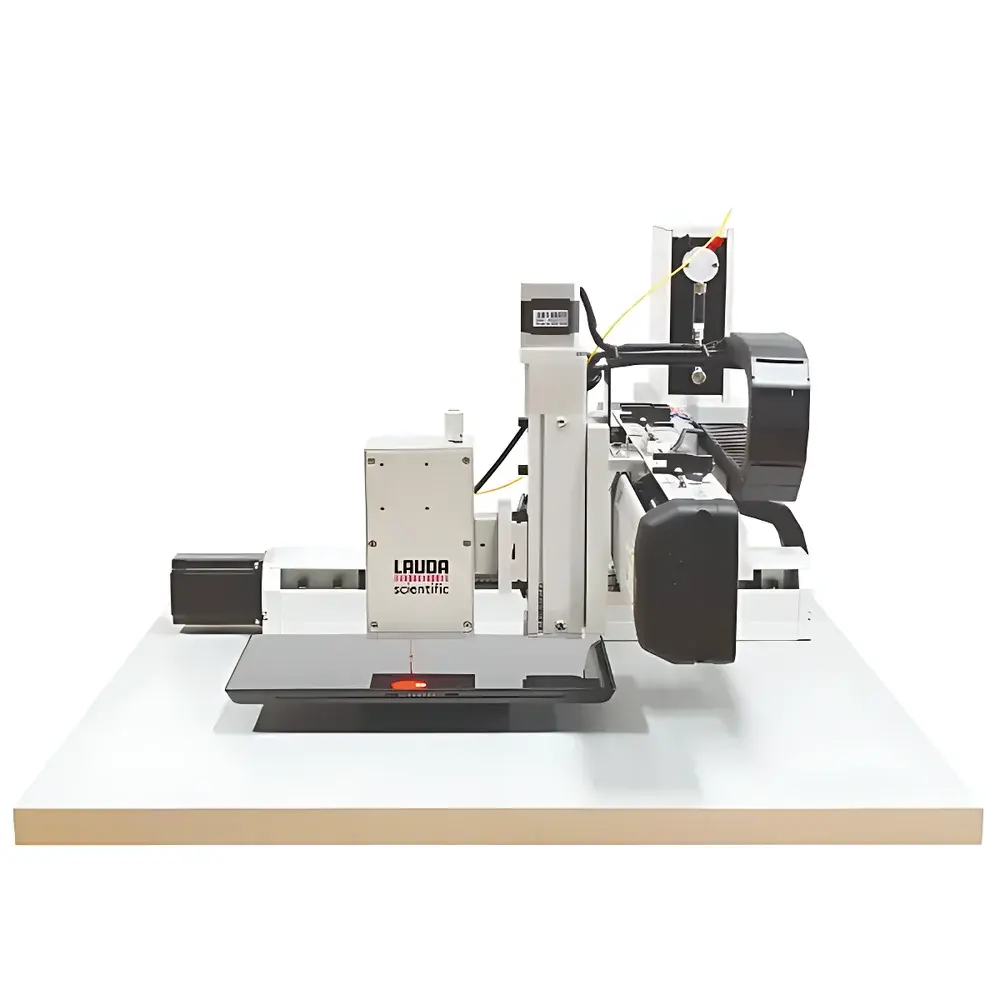
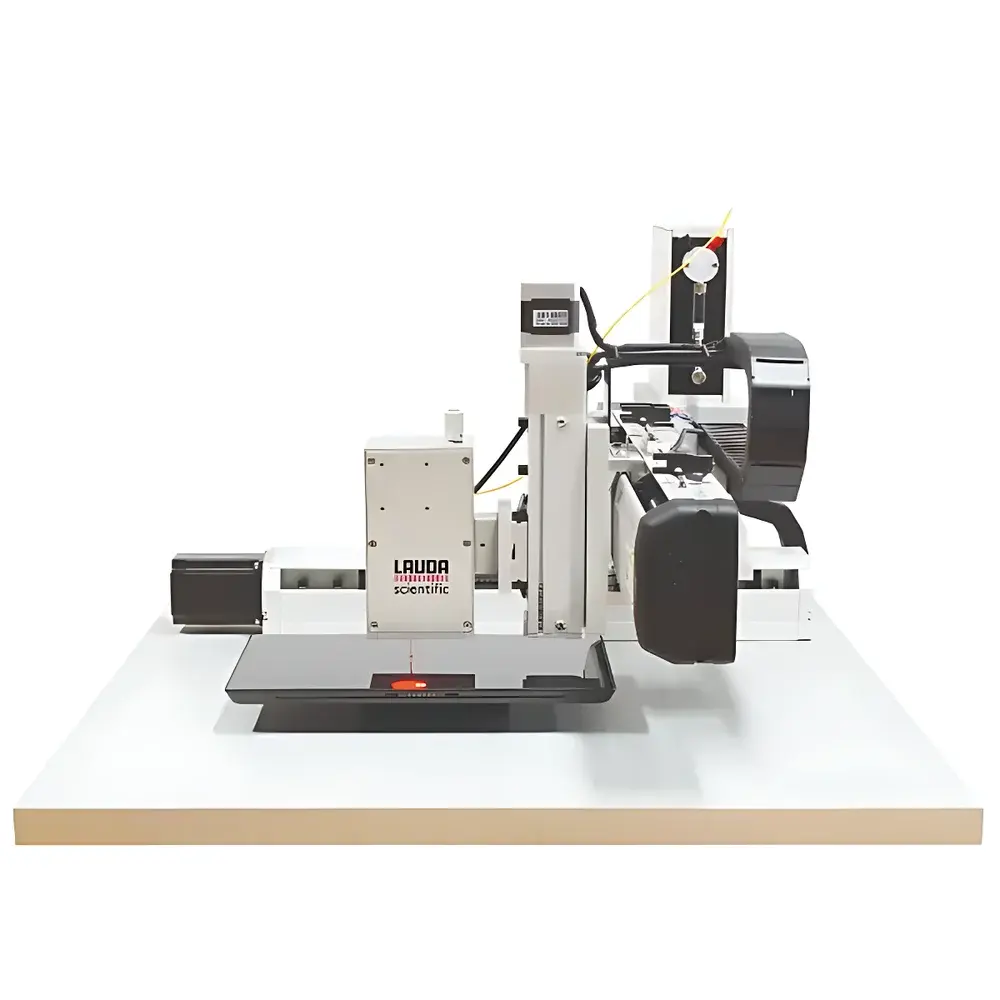
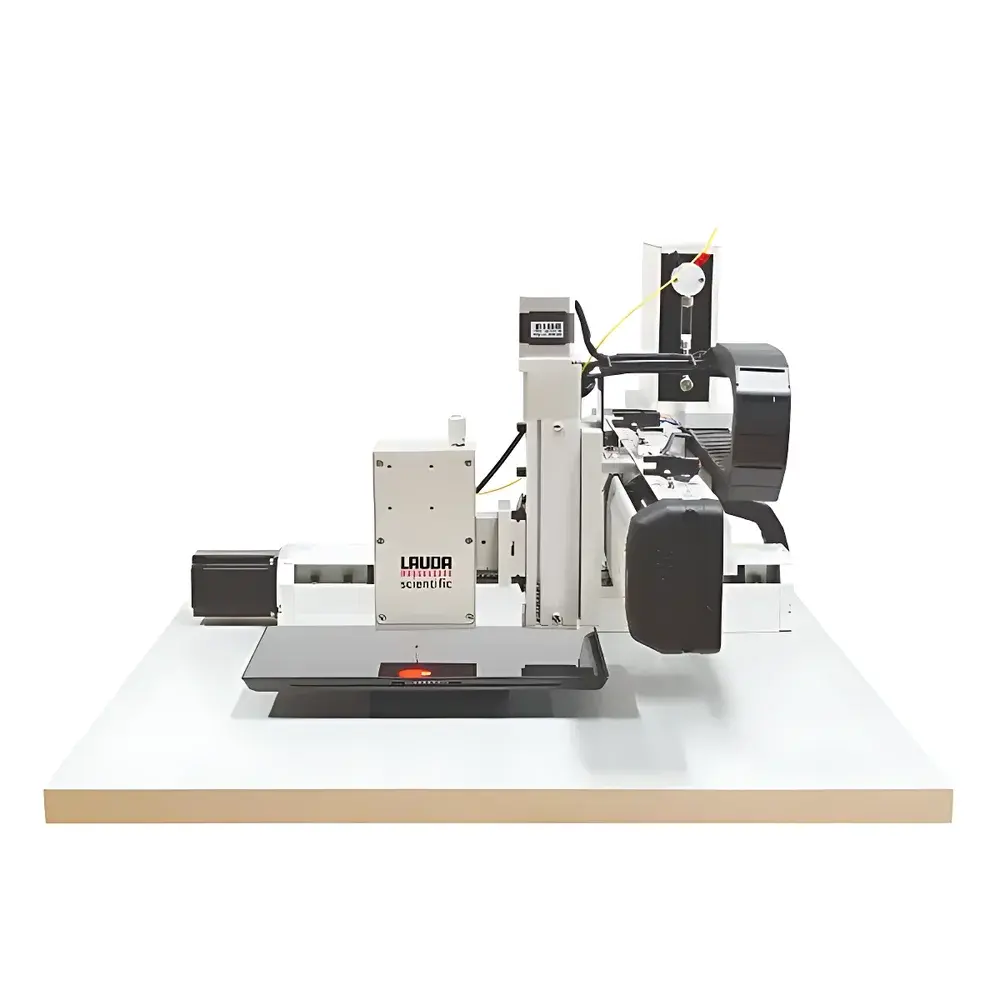
LAUDA Scientific LSA MOB-L Top-View Contact Angle Analyzer
| Brand | LAUDA Scientific |
|---|---|
| Origin | Germany |
| Model | LSA MOB-L |
| Instrument Type | Portable Video-Based Optical Contact Angle Analyzer |
| Contact Angle Range | 0–180° |
| Contact Angle Accuracy | ±0.1° |
| Contact Angle Resolution | 0.01° |
| Surface/Interfacial Tension Range | 1×10⁻³–2×10³ mN/m |
| Surface/Interfacial Tension Accuracy | ±0.01 mN/m |
| Optical Magnification | 6.5× Zoom Lens |
| Sample Handling | Motorized Robotic Arm with Dual-Droplet Dispensing Unit |
| Maximum Sample Size | Unlimited by Geometry or Dimensions |
| Working Distance | Up to 25 mm (Non-Contact Measurement) |
| Customizable Sample Stage | Fully Tailored to Specimen Dimensions |
Overview
The LAUDA Scientific LSA MOB-L Top-View Contact Angle Analyzer is a precision-engineered, portable optical system designed for high-fidelity contact angle and surface free energy characterization of large-area, geometrically complex, or industrially constrained samples. Unlike conventional side-view goniometers relying on profile-based drop contour fitting, the LSA MOB-L implements a true top-view imaging methodology—capturing droplet morphology from directly above using a coaxially aligned, motorized zoom lens and high-resolution CMOS sensor. This geometry eliminates parallax distortion, enables unambiguous detection of contact line position on highly textured, curved, or recessed surfaces, and supports robust analysis under ambient or controlled environmental conditions. The system integrates a programmable robotic arm with sub-millimeter repeatability, synchronized dual-syringe dispensing modules, and automated liquid transfer mechanisms—enabling fully autonomous, spatially resolved mapping across heterogeneous surfaces without manual repositioning or sample disassembly.
Key Features
- True top-view optical architecture with 6.5× motorized zoom lens and telecentric illumination—ensuring consistent magnification and minimal perspective error across measurement fields.
- Non-contact operation with up to 25 mm working distance—preserving surface integrity of soft, fragile, or temperature-sensitive substrates (e.g., OLED layers, polymer films, biological membranes).
- Dual independent liquid dispensing units—supporting simultaneous deposition of two distinct test liquids (e.g., water and diiodomethane) for rapid surface free energy calculation via Owens–Wendt, Wu, or van Oss–Chaudhury–Good models.
- Robust robotic positioning system with XYZ + θ control—capable of raster-scanning arbitrary sample geometries, including curved photovoltaic panels, flexible displays, and irregularly shaped composite materials.
- Sub-degree angular resolution (0.01°) and ±0.1° absolute accuracy—validated per ISO 19403-2 and ASTM D7334 standards for static and advancing/receding contact angle determination.
- Surface and interfacial tension quantification (1×10⁻³–2×10³ mN/m, ±0.01 mN/m) via pendant/sessile drop analysis—fully integrated within the same software environment without hardware reconfiguration.
Sample Compatibility & Compliance
The LSA MOB-L accommodates specimens of unrestricted lateral dimensions and variable topography—including rigid glass substrates, flexible roll-to-roll films, textured solar cell wafers, and three-dimensional molded components. Its open-stage design permits in situ measurements on production-line fixtures or climate-controlled enclosures. The instrument complies with ISO 19403 (Parts 1–4) for contact angle and surface energy evaluation, adheres to ASTM D7334 for coating wettability assessment, and supports GLP/GMP documentation workflows through audit-trail-enabled software logging. All calibration routines—including lens distortion correction, pixel-to-length conversion, and baseline leveling—are traceable to NIST-certified reference standards.
Software & Data Management
Operating on LAUDA’s proprietary SCA20 software platform, the LSA MOB-L delivers comprehensive data acquisition, real-time image processing, and statistical reporting. The software features multi-point batch scripting, automatic droplet detection with edge-enhancement algorithms, dynamic contact angle tracking during evaporation or absorption, and export-ready reports compliant with FDA 21 CFR Part 11 requirements (electronic signatures, change history, user access controls). Raw image sequences, metadata logs, and calculated parameters are stored in vendor-neutral HDF5 format—ensuring long-term archival integrity and third-party interoperability with MATLAB, Python (via h5py), or LIMS systems.
Applications
- High-throughput quality control of large-area optoelectronic devices—including TFT-LCD, OLED, and microLED display panels—where uniformity of hydrophobic/hydrophilic patterning directly impacts inkjet printing fidelity and thin-film adhesion.
- Surface energy mapping of photovoltaic modules to optimize anti-reflective coating performance, assess degradation after UV/thermal cycling, and validate cleaning efficacy prior to lamination.
- R&D of functional textiles, biomedical scaffolds, and self-cleaning surfaces—requiring spatially resolved wettability profiling across graded or patterned chemistries.
- Adhesion science studies involving polymer composites, metal alloys, and ceramic coatings—where interfacial thermodynamics govern bonding strength and delamination resistance.
- Regulatory testing for medical device packaging (ISO 10993-12) and pharmaceutical tablet film coatings (USP ), where surface energetics influence sterilization compatibility and dissolution kinetics.
FAQ
How does top-view imaging improve measurement reliability on non-planar surfaces?
Top-view geometry eliminates projection artifacts inherent in side-view systems, enabling accurate contact line localization on convex, concave, or microstructured surfaces—without requiring assumptions about droplet symmetry or substrate flatness.
Can the LSA MOB-L perform dynamic contact angle measurements?
Yes—through automated sequential dispensing and time-resolved image capture, it supports advancing/receding angle determination, evaporation kinetics analysis, and absorption rate profiling.
Is the system compatible with environmental chambers or gloveboxes?
The modular mechanical design allows integration into custom enclosures; optical path length and working distance are optimized for viewport-compatible operation under inert or humidified atmospheres.
What surface free energy models are implemented in the software?
SCA20 includes Owens–Wendt (2-component), Wu (harmonic mean), van Oss–Chaudhury–Good (3-component acid-base), and Neumann (equation-of-state) methods—with optional dispersion/polar component deconvolution and uncertainty propagation.
Does the system support automated calibration verification?
Yes—integrated reference slide routines verify pixel calibration, lens focus stability, and dispensing volume accuracy at user-defined intervals, with full traceability to internal SOPs and external standards.



