
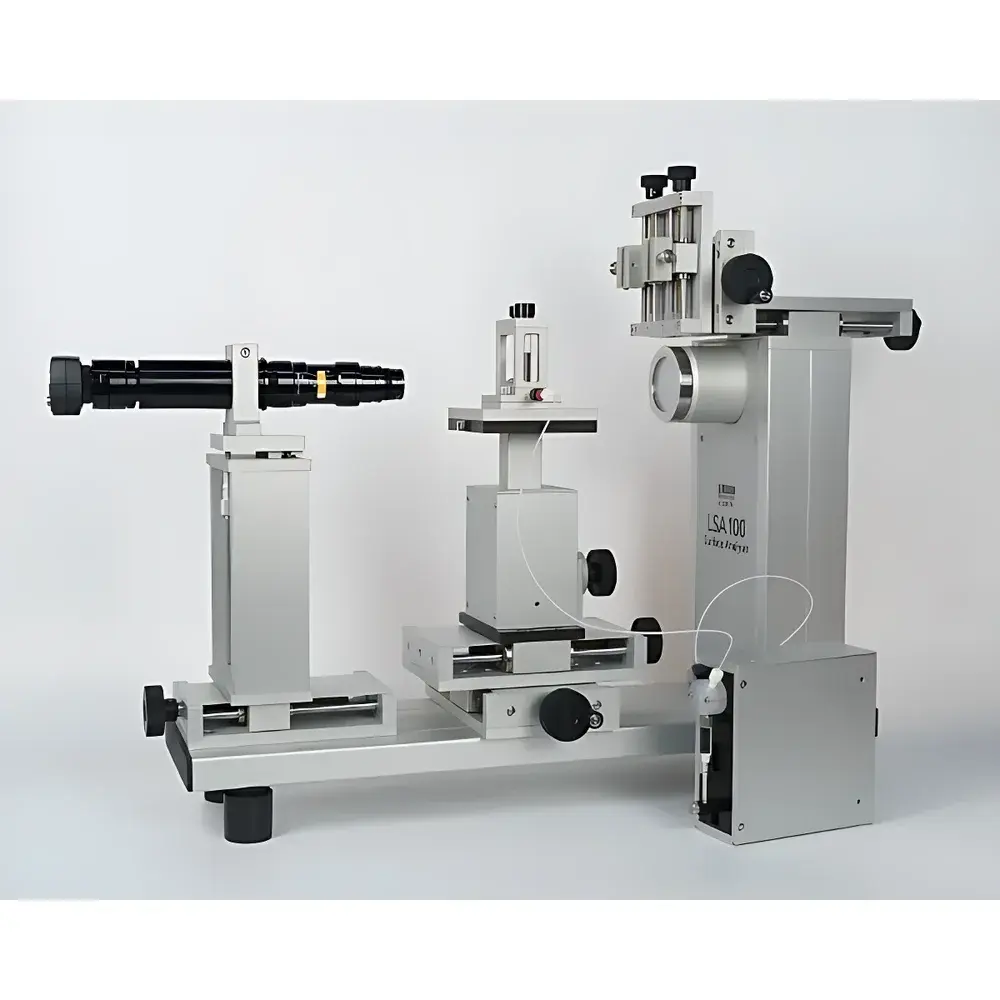
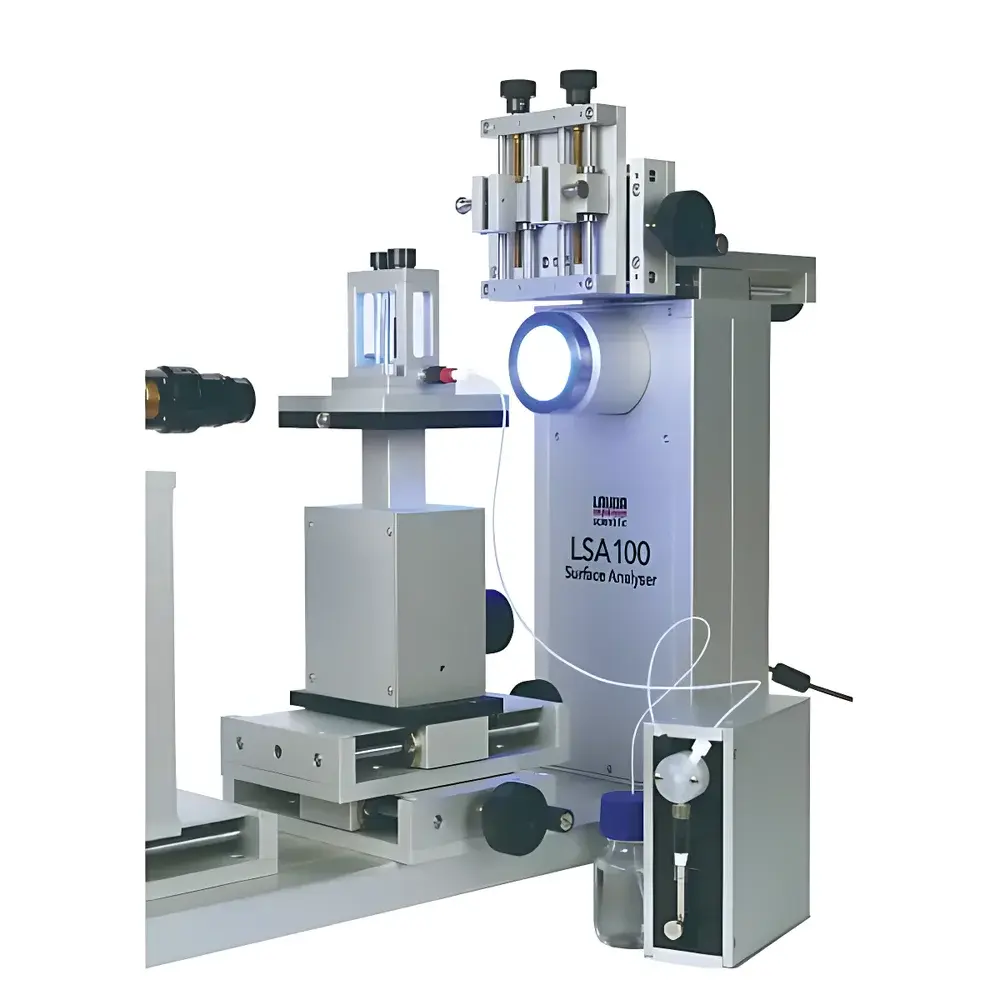
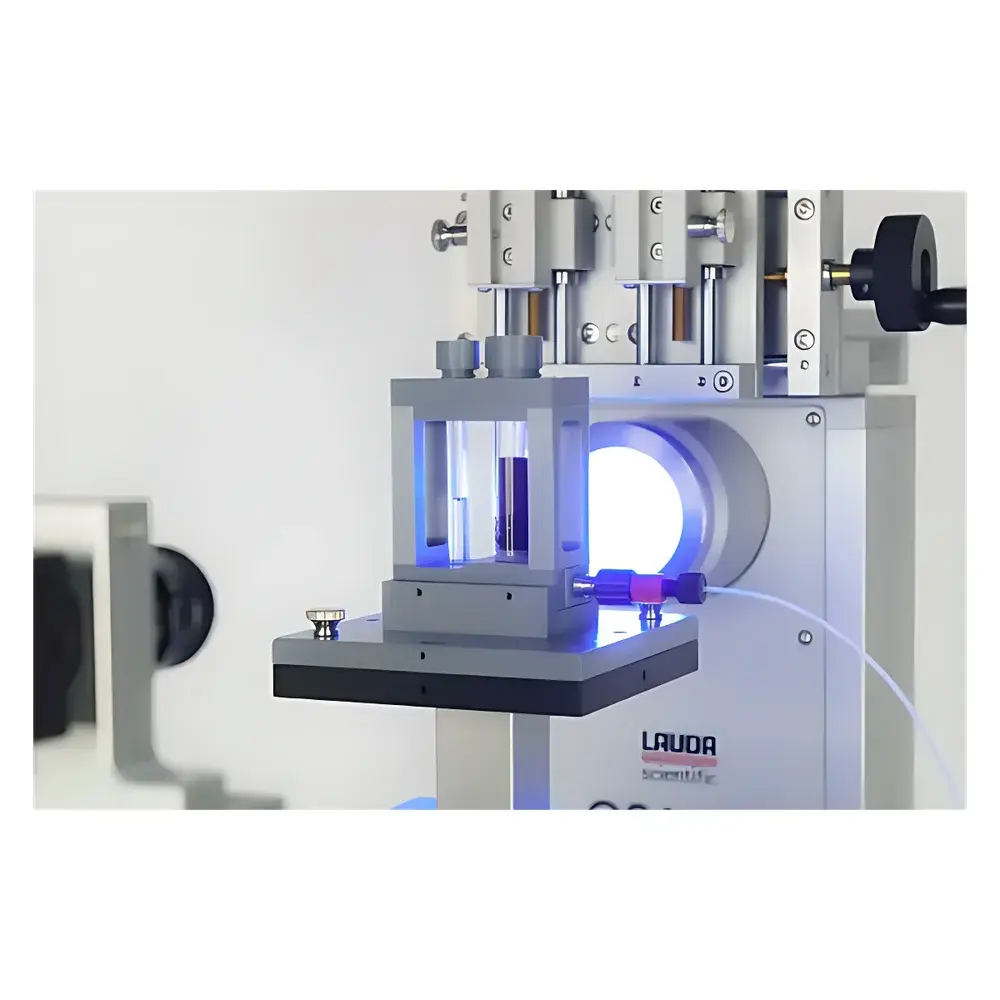
LAUDA Scientific LSA100M2 Fiber-Specific Video Optical Contact Angle Analyzer
| Brand | LAUDA Scientific |
|---|---|
| Origin | Germany |
| Model | LSA100M2 |
| Instrument Type | Benchtop Video Optical Contact Angle Analyzer |
| Contact Angle Range | 0–180° |
| Contact Angle Accuracy | ±0.1° |
| Contact Angle Resolution | 0.01° |
| Surface/Interfacial Tension Range | 0.001–2000 mN/m |
| Surface/Interfacial Tension Resolution | 0.01 mN/m |
| Sample Stage Dimensions | 100 × 100 mm |
| Maximum Sample Size (L×W×H) | ∞ × 240 × 76 mm |
| Stage Load Capacity | 12 kg |
| Imaging Magnification | 45× Zoom Lens |
| High-Speed Camera | USB 3.0, 1920 × 1200 px, up to 3300 fps |
| Field of View (Macro/Micro) | 2.0 × 1.3 – 13.1 × 8.3 mm / 0.2 × 0.13 – 1.31 × 0.83 mm |
| Light Source | Monochromatic Uniform LED, Software-Controllable Intensity |
Overview
The LAUDA Scientific LSA100M2 Fiber-Specific Video Optical Contact Angle Analyzer is a high-precision benchtop instrument engineered for quantitative interfacial characterization of solid–liquid and liquid–liquid systems. Based on the optical sessile drop, pendant drop, and captive bubble principles—combined with advanced image analysis algorithms—the LSA100M2 delivers traceable, reproducible measurements of contact angle, surface free energy, interfacial tension, dynamic wetting behavior, and interfacial rheology. Its modular architecture supports fiber-scale analysis via micro-injection units (nL–pL precision) and high-magnification optics, enabling direct measurement on single filaments, yarns, or electrospun nanofibers—applications where conventional macro-scale goniometers fail due to spatial resolution limits and sample geometry constraints. The system complies with ASTM D7334 (surface energy of polymer films), ISO 19403-2 (contact angle determination), and ISO 1409 (interfacial tension of polymer solutions), supporting GLP/GMP-aligned workflows through audit-trail-enabled software.
Key Features
- Triple-axis motorized sample stage (X/Y/Z, 100/100/50 mm travel) with 12 kg load capacity and sub-micron positioning repeatability
- Dual independent syringe modules: one for standard dispensing, one for non-contact piezoelectric microdispensing (response time < 20 ms; volume control 10–96% of syringe capacity)
- 45× motorized zoom lens with optical distortion < 0.05%, coupled to a USB 3.0 high-speed camera (1920 × 1200 px, up to 3300 fps) for capturing rapid interfacial dynamics
- 360° programmable tilt platform for automated advancing/receding contact angle, roll-off angle, and sliding velocity quantification
- Integrated Washburn module for dynamic contact angle analysis of powders and porous media using video-recorded capillary rise kinetics
- Oscillating droplet interfacial dilatational rheology module for measuring interfacial elasticity (E) and viscosity (ηint) across frequency sweeps (0.01–10 Hz)
- Temperature-controlled stage and environmental chamber options (–20 °C to 200 °C) for thermally resolved interfacial studies
- Modular add-ons: CMC auto-titration unit, adhesion force sensor (vertical pull-off), superhydrophilic/superhydrophobic surface analysis kit, and dual-view (side + top) imaging system
Sample Compatibility & Compliance
The LSA100M2 accommodates heterogeneous sample geometries—from flat substrates and curved fibers (diameter ≥ 5 µm) to irregularly shaped porous monoliths and hydrogels. Its infinite-length sample support (L = ∞) and 240 mm width allow continuous fiber spooling or tape-based high-throughput screening. All measurement protocols adhere to internationally recognized standards: contact angle data conform to ISO 19403-2 (image processing thresholds, baseline detection algorithms); surface free energy calculations follow Owens–Wendt–Rabel–Kaelble (OWRK) and Wu harmonic mean methods per ASTM D7490; interfacial tension results satisfy ISO 1409 (pendant drop method) and ISO 6295 (drop volume method). Software logs include full metadata (timestamp, operator ID, calibration status, environmental conditions), satisfying FDA 21 CFR Part 11 requirements for electronic records and signatures when configured with audit trail and user access controls.
Software & Data Management
The ADVANCE software suite (v6.0+) provides fully scriptable automation, real-time parameter feedback, and multi-dimensional data export (CSV, HDF5, TIFF stacks). It supports batch processing of time-lapse sequences, automated CMC curve fitting using conductometric or tensiometric endpoints, and interfacial relaxation modeling (Maxwell, Voigt, or generalized Kelvin–Voigt models). Raw image datasets are stored with embedded EXIF metadata (exposure, gain, focus position, stage coordinates), enabling retrospective reanalysis without hardware reacquisition. Exported reports include ISO-compliant uncertainty budgets per GUM (Guide to the Expression of Uncertainty in Measurement), with propagation of camera pixel error, lens distortion correction residuals, and syringe volume tolerance. Data integrity is enforced via SHA-256 hashing and optional network-based backup to secure NAS or LIMS-integrated repositories.
Applications
- Single-fiber wettability mapping for textile R&D and functional coating development
- Dynamic contact angle hysteresis analysis of membrane filters under controlled flux conditions
- CMC quantification of biosurfactants and polymeric micelles for pharmaceutical formulation
- Interfacial viscoelasticity profiling of protein-stabilized emulsions in food science
- Surface energy component deconvolution of plasma-treated polymers for adhesive bonding validation
- Washburn kinetics modeling of catalyst supports and battery electrode slurries
- Superwetting transition monitoring during stimuli-responsive hydrogel swelling
- Adhesion work calculation at liquid–solid interfaces for inkjet printing and microfluidic device design
FAQ
Can the LSA100M2 measure contact angles on individual carbon or glass fibers?
Yes—when equipped with the micro-injection module and 45× zoom lens in microscopic mode (FOV down to 0.2 × 0.13 mm), it resolves droplets as small as 20 µm on fibers ≥ 5 µm in diameter.
Does the system support automated temperature ramping during interfacial tension measurement?
Yes—optional Peltier-based stage and environmental chamber enable linear or stepwise thermal profiles (±0.1 °C stability) synchronized with image acquisition and tensiometric analysis.
Is raw image data export compatible with third-party analysis tools like ImageJ or MATLAB?
Yes—all TIFF stacks include calibrated pixel-to-length scaling metadata and are directly importable into MATLAB, Python (OpenCV), or FIJI/ImageJ with no proprietary codec dependency.
How is measurement traceability maintained for regulatory submissions?
Calibration certificates (contact angle reference slides, tension standards traceable to NIST SRM 1920a) are digitally linked to measurement sessions; software enforces mandatory calibration before critical assays and logs deviations exceeding ±0.05° or ±0.02 mN/m.
Can the dual-view configuration be used simultaneously for side + top imaging during dynamic experiments?
Yes—the synchronized dual-camera option (side + top) captures orthogonal projections at full frame rate (3300 fps each), enabling 3D droplet contour reconstruction and curvature gradient analysis.



