
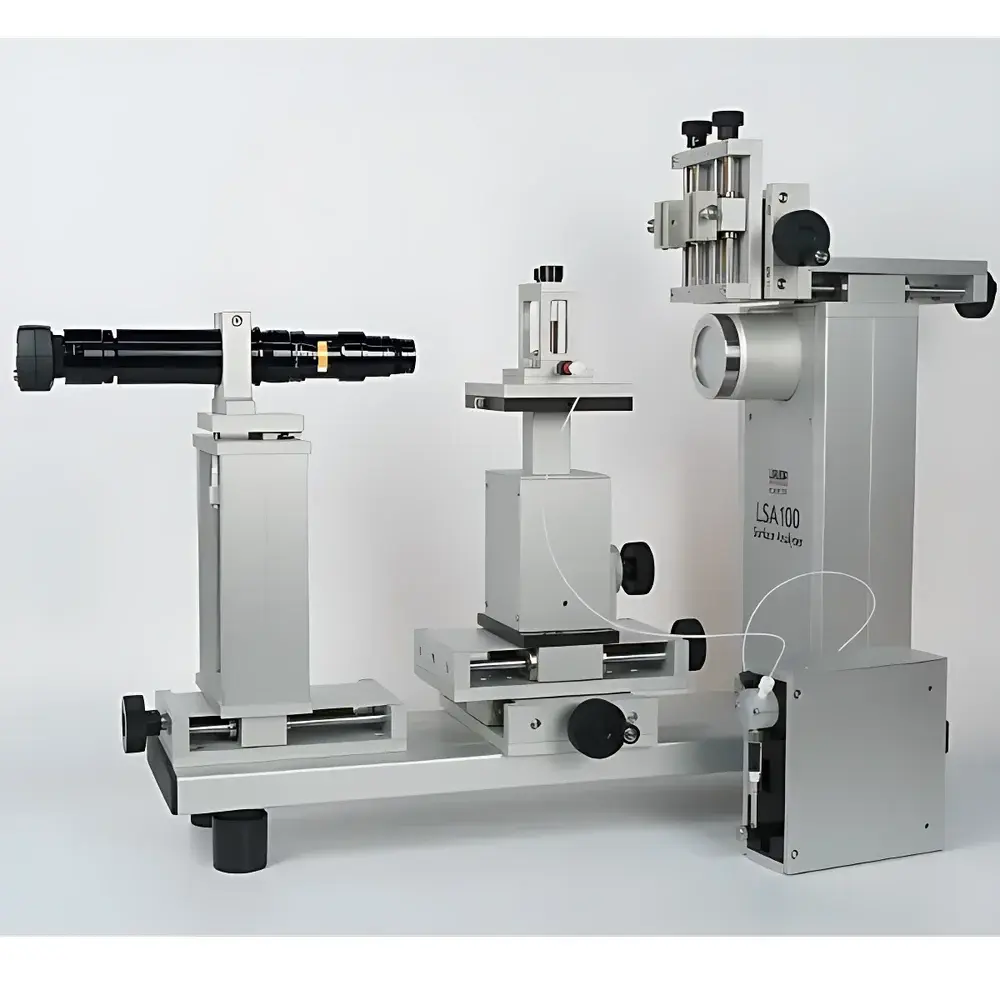
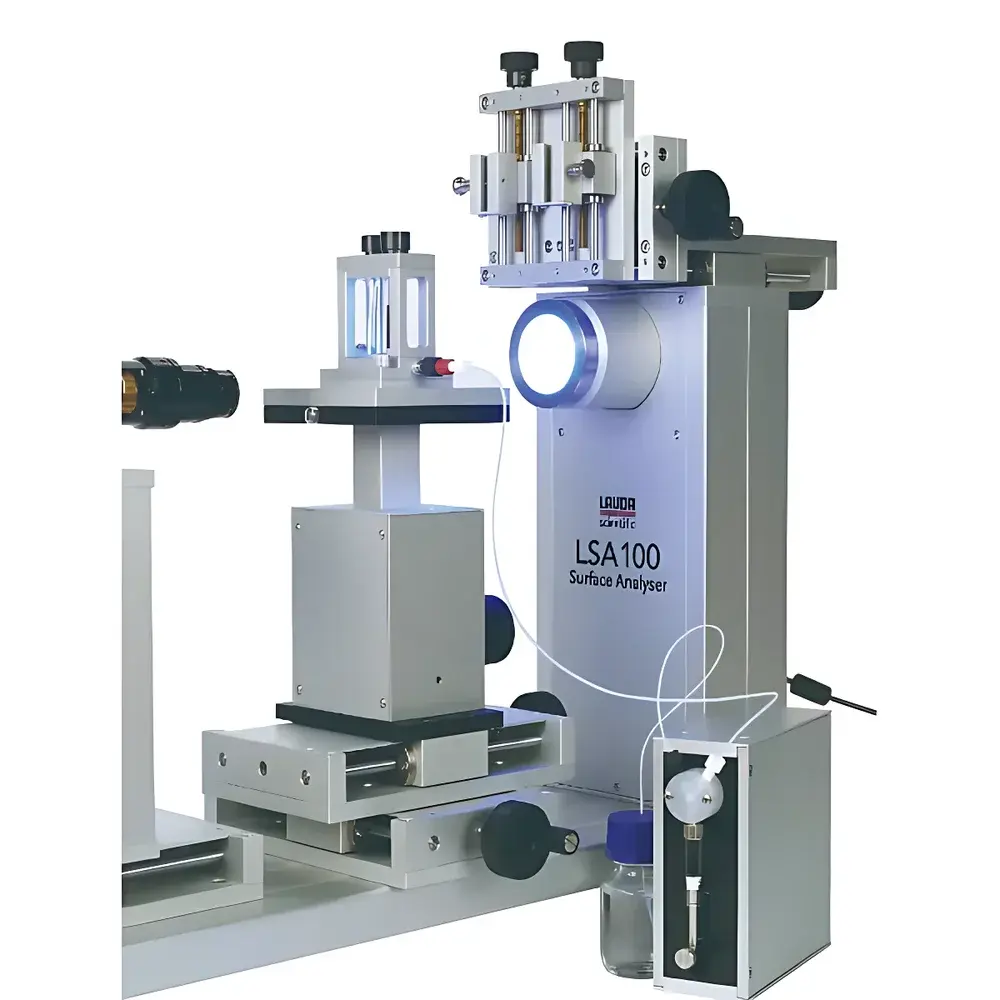
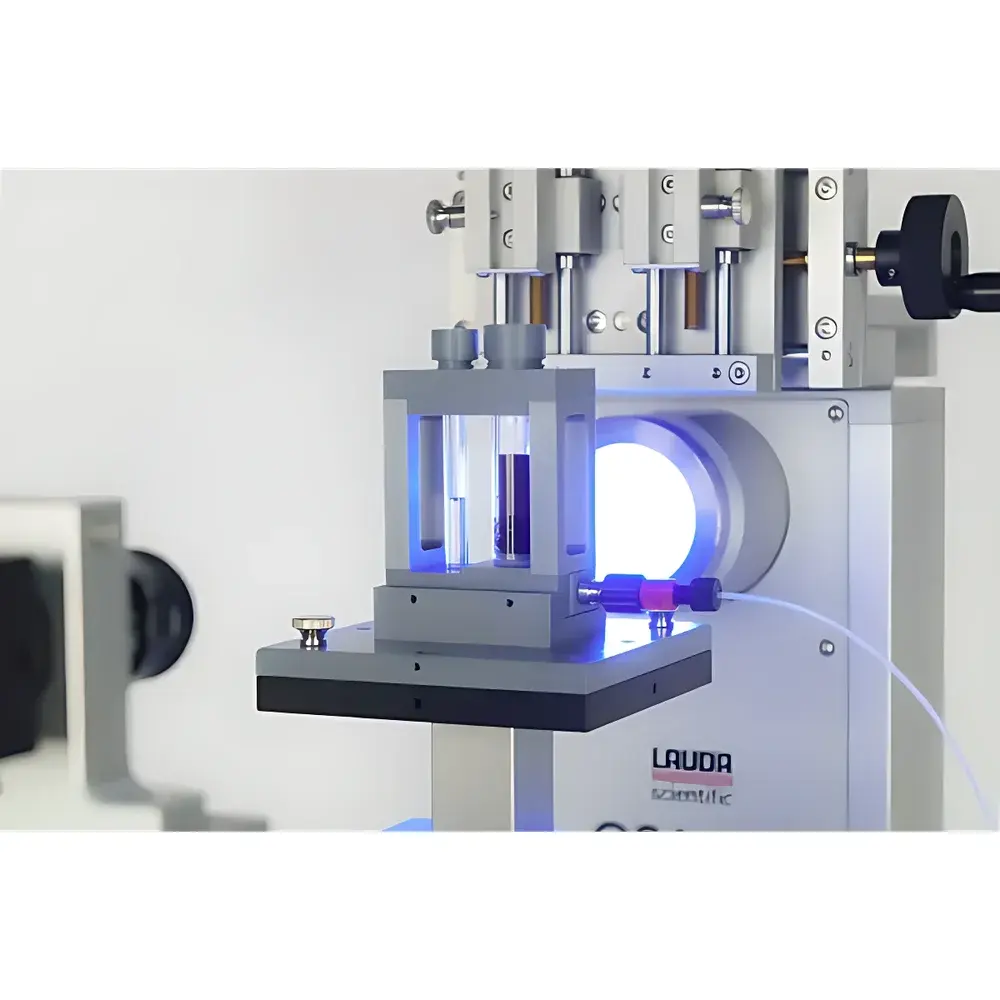
LAUDA Scientific LSA100POM Powder Contact Angle Analyzer
| Brand | LAUDA Scientific |
|---|---|
| Origin | Germany |
| Model | LSA100POM |
| Instrument Type | Benchtop Laboratory Analyzer |
| Contact Angle Measurement Range | 0–180° |
| Washburn Contact Angle Range | 0–90° |
| Contact Angle Accuracy | ±0.1° |
| Contact Angle Resolution | 0.01° |
| Surface/Interfacial Tension Range | 0.01–2000 mN/m |
| Surface/Interfacial Tension Resolution | 0.01 mN/m |
| Sample Stage Dimensions | 100 × 100 mm |
| Maximum Sample Size (L×W×H) | ∞ × 290 × 76 mm |
| Stage Load Capacity | 12 kg |
| Optical Zoom | 6.5× Motorized Zoom Lens |
| Image Resolution | 1280 × 960 pixels |
| Frame Rate | 54 fps @ full resolution |
| Liquid Level Tracking Precision | 10 µm |
| Absorbed Volume Resolution | 0.1 µL |
| Video Analysis Frequency for Powder Uptake | 15 Hz |
| Standard Capillary Tube | Vertical, 40 mm length × 10 mm diameter |
| Light Source | Adjustable High-Uniformity LED Cold Light |
| Power Supply | 110/240 V, 50/60 Hz, 90 W |
| Base Dimensions & Weight | 600 × 160 × 543 mm (L×W×H), 19 kg |
Overview
The LAUDA Scientific LSA100POM Powder Contact Angle Analyzer is a purpose-built optical instrument engineered for quantitative, real-time characterization of wettability dynamics in powders and porous media. Unlike conventional contact angle systems limited to flat solid surfaces, the LSA100POM implements a video-optical Washburn methodology—capturing capillary-driven liquid rise within vertically oriented powder columns via high-resolution, high-speed imaging. By tracking meniscus displacement and correlating it with time-resolved volume uptake (V and V² vs. t), the system computes dynamic contact angles without reliance on gravimetric balance integration—a key differentiator from legacy two-instrument workflows. Its core measurement principle adheres to the Washburn equation: *h² = (γ·cosθ·r·t)/(2η)*, where *h* is penetration depth, *γ* is liquid surface tension, *θ* is the contact angle, *r* is effective pore radius, and *η* is dynamic viscosity. This enables rigorous, model-based quantification of interfacial thermodynamics and kinetic wetting behavior across diverse particulate systems—including hydrophilic/hydrophobic, oleophilic/oleophobic, and high-surface-area materials such as fumed silica, battery-grade carbon black, pharmaceutical excipients, and ceramic precursors.
Key Features
- Real-time meniscus tracking with 10 µm vertical resolution and automated liquid-level replenishment to maintain constant hydrostatic head during extended uptake experiments.
- Simultaneous volumetric analysis: Software-acquired absorption volume (V) and its square (V²) are plotted in real time against time, enabling direct linear regression for Washburn slope extraction and contact angle derivation.
- Standardized powder packing protocol: Integrated dosing rod and calibrated mass weights ensure reproducible sample column density—critical for minimizing inter-trial variability in low-cohesion or electrostatically charged powders.
- Modular, cleanable capillary architecture: Dual-open-end, glass-free sample tubes eliminate fiber entanglement and residue retention; compatible with thermal conditioning up to 200 °C and solvent rinsing protocols.
- Motorized 6.5× zoom optical system with 1280 × 960 pixel CMOS camera (54 fps at full resolution) and precision X-axis focusing stage for optimal meniscus edge definition across variable tube diameters.
- Triaxial motorized stages (X/Y/Z) for independent alignment of sample tube, syringe tip, and optical axis—ensuring geometric consistency across heterogeneous or anisotropic samples.
Sample Compatibility & Compliance
The LSA100POM accommodates unrestricted sample length (theoretical ∞) and supports standard vertical capillaries (40 mm × 10 mm ID) as well as optional horizontal permeation cells for anisotropic flow assessment. It is validated for use with aqueous, organic, and ionic liquid probes—including surfactant solutions used in CMC determination. The system complies with ASTM D7490 (Standard Test Method for Measuring Contact Angles of Solid Surfaces) and ISO 19403-2 (Paints and varnishes — Contact angle measurement — Part 2: Static contact angle). When configured with audit trail-enabled software modules and electronic signatures, it meets GLP and FDA 21 CFR Part 11 requirements for regulated R&D environments. All hardware components are CE-marked and manufactured under ISO 9001-certified processes in Lauda’s German production facility.
Software & Data Management
SurfaceMeter™ Professional Software provides template-driven operation: preconfigured workflows for Washburn analysis, surface energy calculation (Owens–Wendt, Wu, van Oss–Chaudhury–Good), and adhesion work modeling. Raw video streams are stored losslessly with embedded metadata (timestamp, environmental conditions, operator ID). Each measurement generates a structured .csv export containing *t*, *h*, *V*, *V²*, derived *cosθ*, and confidence intervals from linear regression statistics. Batch processing tools allow comparative analysis across multiple samples or probe liquids. Optional modules support GMP-compliant electronic records, including user access logs, change history, and PDF report generation with digital signature fields.
Applications
- Quantitative evaluation of binder–powder affinity in dry granulation and hot-melt extrusion processes.
- Wettability screening of electrode slurries for lithium-ion and solid-state batteries.
- Surface modification efficacy assessment of nanoscale fillers (e.g., silanized silica, graphene oxide).
- Capillary-driven drug dissolution prediction in porous tablet matrices.
- Hydrophobicity ranking of catalyst supports and filtration media under controlled humidity.
- Interfacial thermodynamic modeling of superhydrophobic coatings on microstructured powders.
FAQ
Does the LSA100POM require external balance integration for Washburn analysis?
No. The system replaces gravimetric measurement entirely through optical meniscus tracking and calibrated volumetric conversion—eliminating mechanical drift and buoyancy artifacts inherent in balance-coupled setups.
Can the LSA100POM measure contact angles on single fibers?
Yes, when equipped with the optional Drop-on-Filament module and 12.9× or 45× zoom optics, it supports Young–Laplace fitting for cylindrical geometry and calculates advancing/receding angles on individual filaments down to 5 µm diameter.
Is temperature control available as a factory option?
Yes. The integrated Peltier-based temperature unit (–10 °C to +80 °C, ±0.1 °C stability) mounts directly onto the sample stage and is fully synchronized with video acquisition and data logging.
How is calibration verified for volume and height measurements?
Calibration uses NIST-traceable micrometer standards and certified capillary tubes. Software includes built-in validation routines that generate calibration reports compliant with ISO/IEC 17025 documentation requirements.
What surface tension methods does the LSA100POM support beyond Washburn?
With optional pendant/sessile drop modules, it performs Young–Laplace fitting, liquid bridge analysis, and drop volume tensiometry—covering all major ISO 19403-4 compliant interfacial tension determination techniques.



