
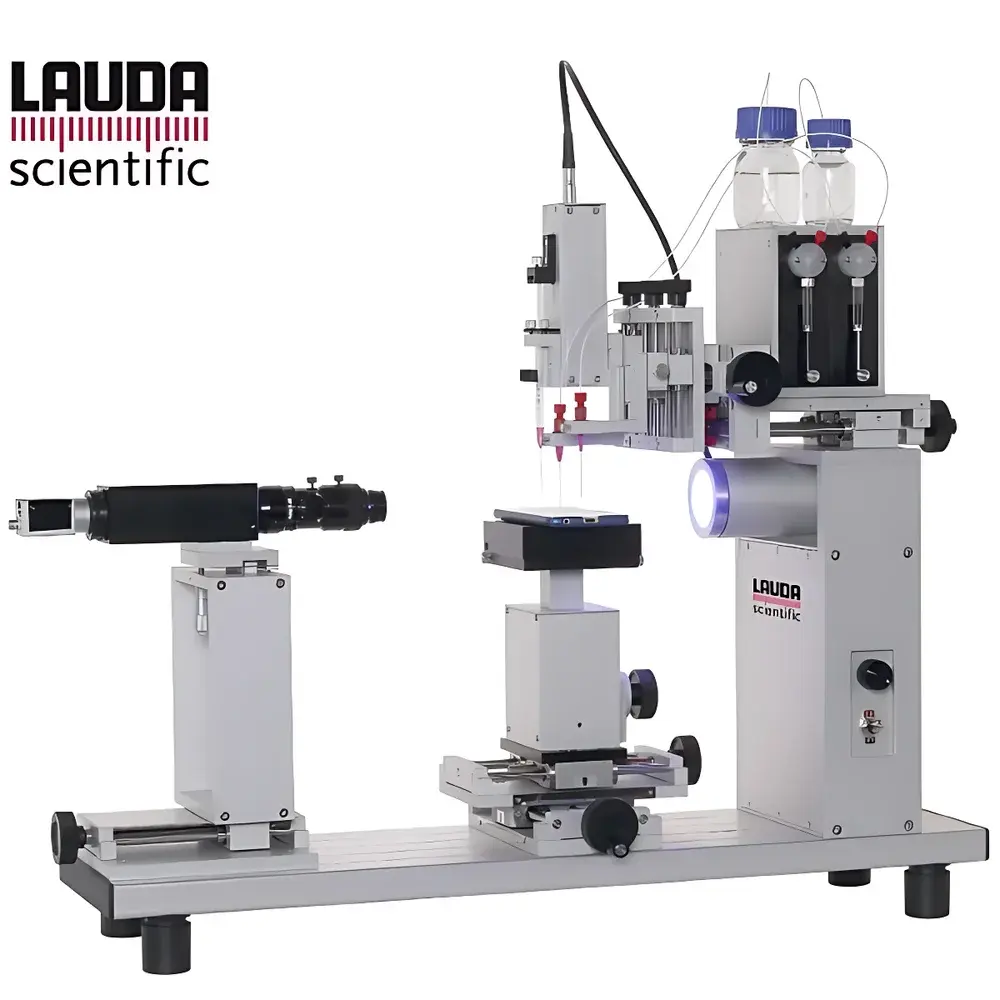
LAUDA Scientific LSA200B Automated Video-Based Optical Contact Angle Analyzer
| Brand | LAUDA Scientific |
|---|---|
| Origin | Germany |
| Model | LSA200B |
| Instrument Type | Benchtop Video Optical Contact Angle Analyzer |
| Contact Angle Measurement Range | 0–180° |
| Contact Angle Accuracy | ±0.1° |
| Contact Angle Resolution | 0.01° |
| Surface/Interfacial Tension Range | 0.001–2000 mN/m |
| Surface/Interfacial Tension Resolution | 0.01 mN/m |
| Sample Stage Dimensions | 100 × 100 mm |
| Maximum Sample Load | 12 kg |
| Maximum Sample Dimensions (L × W × H) | ∞ × 310 × 76 mm |
| Image Magnification | 6.5× Zoom Lens |
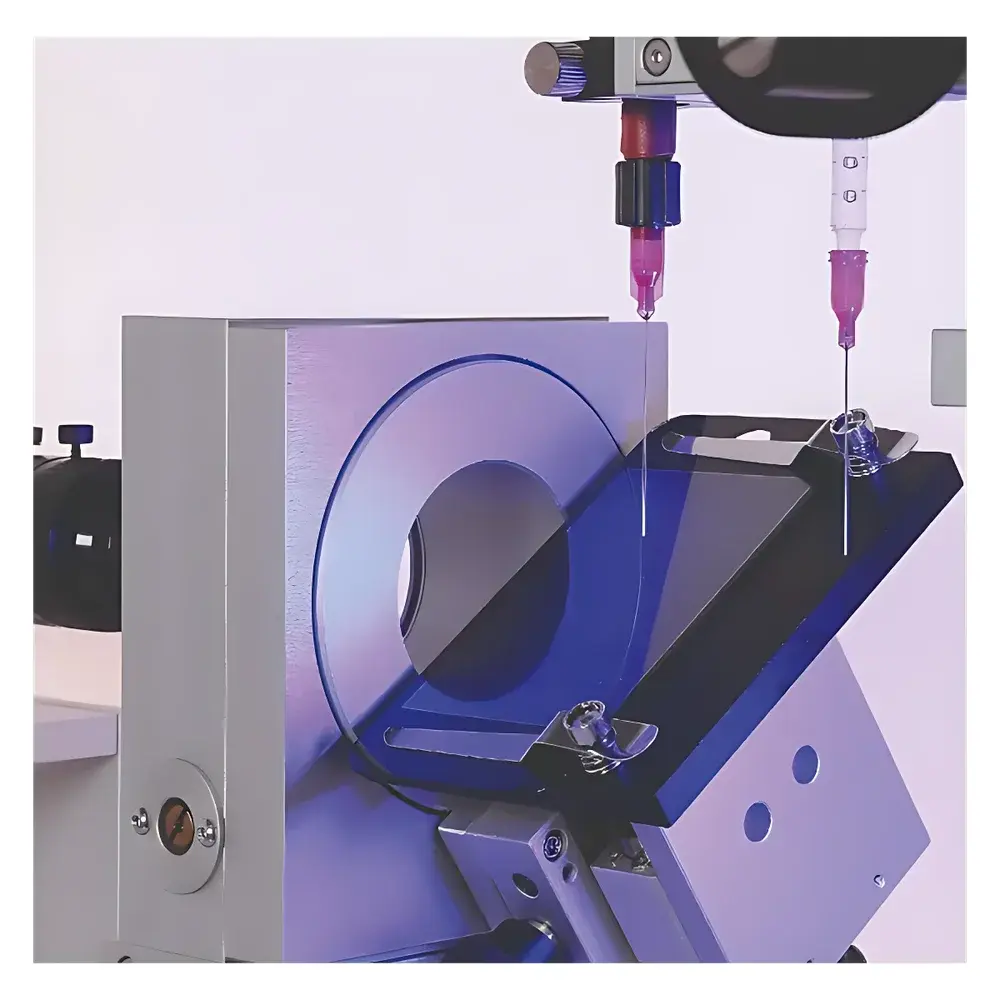
| Automated Tilting Stage | 0–360° |
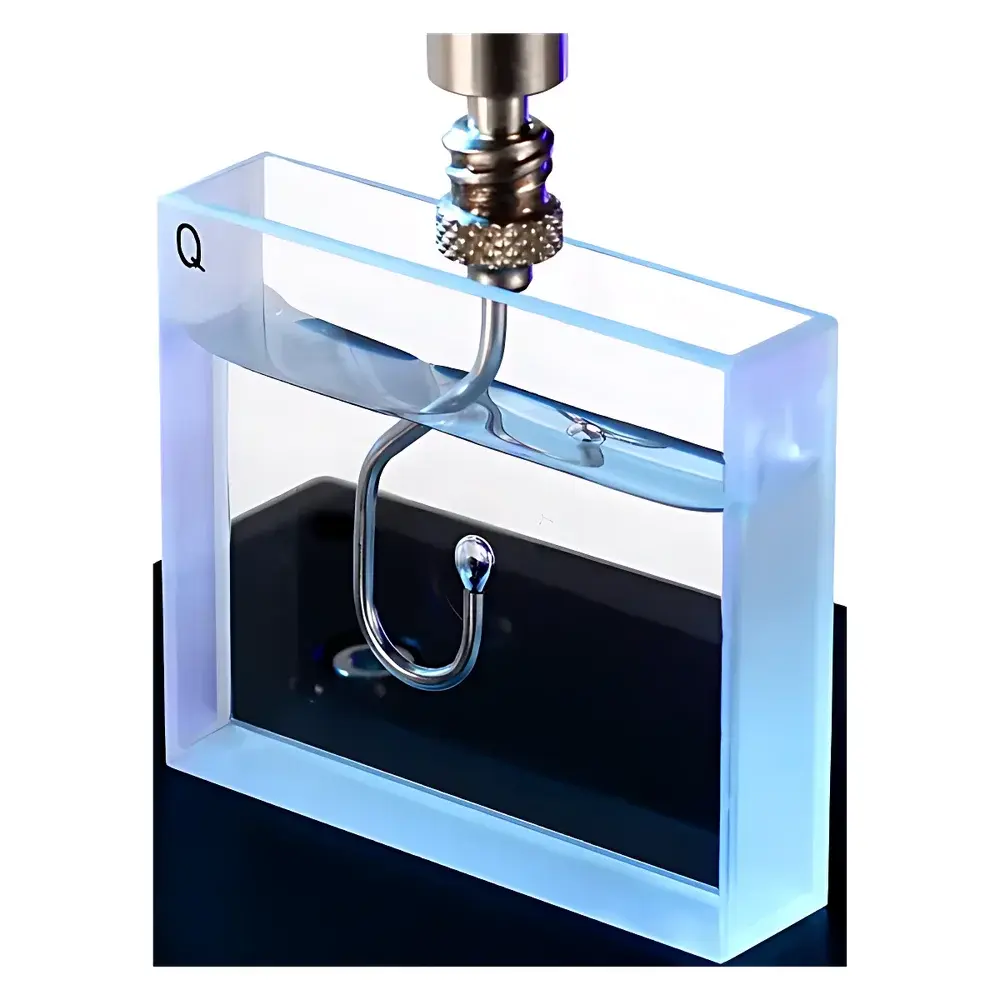
| Adhesion Force Measurement (Vertical | 0.1 μN resolution |
| Horizontal | up to 40g centrifugal equivalent) |
Overview
The LAUDA Scientific LSA200B is a fully automated, high-precision video-based optical contact angle analyzer engineered for rigorous surface and interfacial characterization in academic research laboratories, R&D centers, and quality control environments. It operates on the principle of sessile drop analysis using high-resolution digital imaging, combined with advanced geometric contour fitting algorithms (e.g., Young–Laplace curve fitting, ellipse fitting, and tangent methods) to quantify contact angles with traceable metrological integrity. Unlike conventional single-view systems, the LSA200B integrates synchronized top-view and side-view imaging—enabling true 3D droplet profile reconstruction and eliminating axis-dependent measurement bias. Its modular architecture supports concurrent measurement of static and dynamic contact angles (advancing/receding), rolling angles, surface free energy (via Owens–Wendt, Wu, Fowkes, van Oss–Chaudhury–Good models), interfacial tension, and viscoelastic interfacial rheology via oscillating drop methodology. Designed and manufactured in Germany, the system complies with ISO 19403-2 (contact angle measurement), ISO 1409 (surface tension), and ASTM D7490 (contact angle on coatings), ensuring data traceability and methodological consistency across global regulatory frameworks.
Key Features
- Fully automated dual-view (side + top) optical configuration enabling simultaneous, co-registered contact angle determination from orthogonal perspectives—critical for anisotropic or heterogeneous surfaces.
- Integrated 360° motorized tilting stage with programmable angular velocity (0.05°–7°/s), supporting dynamic contact angle hysteresis, roll-off angle quantification, and gravity-driven wetting front tracking.
- Non-contact liquid dispensing unit with piezoelectric actuation, minimizing substrate disturbance and enabling repeatable multi-droplet deposition without needle contact or vibration artifacts.
- Dual-droplet-in-frame acquisition mode for rapid, self-referenced solid surface free energy calculation using two immiscible probe liquids—reducing operator dependency and measurement time by >60% compared to sequential methods.
- Automated Washburn analysis module for capillary rise kinetics in powders and porous media, delivering contact angle values even for highly hydrophilic materials where sessile drop fails.
- Oscillating drop interfacial rheology capability: precise control of sinusoidal, step, or sawtooth waveform modulation (0.001–4 Hz); real-time extraction of dilatational elastic modulus (E’), viscous modulus (E”), and complex modulus (E*) at air–liquid and liquid–liquid interfaces.
- High-speed imaging subsystem (up to 227 fps at 1440 × 1080 px) with optional 6.5× zoom lens, optimized for transient phenomena such as droplet impact, absorption kinetics in fibrous networks, and spontaneous imbibition in microstructured surfaces.
Sample Compatibility & Compliance
The LSA200B accommodates diverse sample geometries—from ultra-thin films (<100 nm) and single carbon fibers (diameter ~5–20 µm) to large-area substrates (unlimited length × 310 mm width × 76 mm height) and irregularly shaped components mounted on the 100 × 100 mm precision-machined aluminum stage (max load: 12 kg). Its open-stage design allows integration of environmental chambers (temperature/humidity control), electrochemical cells, or custom fixtures. All measurement protocols adhere to GLP-aligned data integrity standards: full audit trail logging (user, timestamp, parameter set, raw image archive), electronic signatures per FDA 21 CFR Part 11 requirements, and export-ready reports compliant with ISO/IEC 17025 documentation guidelines. Calibration verification is supported via certified reference standards (e.g., NIST-traceable contact angle calibration slides, surfactant solutions of known CMC).
Software & Data Management
The instrument is operated via LAUDA’s SCA20 software—a modular, Windows-based platform built on .NET architecture with deterministic real-time acquisition scheduling. It features template-driven workflows: one-click execution of standardized test sequences (e.g., ASTM D7334-compliant advancing/receding angle measurement, ISO 19403-4 CMC determination, or USP interfacial rheology validation). Raw image data are stored in lossless TIFF format with embedded EXIF metadata (exposure, gain, focus position, stage coordinates). Quantitative results—including contact angle histograms, surface energy component breakdowns, interfacial modulus spectra, and time-resolved absorption curves—are exportable to CSV, Excel, or MATLAB-compatible MAT files. Software modules support batch processing, statistical process control (SPC) charting, and direct integration with LIMS via OPC UA or RESTful API endpoints.
Applications
The LSA200B serves critical analytical roles across multiple domains: in biomaterials science, it characterizes protein adsorption kinetics and cell-adhesive surface modifications; in battery R&D, it evaluates electrolyte wettability on separator membranes and electrode coatings; in pharmaceutical development, it assesses tablet coating uniformity and excipient–API interfacial compatibility; in nanomaterial synthesis, it validates superhydrophobic/superhydrophilic functionalization efficacy; and in inkjet printing, it correlates droplet spreading dynamics with printhead performance and substrate pre-treatment optimization. Its ability to measure both equilibrium and non-equilibrium interfacial states makes it indispensable for studying time-dependent phenomena such as surfactant diffusion, polymer interdiffusion at interfaces, and aging effects in self-assembled monolayers.
FAQ
Does the LSA200B support GMP/GLP-compliant data handling?
Yes—SCA20 software includes full 21 CFR Part 11 compliance: role-based access control, immutable audit trails, electronic signatures, and secure database encryption.
Can it measure contact angles on curved or textured surfaces?
Yes—the dual-view geometry and adjustable focal plane (100 mm X-axis travel) enable accurate profiling on convex/concave substrates and micro-roughened surfaces (Ra up to 10 µm).
Is interfacial rheology limited to air–water systems?
No—oscillating drop analysis is validated for liquid–liquid interfaces (e.g., oil–water, polymer melt–surfactant solution) using density-matched systems and calibrated syringe pumps.
What is the minimum detectable surface tension change during CMC measurement?
With baseline noise <0.01 mN/m and automated concentration ramping, the system resolves CMC inflection points with ≤0.05 mM precision for typical nonionic surfactants.
How is thermal drift compensated during long-duration measurements?
The LED illumination system features active thermal stabilization, and the optical path includes low-expansion borosilicate glass elements; software also applies frame-to-frame background subtraction for pixel-level intensity drift correction.



