
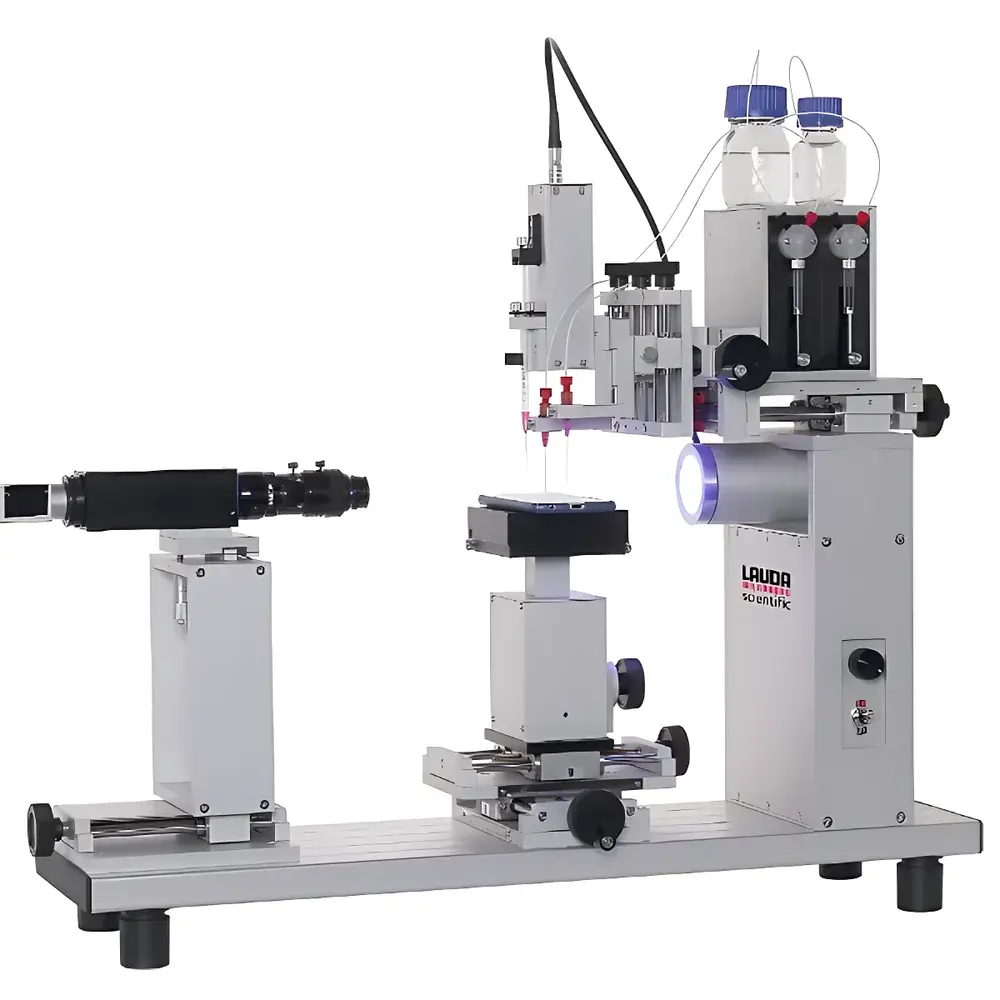
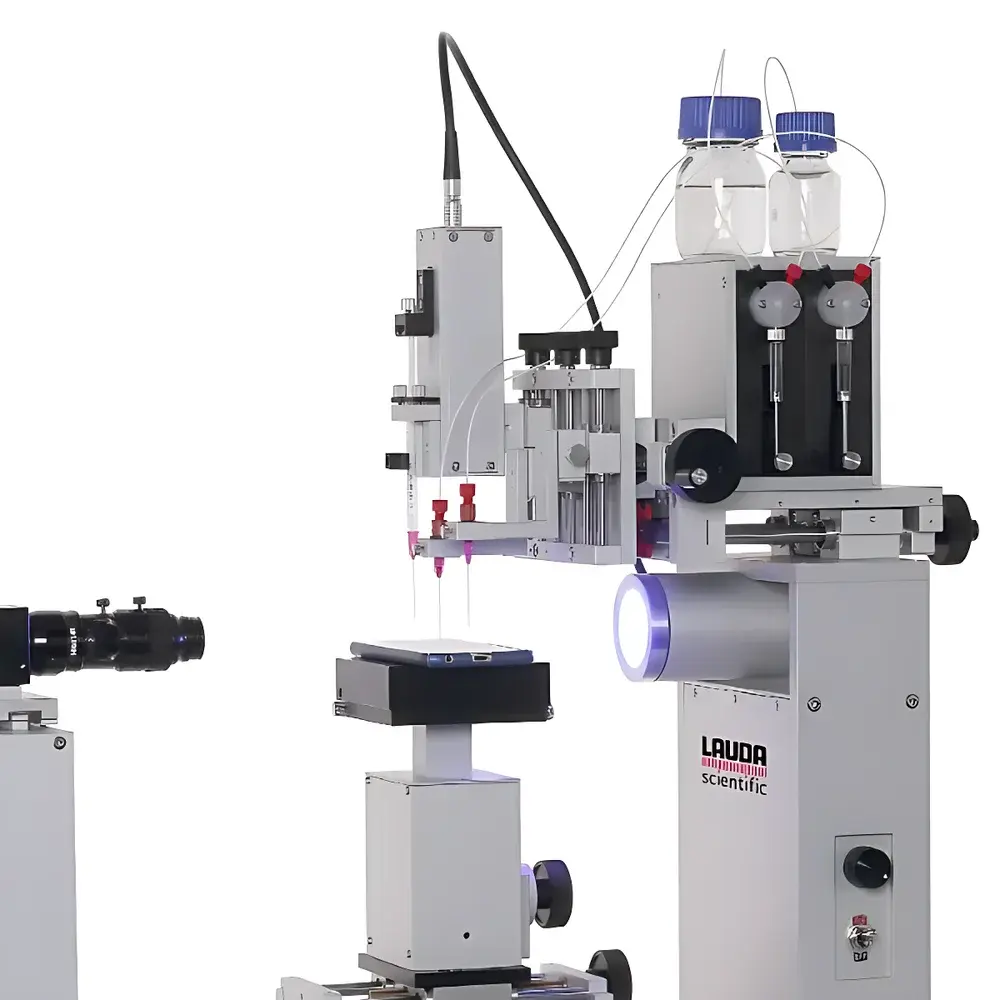
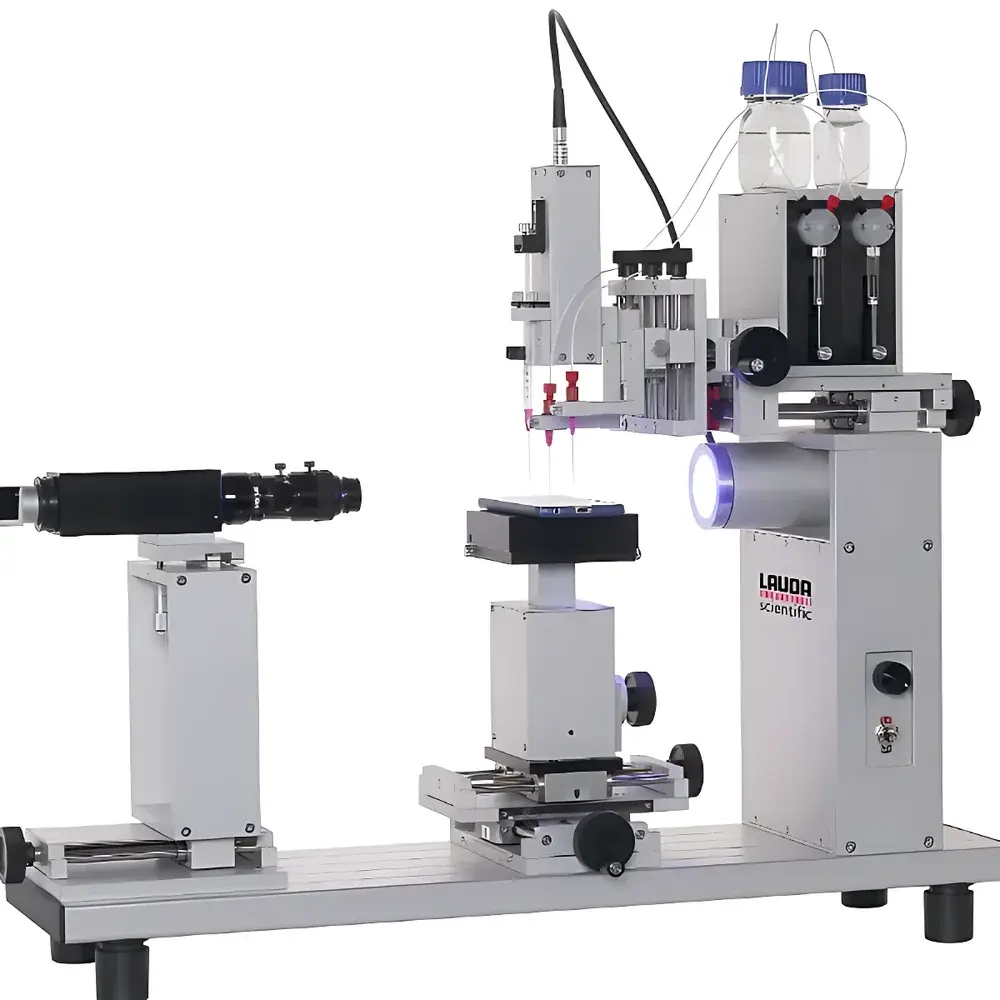
LAUDA Scientific LSA200S Video-Based Optical Contact Angle and Surface Tension Analyzer
| Brand | LAUDA Scientific |
|---|---|
| Origin | Germany |
| Model | LSA200S |
| Instrument Type | Benchtop Video Optical Contact Angle Meter |
| Contact Angle Range | 0–180° |
| Contact Angle Accuracy | ±0.1° |
| Contact Angle Resolution | 0.01° |
| Surface/Interfacial Tension Range | 0.001–2000 mN/m |
| Surface/Interfacial Tension Accuracy | ±0.01 mN/m |
| Sample Stage Dimensions | 100 × 100 mm |
| Maximum Sample Size (L×W×H) | ∞ × 290 × 76 mm |
| Stage Load Capacity | 12 kg |
| Imaging System | 1.9× Zoom Lens |
| High-Speed Camera | USB 3.0, 1280 × 1024 px, 60 fps |
| Field of View | 6.5 × 5.2 to 12.4 × 9.9 mm |
| Light Source | Adjustable LED Cold Light |
| Power Supply | 110/240 V, 50/60 Hz, 90 W |
| Instrument Footprint | 620 × 200 × 536 mm (L×W×H) |
| Weight | 22 kg |
Overview
The LAUDA Scientific LSA200S is a high-precision, benchtop video-based optical contact angle and interfacial tension analyzer engineered for rigorous surface and interface characterization in research and quality control laboratories. It operates on the principle of sessile drop analysis—capturing high-resolution side-view or top-view images of liquid droplets deposited on solid substrates—and applies advanced edge-detection algorithms to determine contact angles with sub-degree accuracy. For interfacial tension quantification, it employs the pendant drop method, Young–Laplace curve fitting, and oscillating drop techniques to derive dynamic interfacial rheological parameters. The system integrates a modular architecture supporting static/dynamic contact angle measurement, advancing front analysis, rolling angle determination via motorized tilt stage, and automated CMC titration—all within a single platform compliant with ASTM D724, ISO 19403, and ISO 1409 standards.
Key Features
- Automated, software-controlled measurement sequences including static contact angle, advancing/receding angle, roll-off angle, and hysteresis evaluation
- Non-contact liquid dispensing module enabling contamination-free droplet deposition on sensitive or hydrophobic surfaces
- Dual-camera configuration option (side + top view) for orthogonal validation and anisotropic surface analysis
- Motorized 360° tilt stage with programmable angular velocity and position-hold capability for precise dynamic wetting studies
- Triple independent syringe pump units with pressure-driven or stepper-motor actuation for multi-liquid sequential dosing
- High-speed imaging at 60 fps (1280 × 1024 px) synchronized with real-time droplet contour tracking and automatic contact angle derivation
- Modular expansion support for Washburn analysis of powders, single-fiber contact angle measurement, dilational interfacial rheology, and fully automated CMC determination
- Thermal control unit integration (optional) for temperature-dependent surface energy and interfacial tension profiling across –20 °C to 120 °C
Sample Compatibility & Compliance
The LSA200S accommodates samples up to 290 mm wide and 76 mm tall, with unlimited length—enabling analysis of flexible films, coated panels, textile swatches, and large-area functionalized substrates. Its 100 × 100 mm precision-machined sample stage supports loads up to 12 kg, ensuring mechanical stability during tilt-based measurements. All optical components utilize achromatic lenses and uniform LED illumination to minimize chromatic aberration and shadow artifacts. The instrument meets CE marking requirements and adheres to electromagnetic compatibility (EMC) Directive 2014/30/EU. Data acquisition and processing workflows are structured to support GLP/GMP environments: audit trails, user access levels, electronic signatures, and raw image archiving align with FDA 21 CFR Part 11 readiness when used with validated SurfaceMeter software configurations.
Software & Data Management
SurfaceMeter v6.x—the proprietary software suite—provides intuitive workflow-guided operation, batch processing, and traceable data handling. It includes over 15 contact angle calculation methods (e.g., Circle, Ellipse, Young–Laplace, Spline), seven surface energy models (Owens–Wendt, Wu, Fowkes, van Oss–Chaudhury–Good, etc.), and automated CMC curve fitting using conductivity or surface tension inflection detection. All measurement parameters, camera settings, and environmental metadata are embedded in exported .csv and .pdf reports. Raw video files (.avi/.mp4) retain time-stamped frame headers for third-party reanalysis. Export formats comply with ASTM E2913 for digital image metadata and ISO/IEC 17025 documentation requirements.
Applications
The LSA200S serves as a core analytical tool in academic and industrial labs engaged in surface science, colloid chemistry, and functional material development. Typical use cases include: evaluating plasma- or corona-treated polymer films for adhesion promotion; quantifying surfactant efficiency in agrochemical formulations via CMC and dynamic surface tension decay; assessing wettability transitions in stimuli-responsive hydrogels; characterizing oil–water–rock interactions in enhanced oil recovery studies; validating coating uniformity and curing kinetics in automotive paint R&D; and measuring fiber–liquid interaction forces in nonwoven filtration media. In regulatory contexts, it supports USP analytical instrument qualification (AIQ) protocols for surface property testing in pharmaceutical packaging and medical device manufacturing.
FAQ
Does the LSA200S support ISO 1409-compliant interfacial tension measurement?
Yes—the pendant drop method implementation follows ISO 1409 Annex A for interfacial tension determination between immiscible liquids, with built-in calibration routines for pixel-to-mm scaling and density input validation.
Can the system measure contact angles on curved or irregularly shaped substrates?
Yes—via motorized X/Y/Z stage positioning and real-time focus adjustment, combined with top-view imaging options, enabling reliable measurements on cylindrical fibers, micro-patterned surfaces, and textured ceramics.
Is the SurfaceMeter software compliant with 21 CFR Part 11 for regulated environments?
When deployed with role-based user accounts, electronic signature enforcement, and immutable audit log generation, the software satisfies key technical controls outlined in FDA 21 CFR Part 11 for electronic records and signatures.
What is the minimum detectable surface tension value using the oscillating drop method?
The oscillating drop module achieves stable measurement down to 0.1 mN/m under controlled ambient conditions, with resolution maintained at 0.01 mN/m across the full 0.001–2000 mN/m range.
How does the system handle powder wettability analysis without capillary rise artifacts?
The integrated Washburn analysis module uses time-resolved video capture of spontaneous liquid uptake into packed powder beds, applying Lucas–Washburn equation fitting while correcting for gravitational and inertial effects per ASTM D5708 guidelines.



