
LAUDA Scientific LSA60 pro Video-Based Optical Contact Angle Analyzer
| Brand | LAUDA Scientific |
|---|---|
| Origin | Germany |
| Model | LSA60 pro |
| Instrument Type | Benchtop Video Optical Contact Angle Analyzer |
| Contact Angle Measurement Range | 0–180° |
| Contact Angle Accuracy | ±0.1° |
| Contact Angle Resolution | 0.01° |
| Surface/Interfacial Tension Range | 0.01–2000 mN/m |
| Surface/Interfacial Tension Resolution | 0.01 mN/m |
| Sample Stage Dimensions | 100 × 100 mm |
| Maximum Sample Size (L×W×H) | ∞ × 240 × 76 mm |
| Stage Load Capacity | 12 kg |
| Optical Zoom Lens | 6.5× Continuous Zoom |
| Camera Resolution | 1450 × 1080 pixels |
| Max Frame Rate | 3400 fps |
| Field of View | 1.1 × 0.8 to 14.3 × 10.7 mm |
| LED Illumination | High-Uniformity Cold Light Source, Software- and Manual-Adjustable Brightness |
| Power Supply | 110/240 V, 50/60 Hz, 90 W |
| Dimensions (Base Unit) | 650 × 160 × 517 mm (L×W×H) |
| Weight | 15 kg |
Overview
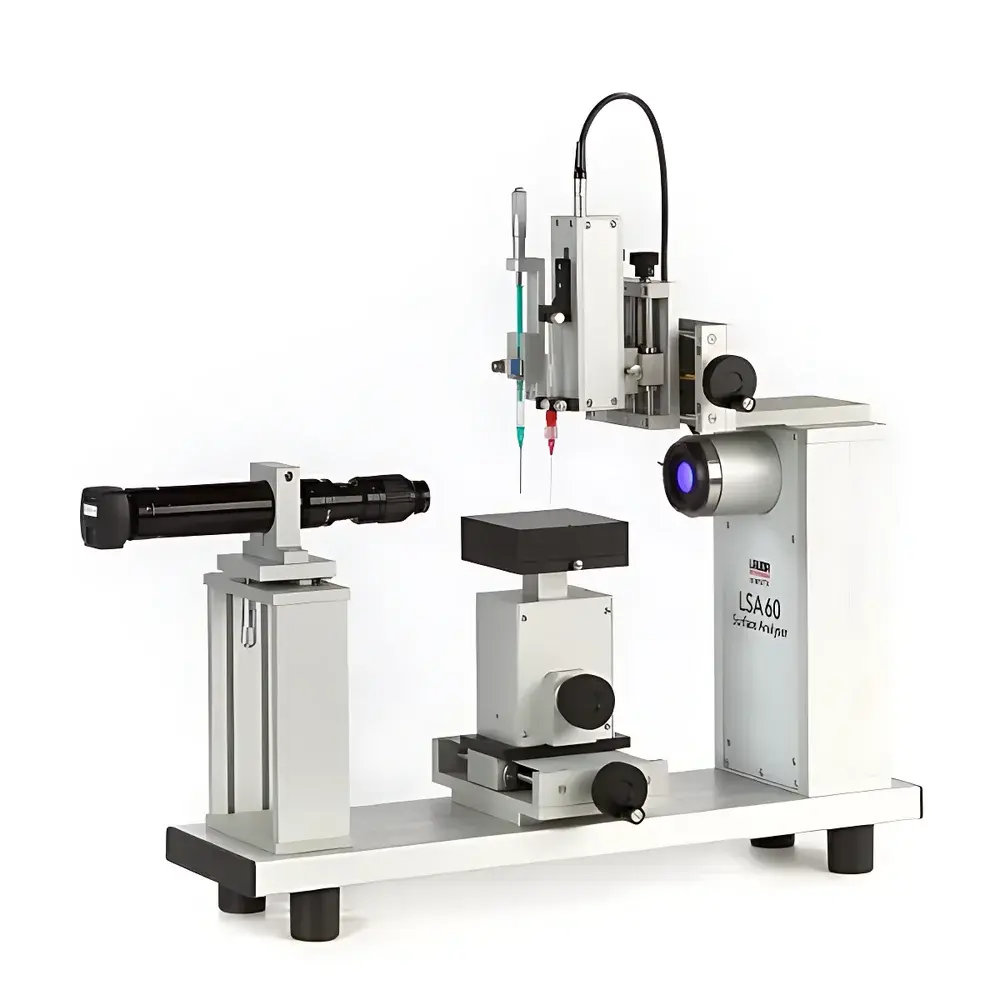
The LAUDA Scientific LSA60 pro is a high-precision, benchtop video-based optical contact angle analyzer engineered for rigorous surface and interfacial characterization in research laboratories and industrial quality control environments. It operates on the principle of sessile drop analysis—capturing high-resolution images of liquid droplets deposited on solid substrates—and applying advanced geometric and physical models (e.g., Circle, Ellipse, Conic, Young–Laplace, and Tangent fitting algorithms) to quantify contact angles with sub-degree accuracy. The system also supports pendant drop analysis for surface and interfacial tension determination, adhering to ISO 19403-3, ISO 19403-4, and DIN 55660-3 standards. Its modular architecture integrates motorized stages, an automated tilt platform, and a high-speed imaging subsystem, enabling static and dynamic measurements—including advancing/receding contact angles, roll-off angles, surface free energy calculation, adhesion work analysis, and real-time wetting kinetics of porous media.
Key Features
- Automated baseline detection and contour fitting using adaptive image clarity evaluation—eliminating manual thresholding bias during static contact angle measurement.
- Programmable measurement templates with guided workflow execution; one-click operation for routine assays without user intervention.
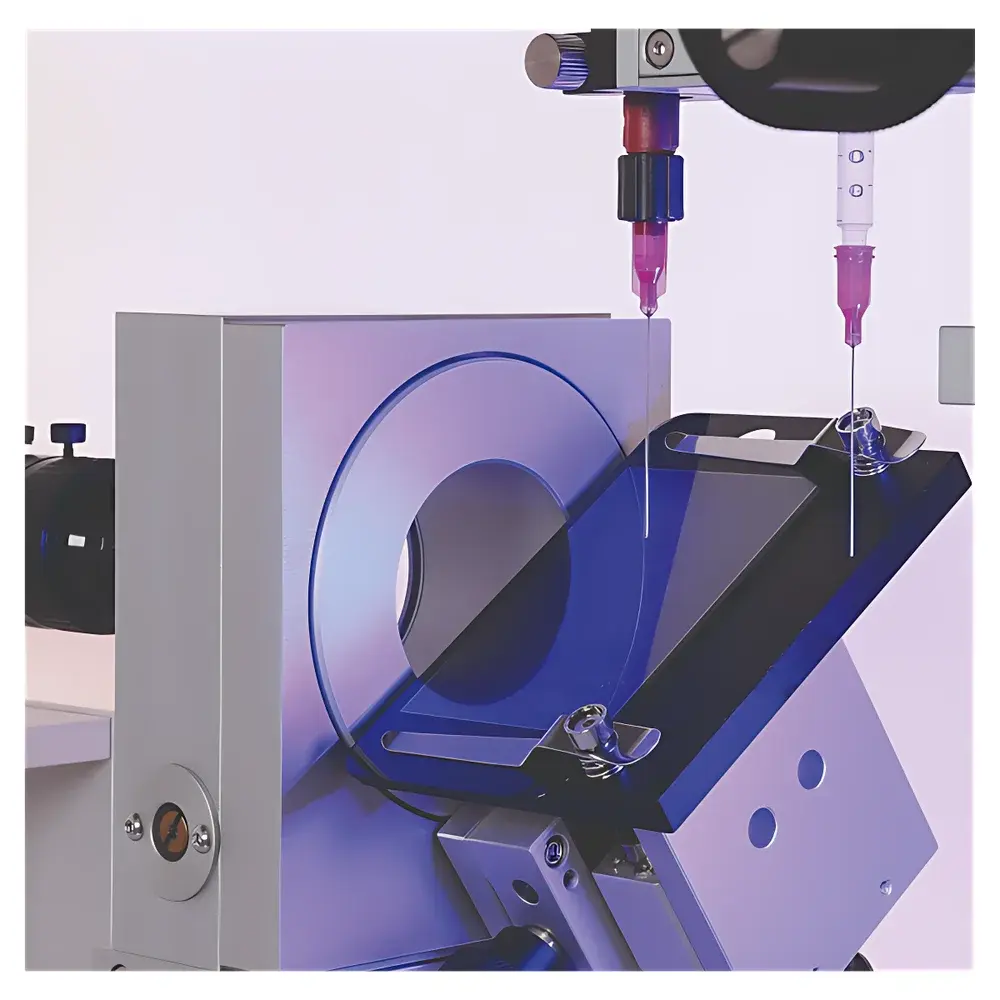
- Dual-method dynamic contact angle acquisition: needle insertion (for controlled volume change) and software-synchronized tilting (0–100° range) with synchronized high-speed video capture at up to 3400 fps.
- Integrated motorized tilt platform enables fully automated roll-off angle determination, including simultaneous tracking of droplet deformation, sliding onset, and receding/advancing angle evolution.
- Surface free energy module implements multiple theoretical frameworks—including Owens–Wendt–Rabel–Kaelble (OWRK), Wu harmonic mean, van Oss–Chaudhury–Good (vOCG), and Acid–Base approaches—suitable for low-energy polymers, high-energy metals, plasma-treated surfaces, and heterogeneous coatings.
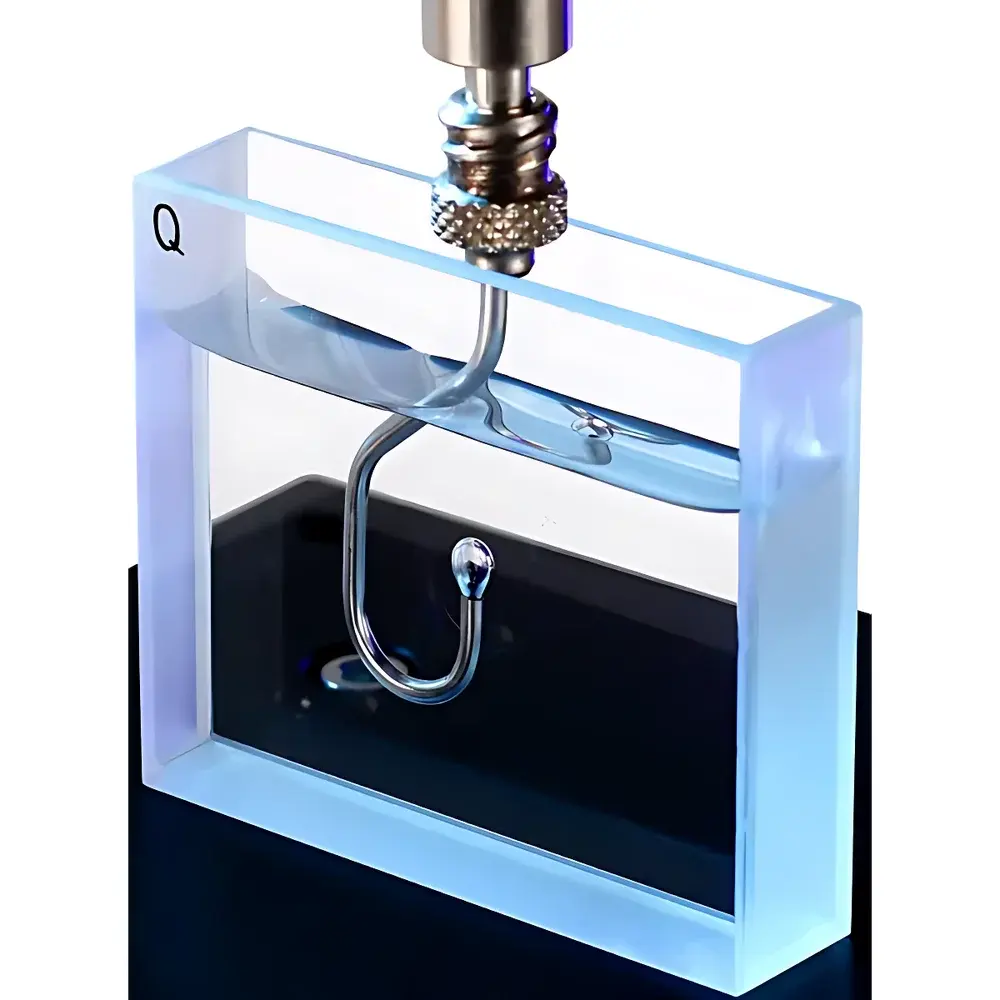
- Young–Laplace-based interfacial tension computation with robust convergence even for asymmetric or top-truncated pendant drops—validated against certified reference fluids per ASTM D971 and ISO 6295.
- High-fidelity wetting kinetics module captures capillary-driven absorption in porous materials (e.g., filter papers, membranes, textiles), computing time-resolved contact angles and imbibition rates via automated edge detection and centroid tracking.
Sample Compatibility & Compliance
The LSA60 pro accommodates diverse sample geometries—from standard 100 × 100 mm flat substrates to oversized specimens up to 240 mm wide and 76 mm tall (length unrestricted). Its 12 kg stage load capacity supports heavy or multi-layered assemblies, such as battery electrodes, composite laminates, or coated metal plates. All measurement protocols align with internationally recognized regulatory frameworks: surface tension results comply with ISO 19403-3/-4 for method validation; contact angle determinations support GLP-compliant documentation when used with audit-trail-enabled SurfaceMeter software (21 CFR Part 11-ready configuration available). The system meets CE marking requirements for electromagnetic compatibility (EMC Directive 2014/30/EU) and low-voltage safety (LVD Directive 2014/35/EU).
Software & Data Management
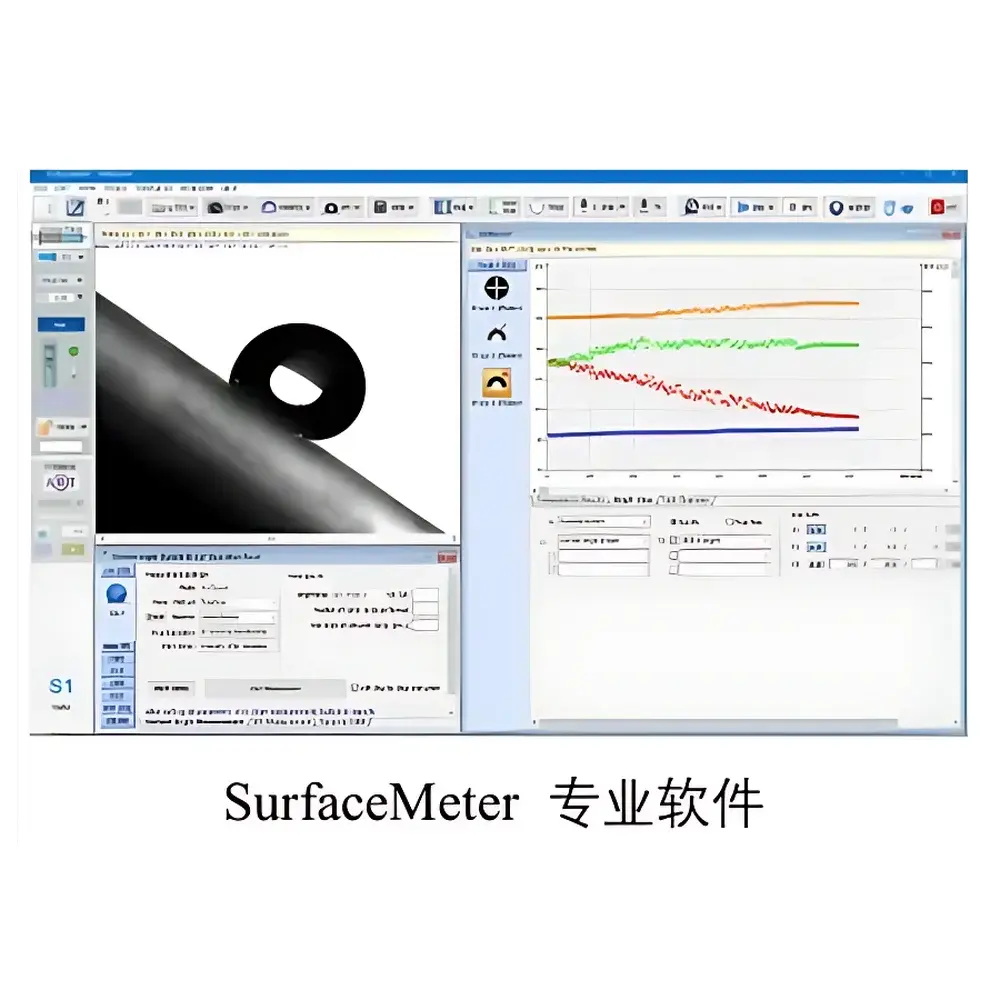
SurfaceMeter v6.x professional software provides a unified interface for instrument control, real-time visualization, and post-acquisition analysis. It features encrypted project databases with timestamped metadata, user-level access permissions, and full electronic lab notebook (ELN) integration capability. Measurement data export options include CSV, XML, and PDF reports compliant with ISO/IEC 17025 documentation standards. Audit trail functionality records all parameter modifications, image processing steps, and operator logins—essential for FDA-regulated environments. Optional modules include non-contact dispensing control (via piezoelectric actuation) and Peltier-based temperature regulation (±0.1 °C stability) for thermally sensitive interfaces.
Applications
- Academic research in colloid & interface science, biomaterials wettability, and nanocoating development.
- QC/QA of hydrophobic/hydrophilic treatments in semiconductor packaging, medical device manufacturing, and automotive paint systems.
- Formulation optimization in personal care (surfactant efficacy), agrochemicals (spray adhesion), and pharmaceutical tablet coating uniformity.
- Surface modification validation following plasma, corona, flame, or UV-ozone treatment.
- Characterization of membrane fouling resistance, filtration efficiency, and inkjet printhead substrate compatibility.
- Regulatory submission support for ISO 10993 biocompatibility assessments requiring surface energy quantification.
FAQ
What contact angle calculation methods does the LSA60 pro support?
Circle, Width–Height, Ellipse, Conic, Young–Laplace, and Tangent fitting algorithms—all selectable per measurement context to ensure optimal fit for smooth, rough, or chemically heterogeneous surfaces.
Can the system measure contact angles on curved or irregularly shaped samples?
Yes—via manual baseline definition and region-of-interest masking within SurfaceMeter; combined with XYZ-stage precision positioning, it enables localized wettability mapping across non-planar geometries.
Is the Young–Laplace tension algorithm validated against certified reference standards?
Yes—the software includes built-in calibration routines using standard liquids (e.g., ultrapure water, diiodomethane) traceable to NIST SRM 849a, with documented uncertainty budgets per ISO/IEC 17025 Annex A.3.
Does the LSA60 pro support GMP/GLP-compliant data integrity requirements?
When configured with password-protected user roles, electronic signatures, and immutable audit trails, the system satisfies ALCOA+ principles and supports 21 CFR Part 11 compliance for regulated life science applications.
What is the minimum detectable surface tension value, and under what conditions?
0.01 mN/m is achievable using optimized pendant drop geometry, high-contrast illumination, and ≥100-frame averaging—typically observed with volatile organic solvents or low-surface-tension fluorosurfactant solutions at controlled ambient humidity.



