
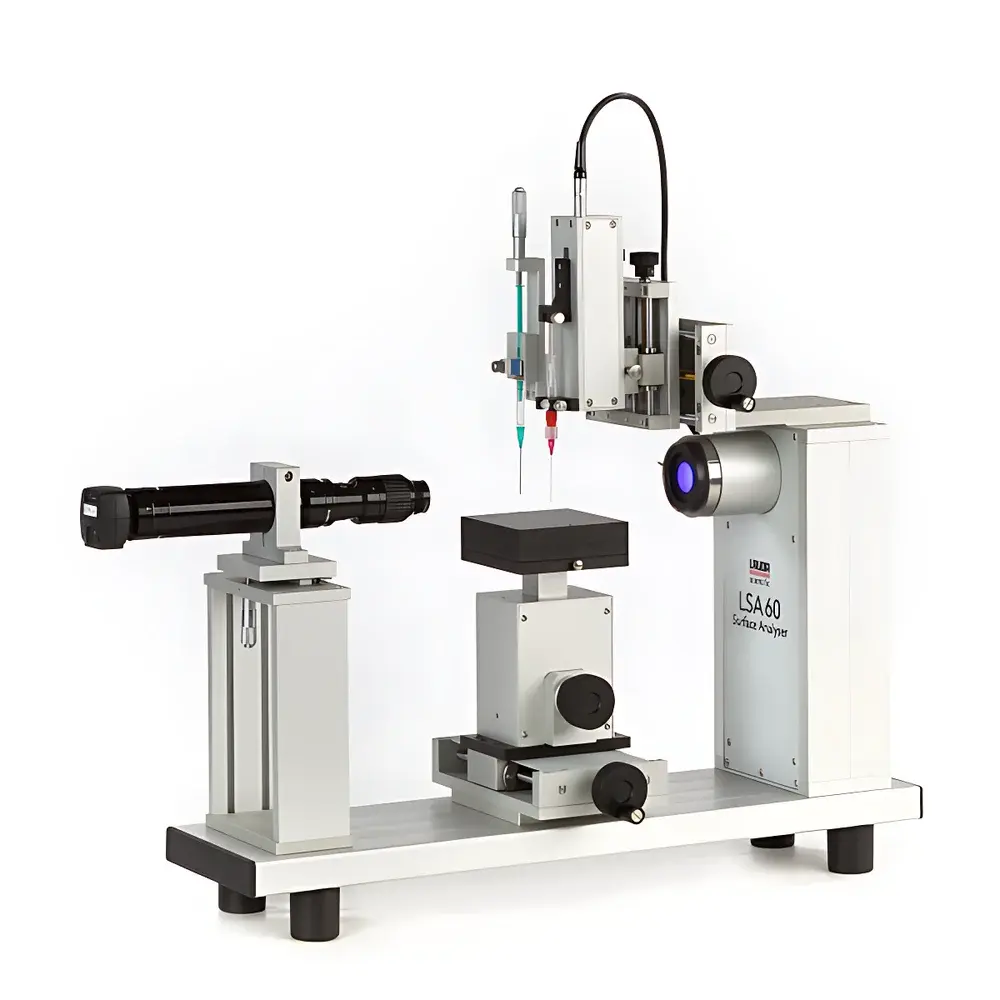
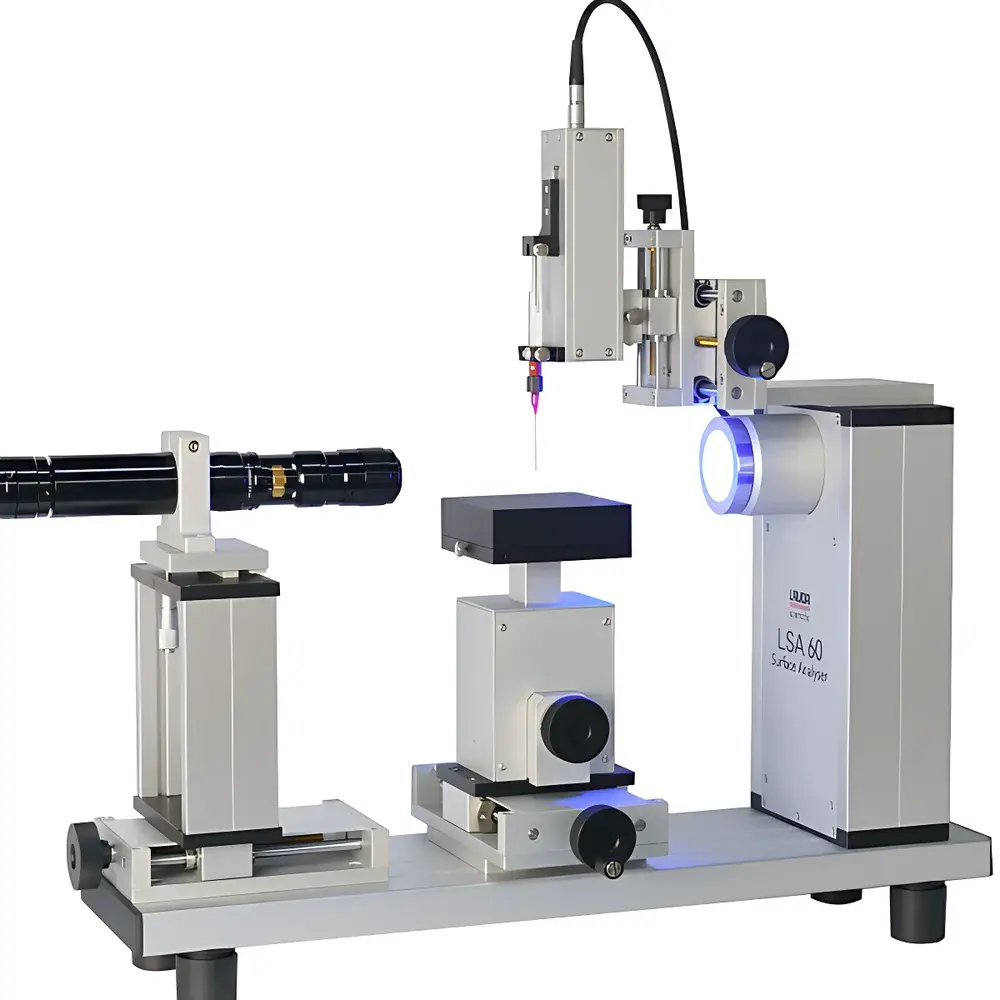
LAUDA Scientific LSA60 Video-Based Optical Contact Angle Analyzer
| Brand | LAUDA Scientific |
|---|---|
| Origin | Germany |
| Model | LSA60 |
| Instrument Type | Benchtop Video Optical Contact Angle Analyzer |
| Contact Angle Measurement Range | 0–180° |
| Contact Angle Accuracy | ±0.1° |
| Contact Angle Resolution | 0.01° |
| Surface/Interfacial Tension Range | 0.01–2000 mN/m |
| Surface/Interfacial Tension Resolution | 0.01 mN/m |
| Sample Stage Dimensions | 100 mm × 100 mm |
| Maximum Sample Size (L×W×H) | ∞ × 240 × 76 mm |
| Sample Stage Load Capacity | 12 kg |
| Optical Zoom Lens | 6.5× (±6 mm focus adjustment) |
| Imaging System | USB 3.0 high-speed camera, 1280 × 1024 px resolution, up to 435 fps |
| Light Source | Monochromatic, uniform LED cold light with software- and manual-intensity control |
Overview
The LAUDA Scientific LSA60 is a benchtop video-based optical contact angle analyzer engineered for precision measurement of interfacial phenomena at solid–liquid and liquid–liquid interfaces. It operates on the principle of sessile drop analysis using high-resolution digital imaging and advanced edge-detection algorithms to determine contact angles with sub-degree accuracy. The system supports both static and dynamic contact angle measurements—including advancing, receding, and roll-off angles—enabling comprehensive wettability characterization. In addition to contact angle quantification, the LSA60 performs surface and interfacial tension determination via pendant drop, sessile drop, and constrained drop methods, as well as solid surface free energy calculation using multiple theoretical models (e.g., Owens–Wendt, Fowkes, Wu, van Oss–Chaudhury–Good). Designed for reliability and reproducibility in regulated and research environments, the LSA60 meets foundational requirements for GLP-compliant documentation and supports audit-ready data capture when integrated with compliant software configurations.
Key Features
- Benchtop architecture with compact footprint (600 × 160 × 517 mm), optimized for space-constrained laboratories
- Motorized Y/Z-axis sample stage with 100 mm (Y) and 50 mm (Z) travel range, precision positioning, and mechanical auto-locking mechanism
- 6.5× zoom lens with <0.05% optical distortion and ±6 mm focus fine-tuning capability for consistent image sharpness across varied working distances
- USB 3.0 high-speed camera delivering up to 435 frames per second at full 1280 × 1024 pixel resolution; field-of-view adjustable from 2.0 × 1.6 mm to 12.9 × 10.3 mm (W × H)
- Monochromatic, uniform LED cold-light source with dual-mode intensity control (software-driven and manual), minimizing thermal drift and sample heating
- Modular liquid dispensing platform supporting single- or dual-syringe configurations with Y/Z-adjustable mounting and optional closed-loop volume feedback (<20 ms response time)
- SurfaceMeter™ professional software suite featuring real-time droplet contour fitting, automated baseline correction, multi-model surface energy decomposition, and batch processing workflows
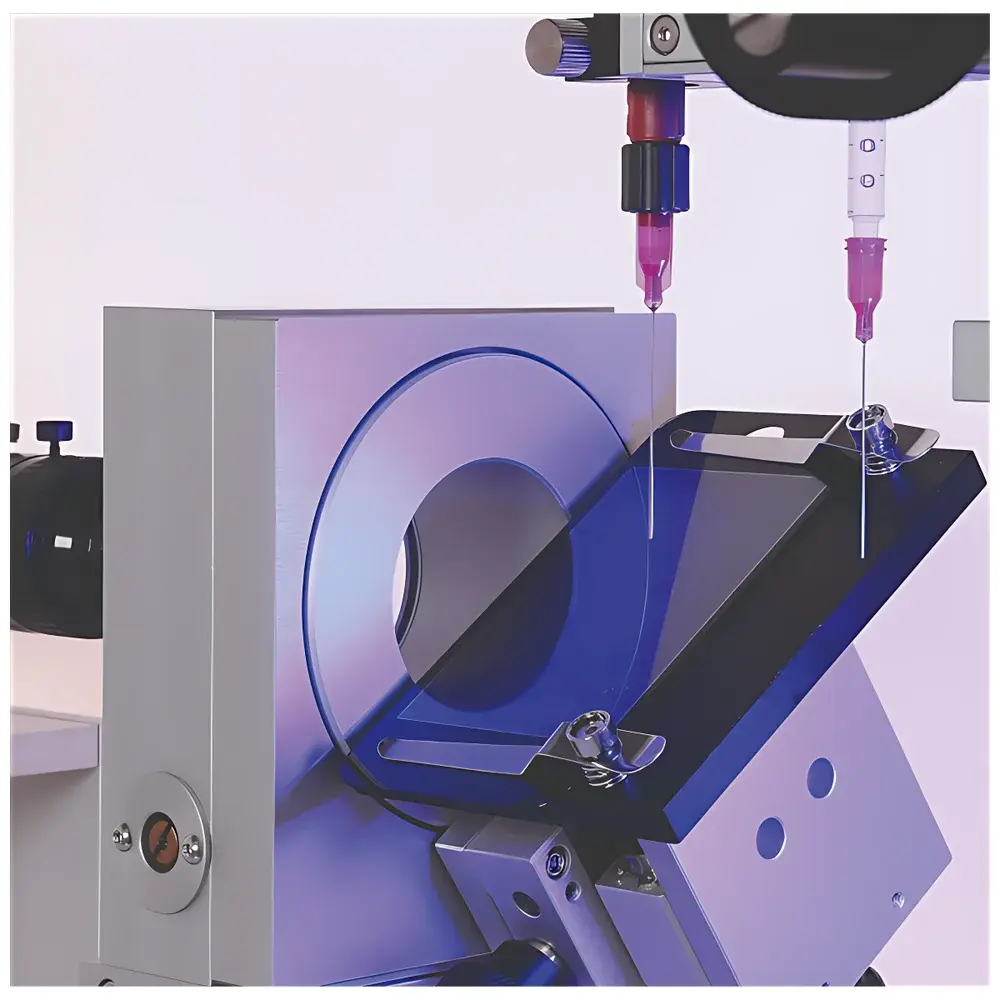
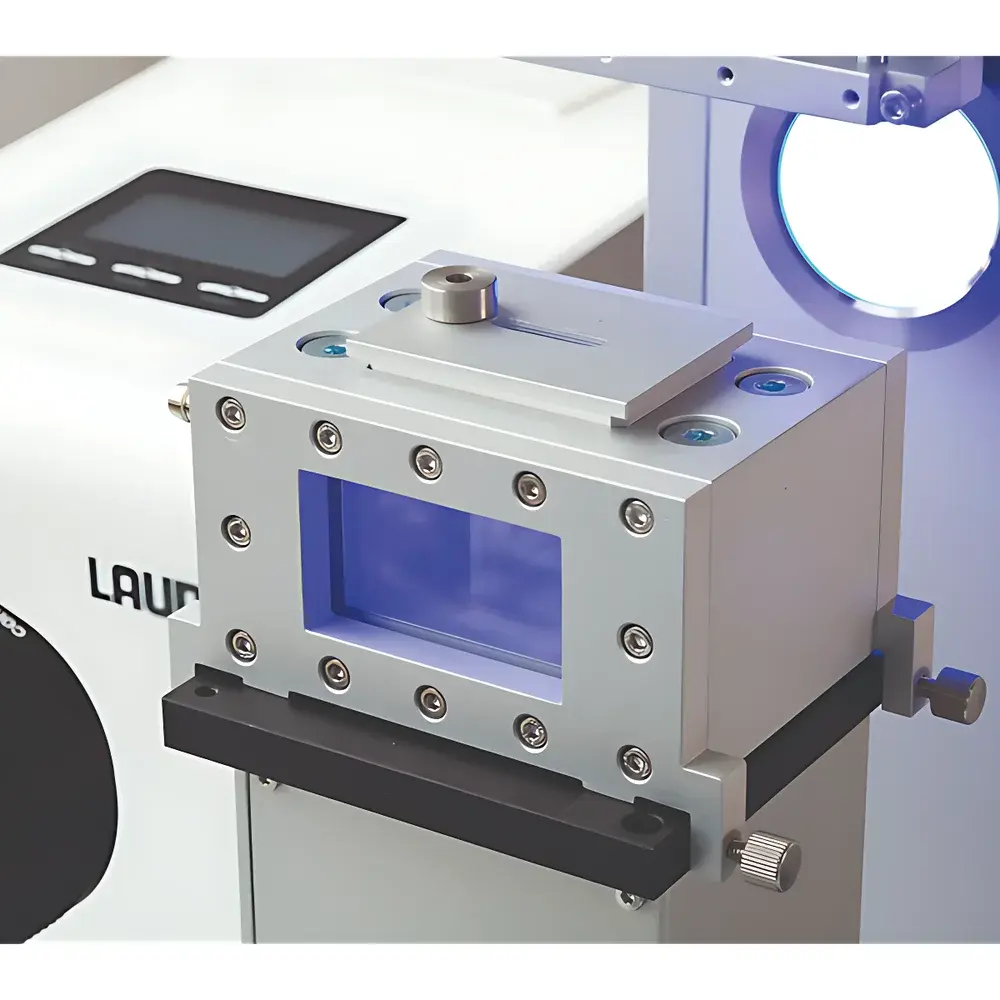
- Expandable hardware ecosystem including optional high-speed imaging upgrade, motorized tilting stage (±90°), Washburn module for powder wettability, heated environmental chamber (up to 200 °C), and automated liquid dosing systems
Sample Compatibility & Compliance
The LSA60 accommodates samples of variable geometry and mass: flat substrates up to 100 × 100 mm are centered on the standard stage, while oversized specimens (up to ∞ × 240 × 76 mm) may be mounted externally with gravity-supported alignment. The 12 kg load capacity enables stable measurement of dense ceramics, metal coupons, coated panels, or composite laminates. For regulatory applications, the instrument supports traceable calibration protocols aligned with ASTM D7334 (surface energy of polymer films), ISO 19403 (contact angle measurement), and ISO 1409 (interfacial tension of polymer solutions). When configured with timestamped, user-authenticated software logging and electronic signature support, the system can fulfill documentation requirements under FDA 21 CFR Part 11 for quality control labs operating under GMP or ISO/IEC 17025 frameworks.
Software & Data Management
SurfaceMeter™ software provides a validated, intuitive interface for acquisition, analysis, and reporting. Core capabilities include real-time contact angle tracking during dynamic processes (e.g., absorption, spreading, evaporation), automatic baseline detection even on non-horizontal surfaces, and simultaneous multi-parameter output (θadv, θrec, Δθ, γLV, γSV, Wad). All image sequences, metadata, and calculation logs are stored in structured .smd format with embedded EXIF-like tags (operator ID, timestamp, instrument serial, calibration status). Export options include CSV, PDF reports with embedded images and statistical summaries, and direct integration into LIMS via configurable API endpoints. Audit trail functionality records all parameter modifications, analysis re-runs, and user logins—ensuring full traceability for internal QA reviews or external accreditation audits.
Applications
- Quality assurance of hydrophobic/hydrophilic coatings in electronics manufacturing (e.g., PCB conformal coatings, display anti-fingerprint layers)
- Surface treatment validation in automotive and aerospace sectors (plasma, corona, flame treatment efficacy assessment)
- Formulation development for surfactants, emulsifiers, and wetting agents in agrochemicals and personal care products
- Characterization of porous media wettability in enhanced oil recovery (EOR) studies and geological core analysis
- Biomedical material evaluation—including protein adsorption propensity, cell adhesion substrates, and implant surface functionalization
- Printing and inkjet compatibility testing via dynamic spreading coefficient and contact line velocity analysis
- Environmental monitoring of soil–water interaction dynamics and contaminant migration modeling
FAQ
What measurement methods does the LSA60 support?
It supports sessile drop, pendant drop, captive bubble, tilting plate (with optional accessory), and Washburn infiltration methods—all accessible within SurfaceMeter™ software without hardware modification.
Can the LSA60 measure contact angles on rough or heterogeneous surfaces?
Yes—the software includes specialized algorithms for baseline correction on inclined or textured surfaces, and supports local contact angle mapping via sequential image acquisition and region-of-interest analysis.
Is calibration traceable to national standards?
Standard calibration uses NIST-traceable reference liquids (e.g., distilled water, diiodomethane, ethylene glycol); LAUDA provides documented calibration certificates upon request, compliant with ISO/IEC 17025 requirements.
How is data integrity ensured during long-term experiments?
The system implements cyclic redundancy checksums on all saved image sequences and enforces write-once archive modes for raw data folders, preventing accidental overwrites or tampering.
Does the LSA60 comply with FDA 21 CFR Part 11 for electronic records?
When deployed with SurfaceMeter™ Enterprise Edition and configured with role-based access control, electronic signatures, and enabled audit trails, it satisfies technical controls required under Part 11 for regulated pharmaceutical and medical device QC environments.
Related Products



