
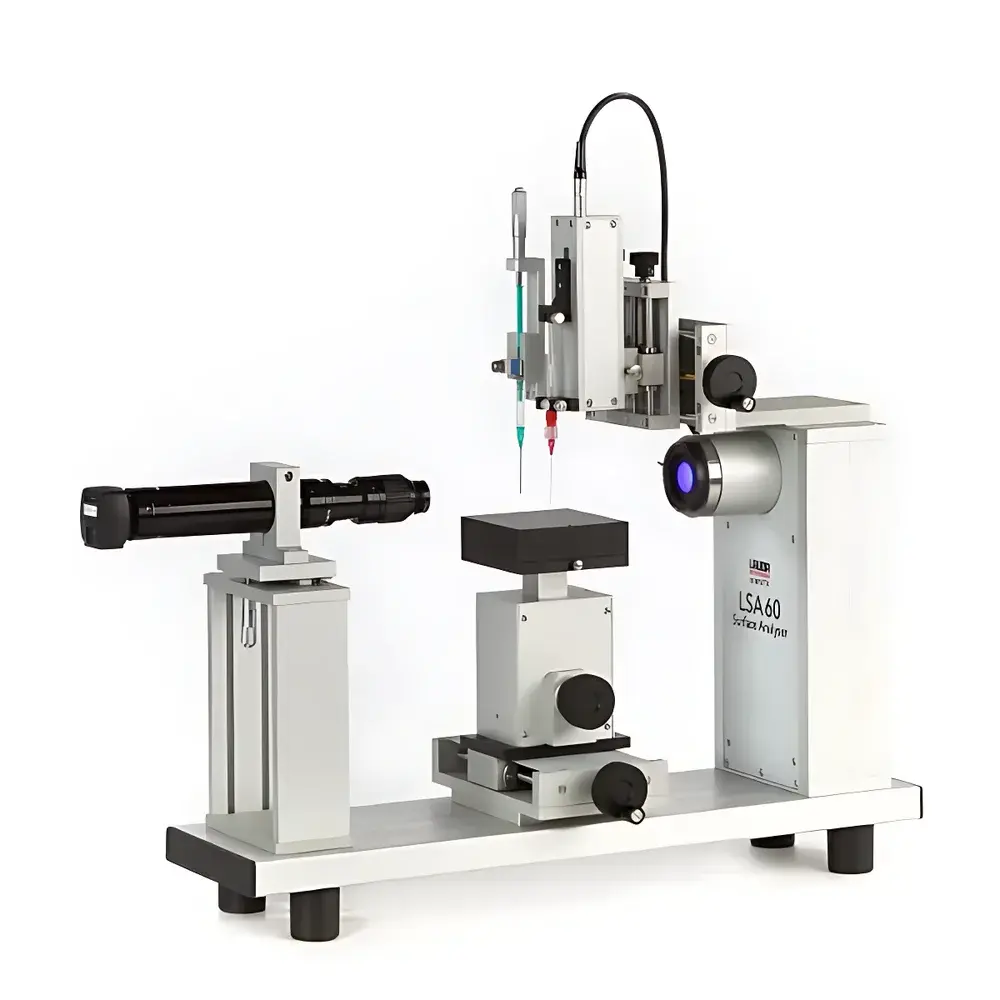
LAUDA Scientific LSA60T Video-Based Optical Contact Angle Analyzer
| Brand | LAUDA Scientific |
|---|---|
| Origin | Germany |
| Model | LSA60T |
| Instrument Type | Benchtop Video Optical Contact Angle Analyzer |
| Contact Angle Measurement Range | 0–180° |
| Contact Angle Accuracy | ±0.1° |
| Contact Angle Resolution | 0.01° |
| Surface/Interfacial Tension Range | 0.01–2000 mN/m |
| Surface/Interfacial Tension Accuracy | 0.01 mN/m |
| Sample Stage Dimensions | 100 × 100 mm |
| Maximum Sample Load | 12 kg |
| Maximum Sample Dimensions (L × W × H) | ∞ × 240 × 76 mm |
| Tilting Stage Range | 0–100° |
| Tilting Speed | 0.05–7 °/s |
| Optical System | 1.3× Zoom Lens (standard), 752 × 480 px @ 60 fps, FOV: 8.5 × 5.3 to 10.5 × 6.6 mm |
| Illumination | Adjustable High-Uniformity LED Cold Light Source |
| Power Supply | 110/240 V, 50/60 Hz, 90 W |
| Base Dimensions & Weight | 600 × 160 × 517 mm, 15 kg |
Overview
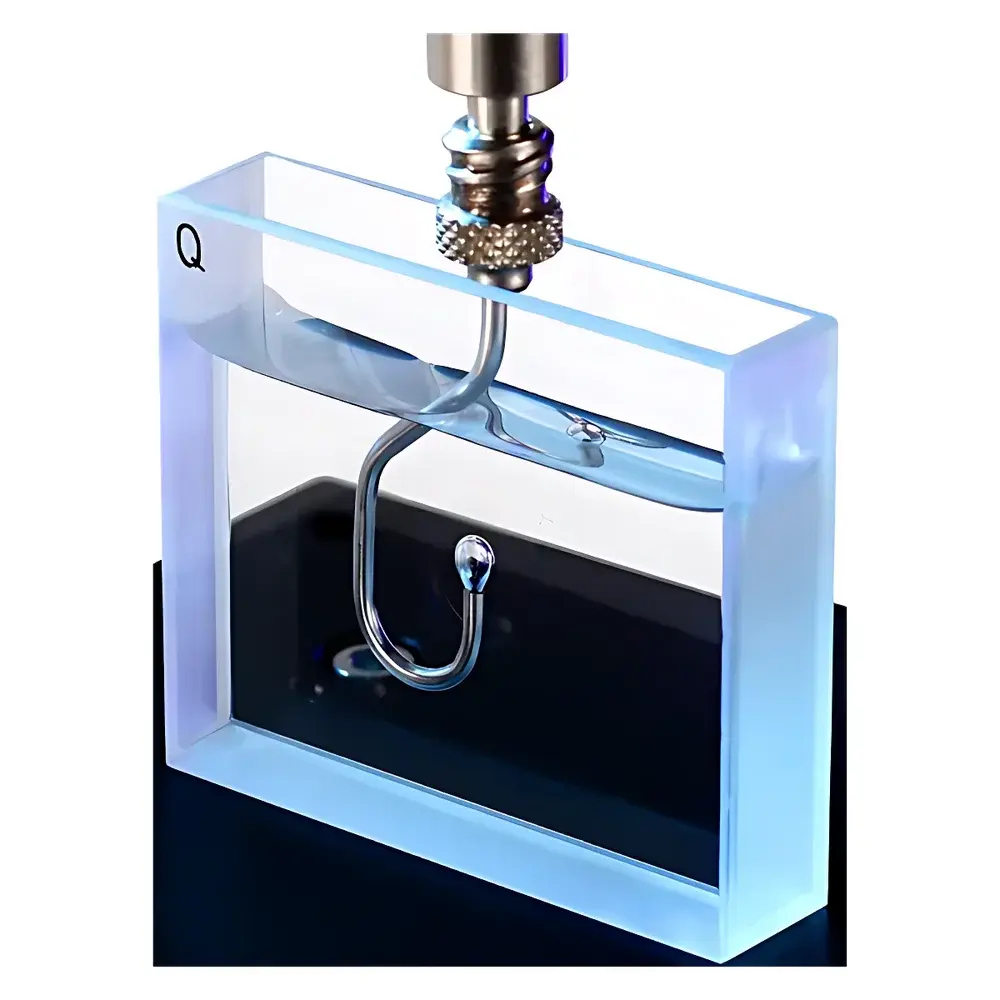
The LAUDA Scientific LSA60T is a benchtop video-based optical contact angle analyzer engineered for high-precision quantification of interfacial phenomena at solid–liquid and liquid–liquid boundaries. It operates on the principle of sessile drop analysis, where high-resolution digital imaging captures the silhouette of a liquid droplet deposited on a solid substrate; advanced edge-detection algorithms then compute contact angle values based on geometric fitting (e.g., Young–Laplace or circle/ellipse fitting). The system further supports dynamic measurements—including advancing/receding angles via automated liquid dosing—and interfacial tension determination using pendant drop or constrained drop methods. Designed in accordance with ISO 19403 (Contact Angle Measurement) and ASTM D7334 (Surface Wettability of Coated Surfaces), the LSA60T delivers traceable, reproducible results suitable for GLP-compliant laboratories and regulated industrial environments.
Key Features
- Benchtop modular architecture with rigid aluminum base and vibration-damped optical platform for stable image acquisition
- Standard 1.3× zoom optical lens with motorized focus control, delivering consistent magnification across variable working distances; optional 6.5× zoom and high-speed camera modules available for microfluidic or rapid wetting kinetics studies
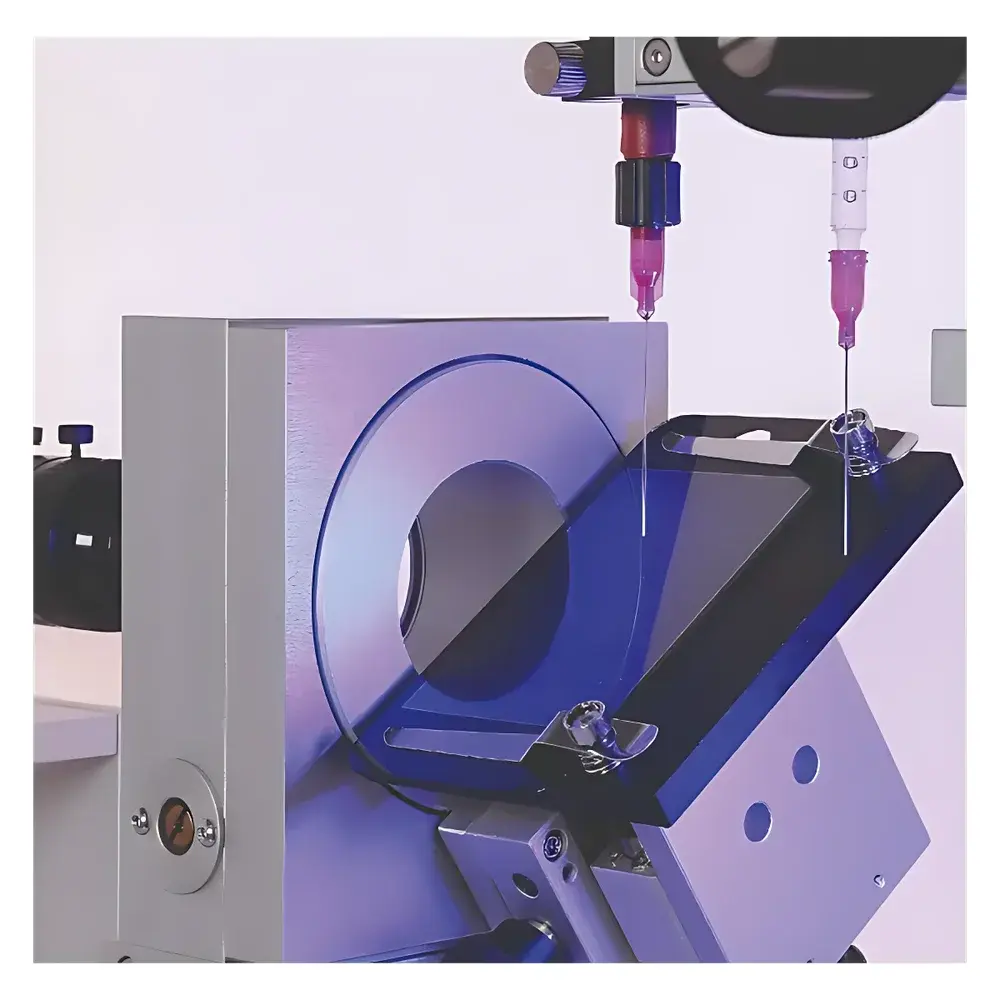
- Motorized precision tilting stage (0–100°, resolution 0.01°, speed 0.05–7 °/s) enabling automated roll-off angle and hysteresis analysis per ISO 27448
- Adjustable high-uniformity LED cold light source with software-controlled intensity modulation to minimize thermal drift and sample heating
- Integrated high-frame-rate camera (60 fps at 752 × 480 px) synchronized with dispensing units for time-resolved contact angle evolution (e.g., absorption into powders or porous media)
- Comprehensive surface energy module implementing Owens–Wendt, Wu, van Oss–Chaudhury–Good, and Fowkes models—each requiring user-defined reference liquid surface tension components (γL, γLd, γLp) per ASTM D7490
Sample Compatibility & Compliance
The LSA60T accommodates a broad range of sample geometries and material classes: flat substrates up to 240 mm wide and 76 mm tall (length unrestricted), including wafers, polymer films, coated metals, textiles, and biological membranes. Its 100 × 100 mm motorized XY stage supports precise positioning under the optical axis. For powdered or granular samples, the system enables Washburn-type capillary rise analysis using vertical sample holders and time-lapse imaging. All measurement protocols align with international standards governing surface characterization: ISO 19403-1 to -4 (contact angle), ISO 1409 (interfacial tension), and USP for analytical instrument qualification in pharmaceutical QC labs. Data integrity complies with FDA 21 CFR Part 11 requirements when used with validated SCA20 software configurations featuring electronic signatures and audit trails.
Software & Data Management
Controlled by LAUDA’s SCA20 software suite (Windows 10/11 compatible), the LSA60T provides fully automated workflows—from droplet deposition and image capture to multi-point contact angle mapping and statistical reporting. The software includes batch processing for repetitive measurements, customizable report templates (PDF/Excel export), and raw image archiving with metadata (timestamp, environmental conditions, operator ID). Advanced modules support real-time curve fitting (Young–Laplace iteration), dynamic contact angle modeling (e.g., exponential decay fitting for absorption kinetics), and surface energy component decomposition with uncertainty propagation. All data files are stored in vendor-neutral HDF5 format, ensuring long-term accessibility and third-party analysis compatibility (e.g., MATLAB, Python pandas).
Applications
- Quality assurance of hydrophobic/hydrophilic coatings in automotive, aerospace, and medical device manufacturing
- Surface modification evaluation of plasma-treated polymers, ALD-grown thin films, and nanocomposite membranes
- Formulation development in agrochemicals and personal care products—assessing surfactant efficacy, spreading coefficients, and emulsion stability
- Research on biomaterial wettability (e.g., cell-adhesive surfaces, antifouling hydrogels) per ISO 10993-6 biocompatibility guidelines
- Characterization of porous electrodes and separators in battery R&D, including electrolyte wettability and capillary penetration rate
- Regulatory testing for ASTM D5725 (coating wettability), ISO 8510-2 (adhesion prediction), and DIN 53364 (surface energy of plastics)
FAQ
What standard calibration procedures does the LSA60T support?
The system includes certified reference slides (e.g., PTFE, silicon wafer, glass) with traceable contact angle values; users perform routine verification using distilled water and diiodomethane per ISO 19403-2.
Can the LSA60T measure contact angles on curved or irregular surfaces?
Yes—via XYZ motorized stage alignment and software-based perspective correction; however, quantitative accuracy requires curvature radius >5 mm and surface roughness <Ra 0.8 µm.
Is the SCA20 software compliant with 21 CFR Part 11 for pharmaceutical use?
When deployed in a validated configuration (with role-based access control, electronic signatures, and immutable audit logs), SCA20 meets Part 11 requirements for electronic records and signatures.
How is interfacial tension determined without a tensiometer?
Using pendant drop analysis: the software fits the droplet contour to the Young–Laplace equation, extracting interfacial tension from shape deformation under gravity—validated against Du Noüy ring and Wilhelmy plate methods per ISO 1409.
Does the system support environmental control options?
Yes—optional temperature-controlled stages (−20 to 120 °C) and humidity chambers (10–95% RH) integrate seamlessly with SCA20 for climate-dependent wettability studies.



