LaVision DaVis-Pressure Software Package
| Brand | LaVision GmbH |
|---|---|
| Country of Origin | Germany |
| Model | DaVis-Pressure |
| Software Type | PIV/PTV-Based Pressure Field Reconstruction Software |
| Compliance | Designed for ISO/IEC 17025-aligned laboratory environments, supports audit-ready data provenance in GLP/GMP contexts |
Overview
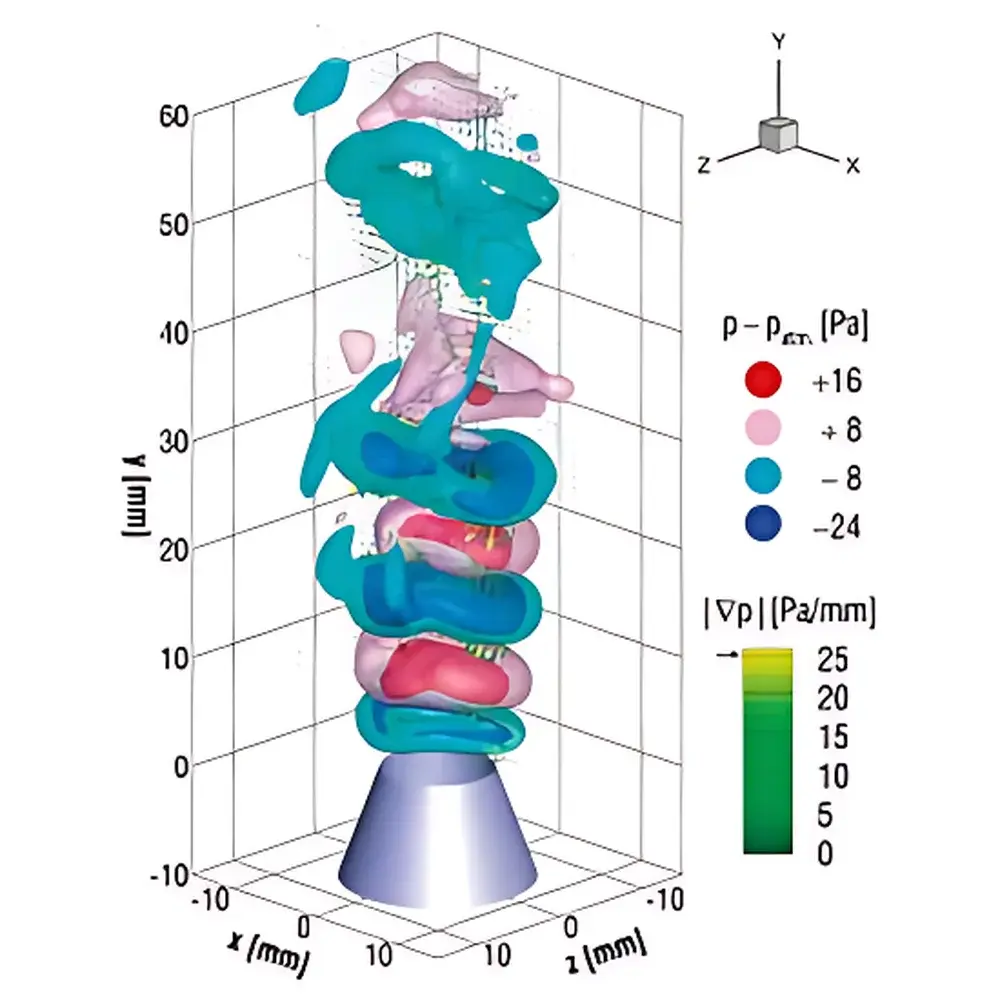
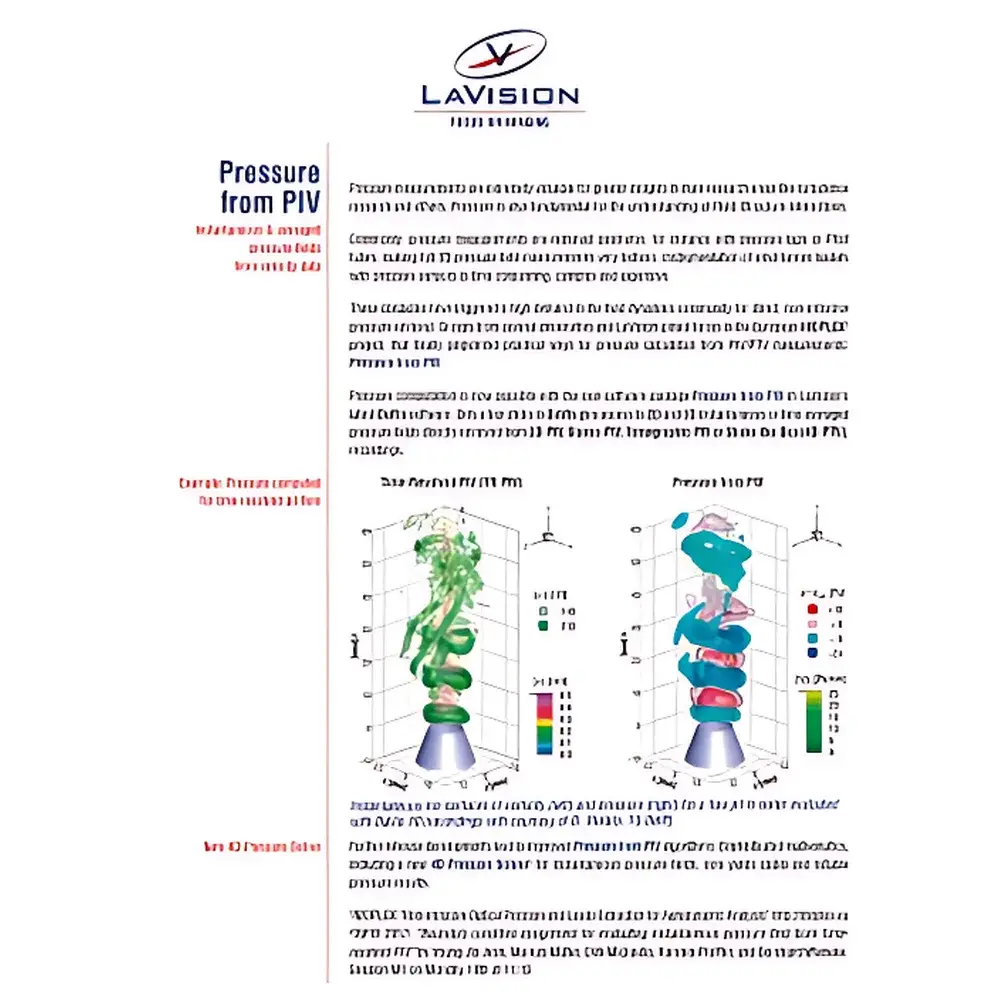
LaVision DaVis-Pressure is a specialized scientific software module integrated within the DaVis 10 platform, engineered to reconstruct quantitative pressure fields—both time-averaged and instantaneous—from particle image velocimetry (PIV) and particle tracking velocimetry (PTV), including Shake-the-Box (4D-PTV) datasets. Unlike conventional point-wise pressure measurement techniques (e.g., static pressure taps, Kulite sensors, or Pitot-static probes), DaVis-Pressure enables non-intrusive, volumetric pressure estimation across entire fluid domains without physical sensor placement. Its underlying methodology solves the pressure Poisson equation derived from the Navier–Stokes momentum equations, using measured velocity gradients as input. This approach is grounded in fundamental fluid dynamics and has been rigorously validated through benchmark cases including laminar jets, turbulent boundary layers, and vortex-dominated flows. The software was co-developed under the European NIOPLEX project—a collaborative initiative involving TU Delft, ETH Zurich, and other academic partners—to establish robust, experimentally viable pathways for pressure inference in complex unsteady flows.
Key Features
- Full 2D and 3D pressure field reconstruction from both steady-state and time-resolved PIV/PTV velocity data
- Proprietary 4D Pressure Solver that enforces temporal continuity across spatio-temporal data blocks, minimizing unphysical oscillations and boundary condition sensitivity
- Automatic propagation of pressure solutions between successive 4D blocks—user-defined boundary conditions required only for the first time step of the initial block
- Tight integration with DaVis 10 workflow: seamless import of native DaVis velocity fields or third-party velocity data in HDF5, TIFF stack, or ASCII formats
- GPU-accelerated solvers for accelerated computation of large-scale 3D time series (e.g., 100+ volumes at 1024³ resolution)
- Uncertainty quantification framework based on velocity gradient error propagation, supporting traceable uncertainty reporting per pixel/voxel
- Export capabilities compliant with HDF5, VTK, and ParaView-compatible formats for post-processing and multi-software interoperability
Sample Compatibility & Compliance
DaVis-Pressure accepts velocity inputs from all standard PIV configurations—including micro-PIV, stereo-PIV, tomographic PIV (Tomo-PIV), and high-speed 4D-PTV—and supports both planar and volumetric acquisition geometries. It accommodates data acquired under diverse experimental conditions: water channels, wind tunnels, combustion rigs, and microfluidic devices. The software complies with principles outlined in ISO/IEC 17025:2017 (Clause 7.7 on data control) and supports traceable data lineage required for GLP and GMP-regulated laboratories. While not a standalone FDA 21 CFR Part 11-compliant system, it operates within DaVis 10’s secure user-role architecture, enabling electronic signatures, audit trails, and version-controlled analysis scripts when deployed on validated IT infrastructure.
Software & Data Management
DaVis-Pressure operates exclusively as a licensed module within the DaVis 10 ecosystem. All processing steps—including preprocessing, pressure solver configuration, post-processing filtering, and visualization—are logged automatically in DaVis’ embedded metadata framework. Each pressure result file retains full provenance: timestamp, operator ID, DaVis version, solver parameters (e.g., regularization strength, divergence correction method), and source velocity dataset hash. Batch processing is supported via Python scripting interface (DaVis Scripting API), allowing automation of parameter sweeps, sensitivity studies, or routine QA/QC workflows. Exported pressure fields include calibrated units (Pa or kPa), spatial metadata (voxel size, origin), and optional uncertainty maps—ensuring compatibility with downstream CFD validation, statistical flow analysis, or machine learning training pipelines.
Applications
- Aerodynamic load mapping on scaled aircraft models and UAV components in low-speed wind tunnels
- Unsteady pressure distribution analysis in pulsatile cardiovascular flow phantoms and heart valve testing rigs
- Jet impingement and cavity resonance characterization in propulsion and thermal management systems
- Acoustic source localization via pressure gradient analysis in aeroacoustic experiments
- Validation of LES and DNS simulations using experimental pressure fields reconstructed from high-fidelity PTV data
- Non-intrusive pressure diagnostics in optically accessible internal combustion engines and scramjet test sections
FAQ
Does DaVis-Pressure require raw image data, or can it process exported velocity fields?
It processes velocity vector fields—either computed directly in DaVis or imported from external PIV/PTV tools—without requiring original camera images.
Is the 4D Pressure Solver compatible with irregular or moving domains?
Yes; the solver accommodates deforming domains via Lagrangian mapping of particle trajectories and supports domain masking for complex geometries.
Can pressure results be exported for use in ANSYS Fluent or OpenFOAM?
Yes—VTK and HDF5 exports include structured/unstructured grid definitions and are routinely ingested into commercial and open-source CFD platforms for hybrid simulation-experiment workflows.
What level of computational hardware is recommended for large 3D time-series analysis?
A workstation with ≥64 GB RAM, NVIDIA A100 or RTX 6000 Ada GPU, and ≥2 TB NVMe storage is recommended for optimal throughput on datasets exceeding 50 time-resolved Tomo-PIV volumes.
Is technical support and solver validation documentation provided with the license?
Yes—LaVision supplies application notes, verification cases (e.g., analytical Couette flow, DNS-based validation), and remote expert support for method implementation and uncertainty assessment.
Related Products