
LaVision FlameMaster Raman Imaging System
| Brand | LaVision GmbH |
|---|---|
| Origin | Germany |
| Model | FlameMaster Raman |
| Instrument Type | Grating-Based Raman Spectrometer |
| Spectral Range | 300–800 nm |
| Spectral Resolution | 1 cm⁻¹ |
| Spatial Resolution | 1 mm |
| Minimum Wavenumber Shift | 10 cm⁻¹ |
| Spectral Reproducibility | ±0.15 cm⁻¹ |
Overview
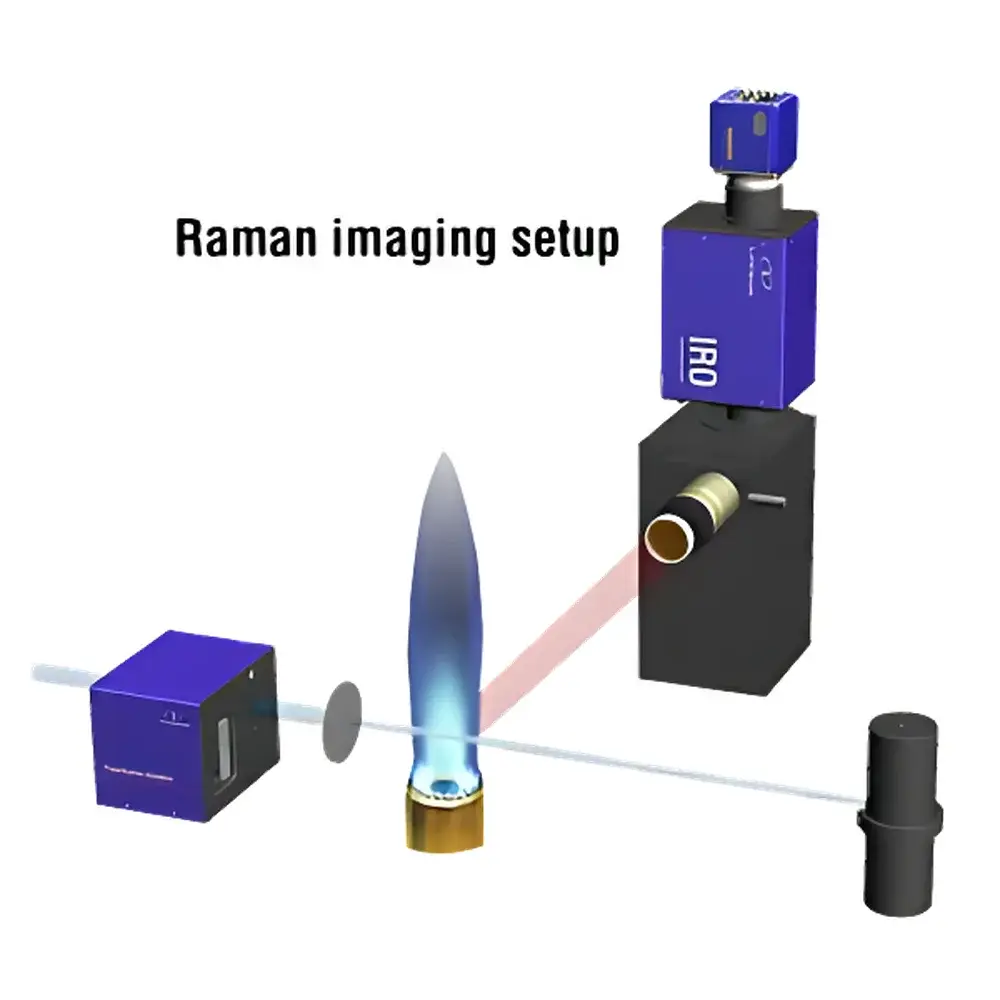
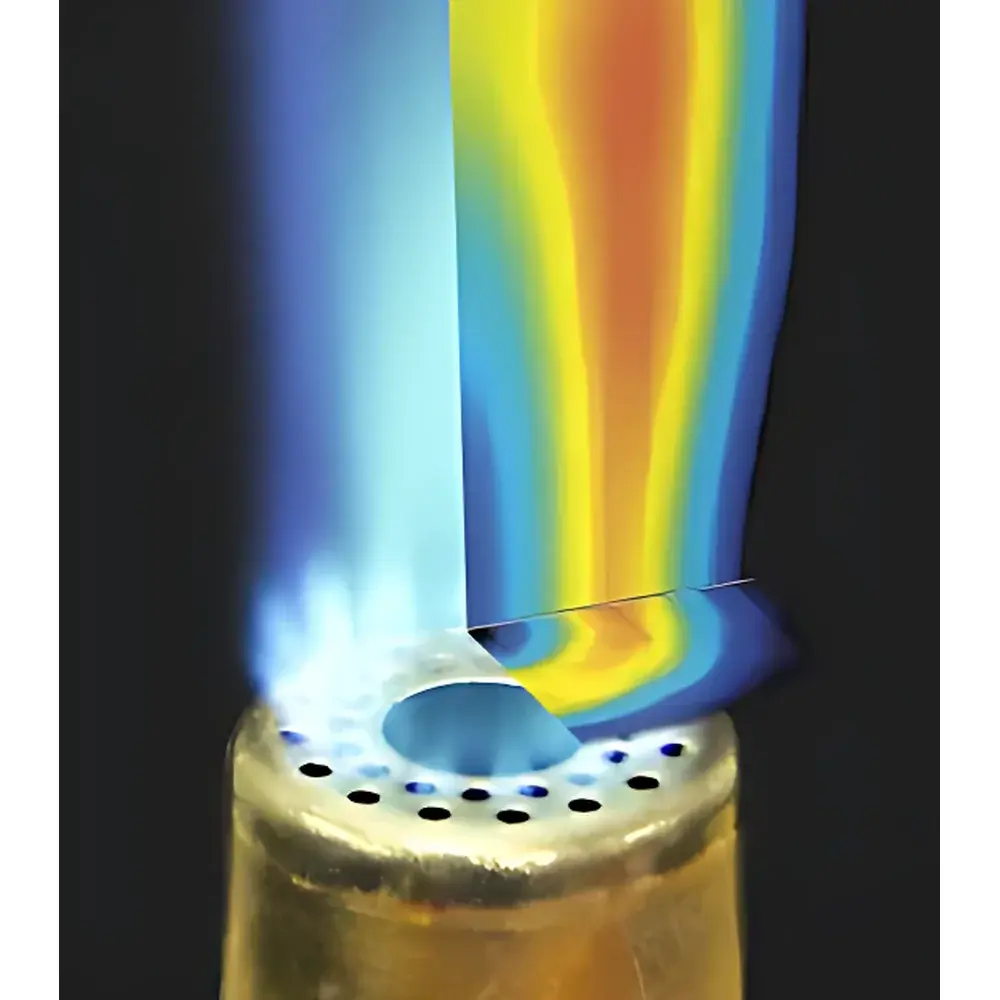
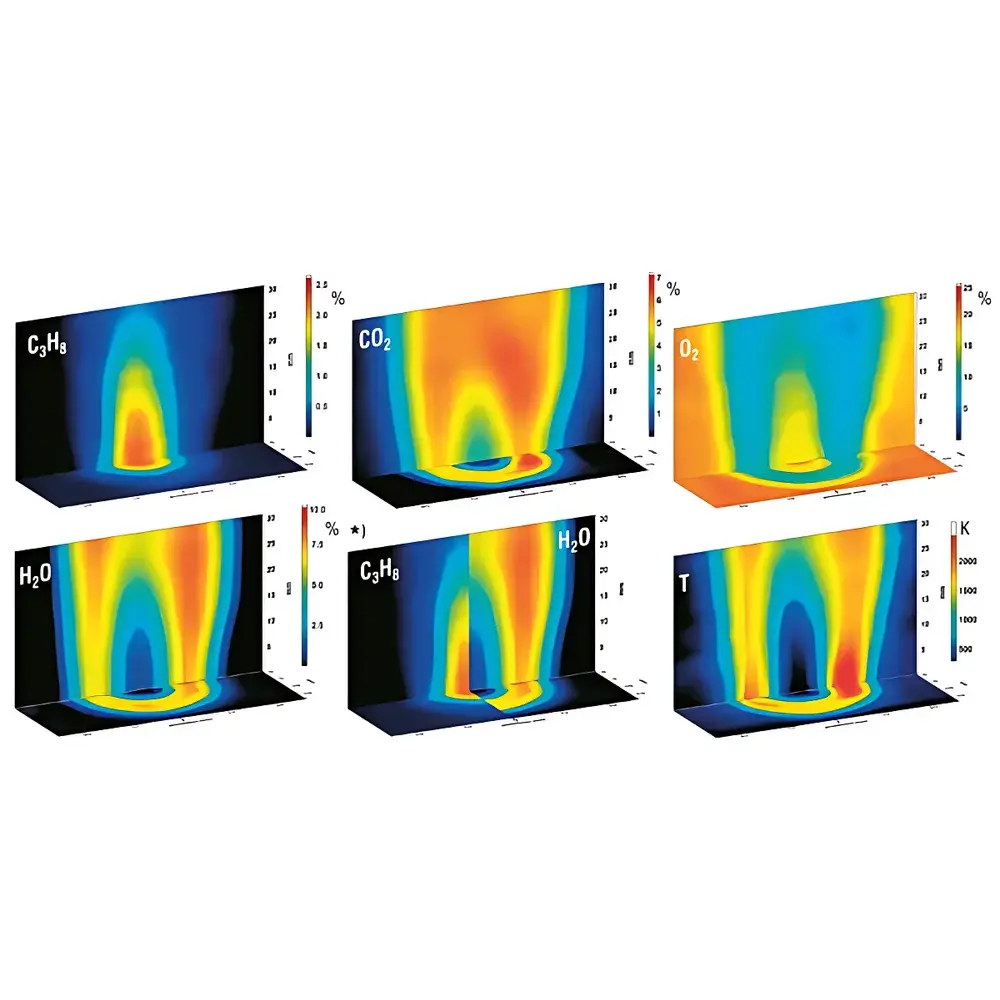
The LaVision FlameMaster Raman Imaging System is a high-precision, line-imaging Raman spectroscopy platform engineered for quantitative, spatially resolved combustion diagnostics. It operates on spontaneous Raman scattering principles—where monochromatic laser light interacts with molecular vibrational modes—to simultaneously resolve concentration distributions of major flame species (e.g., C₃H₈, O₂, CO₂, H₂O) and rotational Raman thermometry-derived temperature fields along a laser line focus. Unlike point-scanning or broadband approaches, the system captures full spectral information across a 1D line (typically 10–30 mm in length) in a single exposure, enabling rapid acquisition of 2D planar or 3D volumetric reconstructions via precise motorized translation of the line focus through the flame volume. Its design adheres to fundamental requirements of quantitative optical diagnostics: high spectral fidelity, calibrated radiometric response, and robust signal-to-noise performance under turbulent, luminous, and transient combustion conditions.
Key Features
- Simultaneous multi-species and temperature imaging: Captures Raman spectra from all dominant combustion intermediates and products within a single acquisition frame.
- Line-focused excitation geometry: Enables high spatial resolution (1 mm) across the measurement plane without sacrificing signal throughput or temporal resolution.
- Grating-based spectrometer architecture: Optimized for high throughput and low stray light, supporting spectral resolution of 1 cm⁻¹ across the 300–800 nm detection window.
- Low wavenumber capability: Operational down to 10 cm⁻¹ enables access to rotational Raman bands critical for accurate gas-phase thermometry.
- Integrated calibration suite: Includes NIST-traceable wavelength and intensity calibration sources, ensuring long-term spectral reproducibility (±0.15 cm⁻¹) and quantitative cross-comparison between experiments.
- Modular optical interface: Compatible with standard LaVision high-speed ICCD and sCMOS detectors, as well as tunable pulsed lasers (e.g., Nd:YAG harmonics, dye lasers) for optimal excitation wavelength selection.
Sample Compatibility & Compliance
The FlameMaster Raman system is designed for non-intrusive, in-situ measurements in atmospheric and pressurized laminar and turbulent flames—including Bunsen burners, swirl-stabilized combustors, and spray flames. It supports operation in environments with moderate soot loading and background chemiluminescence when combined with appropriate notch filtering and gated detection. All optical components comply with DIN EN ISO 10110 surface quality standards; mechanical stages meet ISO 9283 repeatability specifications. The system architecture supports GLP-compliant data acquisition workflows, including metadata embedding (laser energy, integration time, grating position, calibration timestamps) and audit-trail-enabled software logging per FDA 21 CFR Part 11 requirements when deployed with validated LaVision DaVis software configurations.
Software & Data Management
Data acquisition, preprocessing, and quantification are executed using LaVision’s DaVis 10.5+ software platform. The Raman-specific module includes automated spectral alignment, background subtraction (polynomial and morphological), multivariate curve resolution (MCR) for overlapping band deconvolution, and physics-based fitting routines for rotational Raman thermometry. All raw hyperspectral line images (λ × x × t) are stored in HDF5 format with embedded SI-unit metadata. Batch processing pipelines support calibration propagation, uncertainty estimation (based on photon statistics and calibration residuals), and export to standardized formats (e.g., NetCDF, CSV) for integration with CFD post-processing tools such as Tecplot, ParaView, or OpenFOAM. Software validation documentation—including IQ/OQ protocols—is available upon request for regulated laboratory environments.
Applications
- Quantitative validation of turbulent combustion CFD models via 2D/3D species and temperature field comparison.
- Investigation of flame stabilization mechanisms in lean-premixed and MILD combustion regimes.
- Time-resolved analysis of ignition transients and extinction events in lifted flames.
- Multi-parameter optimization of burner geometries and fuel-air mixing strategies.
- Intercomparison studies with complementary techniques (e.g., OH-LIF, CH* chemiluminescence, PLIF of NO) within the same experimental campaign.
- Development and verification of reduced kinetic mechanisms for surrogate fuels (e.g., propane, methane, Jet-A surrogates).
FAQ
What laser wavelengths are compatible with the FlameMaster Raman system?
The system is optimized for 532 nm excitation but supports 355 nm, 266 nm, and tunable visible outputs (450–650 nm) via interchangeable optics and dispersion gratings.
Can the system resolve minor species such as NO or OH?
No—FlameMaster Raman is designed for major species (≥1% mole fraction). Trace radicals require resonance-enhanced techniques such as LIF or CRDS.
Is vacuum or purging required for low-wavenumber measurements?
Purging with dry nitrogen or argon is recommended below 200 cm⁻¹ to minimize atmospheric CO₂/H₂O interference; vacuum operation is not required.
How is temperature calculated from Raman spectra?
Temperature is derived from the intensity ratio of rotational Raman Q-branch lines of N₂ (or O₂), fitted using precomputed synthetic spectra based on HITRAN line lists and quantum-mechanical partition functions.
Does the system support real-time processing?
Spectral fitting and species mapping are post-acquisition; however, line-integrated peak intensities can be monitored in real time via DaVis’ live ROI analysis mode.
Related Products




