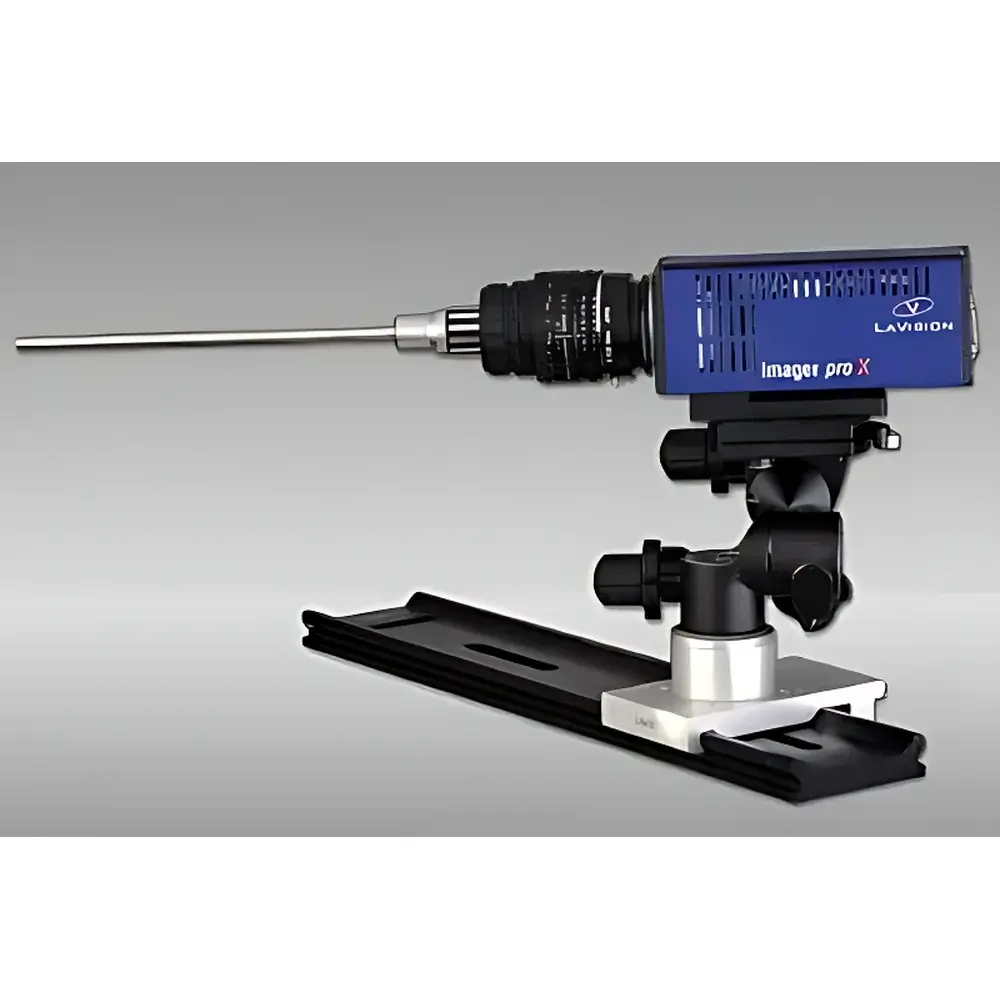
LaVision FlowMaster®-Endo Endoscopic Particle Image Velocimetry System
| Brand | LaVision GmbH |
|---|---|
| Origin | Germany |
| Model | FlowMaster®-Endo |
| Measurement Domain | Planar (2D/3D) |
| Velocity Range | 0–2 km/s |
| Accuracy | ±1% of reading |
| Field of View | Up to 1 m × 1 m |
| Frame Rate | Low-frequency acquisition (typically < 100 Hz for high-resolution endoscopic configurations) |
| Optical Bandpass | Visible to UV (193–700 nm) |
| Compliance | Designed for integration with ASTM E2847, ISO 20456, and GLP/GMP-aligned experimental workflows |
Overview
The LaVision FlowMaster®-Endo Endoscopic Particle Image Velocimetry (PIV) System is an engineered solution for non-intrusive, high-fidelity velocity field measurement inside geometrically constrained or optically inaccessible fluid domains. Unlike conventional PIV systems requiring full optical access via transparent windows or scaled glass models, the FlowMaster®-Endo employs rigid or flexible endoscopic imaging and illumination pathways—enabling quantitative flow characterization through apertures as small as 3 mm in diameter. The system operates on the fundamental principle of double-pulse laser sheet illumination synchronized with high-sensitivity CMOS camera acquisition, followed by cross-correlation analysis of seeded particle displacement between successive frames. Its core architecture supports both two-dimensional (2D) planar and stereoscopic three-dimensional (3D) velocity vector field reconstruction, making it particularly suitable for internal combustion engine cylinders, turbine blade passages, pump volutes, and biomedical flow chambers where structural integrity must be preserved.
Key Features
- Endoscope-integrated optical train: Compatible with LaVision’s proprietary rigid and flexible endoscopes featuring broadband transmission (193–700 nm), supporting both visible-light PIV and UV-excited Laser-Induced Fluorescence (LIF) for species-specific flow–chemistry coupling studies.
- Automated distortion correction: Embedded calibration routines within DaVis software perform pixel-level mapping and inverse distortion compensation for wide-angle endoscopic lenses, ensuring sub-pixel spatial fidelity across the entire interrogation window.
- Modular laser delivery: Integrated fiber-coupled Nd:YAG lasers (e.g., Litron Nano L series) provide tunable pulse energy and timing resolution for optimal seeding visibility and minimal motion blur—even at velocities up to 2 km/s.
- Ruggedized hardware interface: All optical components—including beam expanders, cylindrical lens arrays, and synchronizers—are rated for industrial environments and compatible with high-temperature, high-vibration test benches.
- Real-time preprocessing: On-the-fly image registration, background subtraction, and dynamic range optimization reduce post-processing latency and support iterative experimental refinement.
Sample Compatibility & Compliance
The FlowMaster®-Endo accommodates a broad spectrum of opaque or semi-opaque test sections without requiring major mechanical modification. It has been validated for use with metallic engine blocks, ceramic-coated combustors, polymer-based microfluidic devices, and pressurized hydraulic manifolds. Calibration adheres to ISO 20456:2018 (Optical methods—PIV—Requirements for uncertainty estimation) and supports traceable validation using NIST-traceable translation stages. For regulated research environments—including pharmaceutical process development and aerospace propulsion qualification—the system can be configured with audit-trail-enabled DaVis software compliant with FDA 21 CFR Part 11 requirements when deployed under documented GLP or GMP protocols.
Software & Data Management
Control, acquisition, and analysis are unified within LaVision’s DaVis 10.2+ platform—a modular, scriptable environment supporting Python and MATLAB APIs. Key capabilities include multi-camera synchronization (up to 4 channels), stereo PIV triangulation, time-resolved ensemble averaging, and export of velocity fields in HDF5, Tecplot PLT, and VTK formats. Raw image data is stored with embedded metadata (timestamp, laser energy, trigger delay, lens ID), enabling full experimental reproducibility. Optional modules include Dynamic Mode Decomposition (DMD) for coherent structure identification and machine-learning-assisted outlier detection for low-SNR endoscopic acquisitions.
Applications
- Internal combustion engine in-cylinder flow analysis: Quantification of tumble, swirl, and squish motions during intake/compression strokes.
- Turbomachinery secondary flow mapping: Visualization of tip-leakage vortices and passage vortices within axial compressor rotors.
- Biomedical fluid dynamics: Wall shear stress estimation in stented arterial segments using micro-PIV-compatible endoscopes.
- Chemical reactor hydrodynamics: Coupling with OH-LIF or CH* chemiluminescence for simultaneous velocity–reaction zone interrogation.
- Hydraulic component validation: Flow separation and cavitation onset detection in high-pressure fuel injectors and servo-valve spools.
FAQ
Can the FlowMaster®-Endo perform true 3D velocity measurements?
Yes—when equipped with dual-camera stereoscopic endoscopy and calibrated using LaVision’s self-calibrating target methodology, the system delivers full 3D3C (three-component, three-dimensional) velocity vectors with typical depth-of-field coverage of 5–20 mm depending on working distance and lens configuration.
Is UV-capable illumination included by default?
UV-grade fiber optics and quartz-transmissive endoscopes are available as optional configurations; standard systems operate in the visible band (400–700 nm), but all optical paths are UV-ready upon specification.
How is spatial resolution maintained given optical distortion from endoscopic lenses?
DaVis implements a two-stage correction: first, a polynomial-based distortion model derived from a single-plane calibration target; second, real-time interpolation using GPU-accelerated resampling kernels that preserve local correlation peak integrity during interrogation window shifting.
What seeding particle types are recommended for endoscopic PIV in high-temperature environments?
TiO₂-coated hollow glass spheres (1–5 µm), alumina nanoparticles, or Mie-scattering-compatible polymer microspheres are commonly used; LaVision provides application-specific seeding guidelines aligned with ASTM D7504 for thermal stability and optical contrast optimization.