
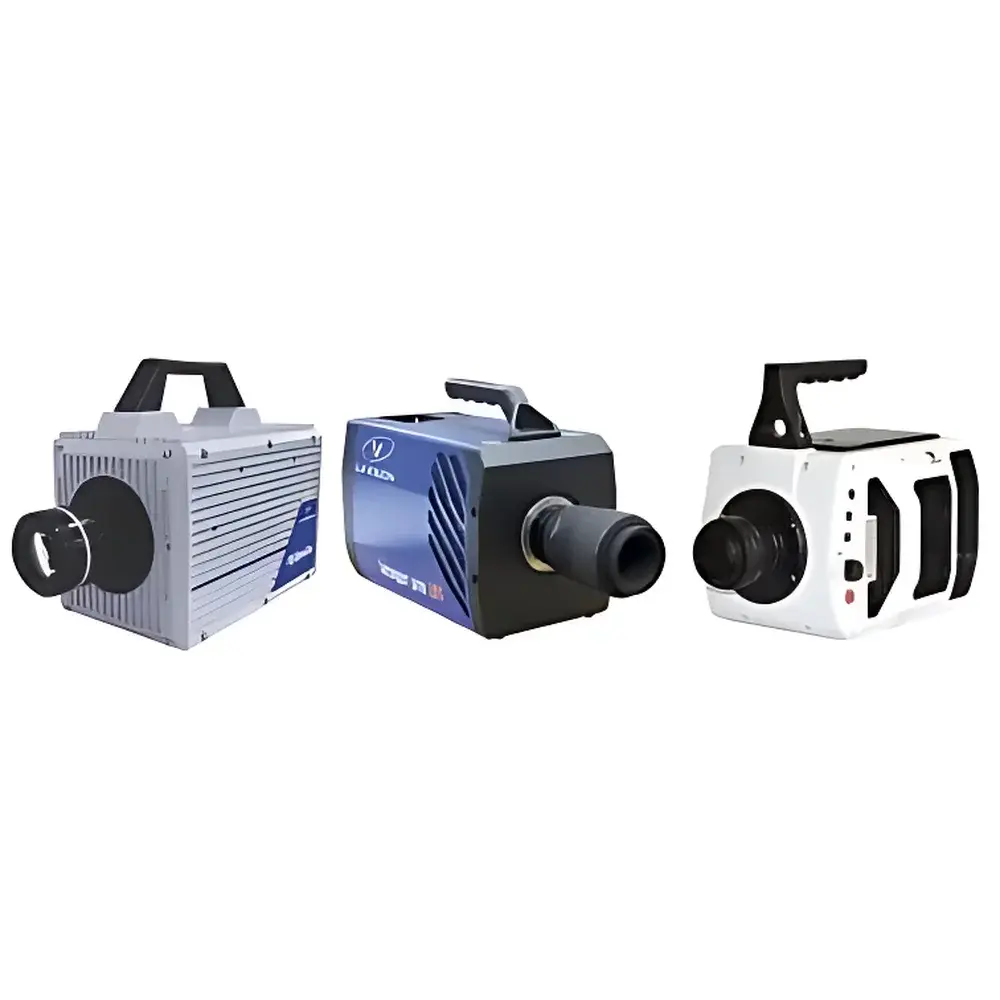
LaVision HighSpeedStar High-Speed CMOS Camera System
| Brand | LaVision GmbH |
|---|---|
| Origin | Germany |
| Model | HighSpeedStar |
| Effective Resolution | 2016 × 2016 pixels |
| Pixel Size | 11 µm |
| Max Full-Resolution Frame Rate | up to 22 kHz |
| Max Reduced-Resolution Frame Rate | up to 600 kHz+ |
| Intensifier Option | HS-IRO (lens-coupled, multi-stage MCP amplification) |
| Software Integration | Fully compatible with DaVis and PTU X control platforms |
Overview
The LaVision HighSpeedStar is a high-performance, modular CMOS-based high-speed imaging system engineered for quantitative scientific and industrial visualization applications where temporal resolution, spatial fidelity, and synchronization integrity are critical. Operating on the principle of ultra-fast electronic shuttering and on-chip analog-to-digital conversion, the HighSpeedStar captures transient phenomena—including combustion dynamics, shockwave propagation, fluid–structure interaction, and plasma evolution—with sub-microsecond temporal resolution. Its native 2016 × 2016 pixel sensor delivers true square-format imaging ideal for symmetric flow fields or rotational symmetry analysis, while the 11 µm pixel pitch ensures optimal balance between light collection efficiency and spatial sampling density. Unlike consumer-grade high-speed cameras, the HighSpeedStar is designed from the ground up for integration into metrology-grade experimental setups—supporting precise hardware triggering, deterministic exposure timing, and deterministic frame-to-frame latency essential for phase-locked acquisition in periodic processes such as internal combustion engine studies or laser-induced breakdown spectroscopy (LIBS).
Key Features
- High-fidelity 4 MP CMOS sensor with global shutter architecture, eliminating motion skew and enabling distortion-free capture of fast-moving objects.
- Scalable frame rate performance: up to 22,000 fps at full resolution (2016 × 2016), and >600,000 fps at reduced regions of interest (ROI), configurable via software-defined binning and subsampling.
- Native support for external trigger inputs (TTL, LVDS, optical) with jitter <50 ns, enabling synchronization with pulsed lasers, spark igniters, or encoder signals.
- Modular intensifier interface: optional lens-coupled High-Speed IRO (HS-IRO) provides gated image intensification with multi-stage microchannel plate (MCP) gain, sustaining high signal-to-noise ratio even at frame rates exceeding 100 kHz under low-light conditions.
- Fully integrated operation within LaVision’s DaVis software environment, including real-time preview, buffer management, and synchronized multi-camera acquisition across heterogeneous camera models (e.g., Phantom VEO, FASTCAM Mini UX100).
- Robust mechanical design compliant with ISO 10360-7 dimensional metrology mounting standards; includes M42 and C-mount lens interfaces with calibrated flange distance tolerance ≤ ±5 µm.
Sample Compatibility & Compliance
The HighSpeedStar is routinely deployed in laboratories adhering to ISO/IEC 17025-accredited test procedures and supports traceable calibration workflows per ASTM E2847 (Standard Practice for Calibration of High-Speed Imaging Systems). Its digital output conforms to Camera Link HS and CoaXPress 2.0 protocols, ensuring compatibility with industrial frame grabbers certified under CE, FCC Part 15, and RoHS directives. When configured with HS-IRO intensification, the system meets the minimum photon detection efficiency requirements specified in USP for time-resolved luminescence imaging and satisfies GLP-compliant audit trails when used with DaVis software operating under FDA 21 CFR Part 11 mode (electronic signatures, user access control, immutable acquisition logs).
Software & Data Management
Control, acquisition, and post-processing are unified through LaVision’s DaVis platform—a validated, scriptable environment supporting Python and MATLAB APIs. DaVis provides non-destructive raw data handling in HDF5 format with embedded metadata (exposure time, trigger delay, sensor temperature, ROI coordinates). Time-stamped frame headers comply with IEEE 1588 Precision Time Protocol (PTP) for distributed multi-sensor synchronization. All acquisition parameters are version-controlled and exportable as XML configuration profiles, facilitating method transfer between instruments and regulatory documentation (e.g., SOPs for automotive crash testing or aerospace turbine blade vibration analysis). Optional PTU X hardware controller enables deterministic sequencing of multi-pulse laser illumination synchronized to camera exposure windows with sub-100 ns accuracy.
Applications
- Combustion research: flame front propagation, ignition delay measurement, soot volume fraction mapping via two-color pyrometry.
- Ballistics and impact dynamics: projectile deformation, material fracture initiation, shockwave velocity profiling.
- Microfluidics and droplet dynamics: jet breakup, coalescence events, electrohydrodynamic instabilities.
- Turbomachinery diagnostics: blade tip clearance monitoring, cavitation inception detection in pump impellers.
- Laser-material interaction: ablation plume expansion, melt pool oscillation, keyhole formation in laser welding.
- Biomechanics: high-speed gait analysis, vocal fold vibration, insect wing kinematics.
FAQ
What is the maximum sustained frame rate at full resolution?
Up to 22,000 frames per second at 2016 × 2016 pixels, subject to thermal management and storage bandwidth constraints.
Can the HighSpeedStar be synchronized with other LaVision instruments?
Yes—via DaVis and PTU X, it supports hardware-level synchronization with PIV systems, PLIF lasers, and stereoscopic imaging heads with sub-microsecond timing precision.
Is the HS-IRO intensifier permanently attached?
No—the HS-IRO is a removable, lens-coupled module that can be disengaged for daylight-level imaging scenarios without compromising native sensor performance.
Does the system support third-party software integration?
Yes—through GenICam-compliant drivers and documented SDKs, enabling integration with LabVIEW, Python (OpenCV, NumPy), and custom C++ acquisition frameworks.
What calibration services are available?
LaVision offers NIST-traceable spatial calibration (pixel size, distortion), temporal calibration (exposure linearity, shutter lag), and photometric calibration (quantum efficiency, EM gain curve) as part of extended service contracts.





