
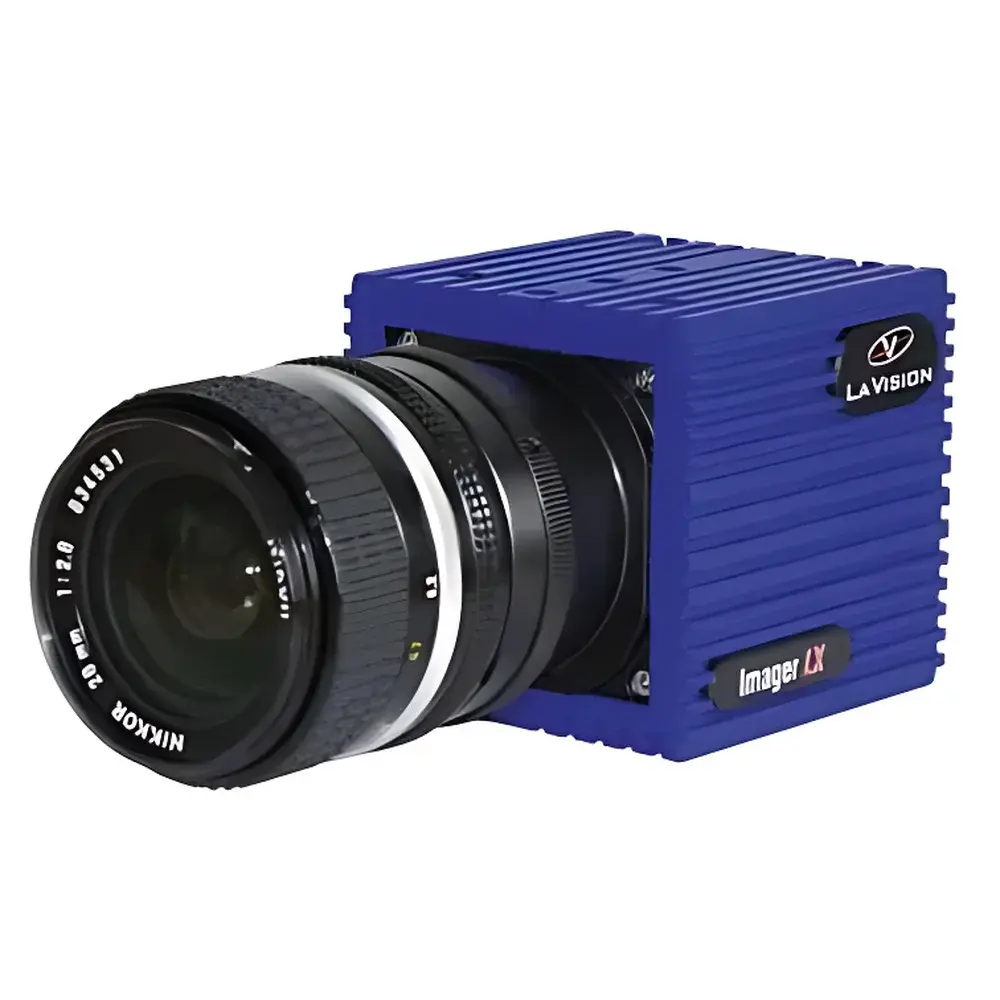
LaVision Imager LX Particle Image Velocimetry (PIV) Camera
| Brand | LaVision GmbH |
|---|---|
| Origin | Germany |
| Model | Imager LX |
| Sensor Type | Progressive Scan CCD |
| Resolution | 8–29 MP |
| Bit Depth | Up to 14-bit |
| Minimum Interframe Time | 0.3 µs |
| Interface | Gigabit Ethernet |
| Camera Form Factor | Compact Industrial Housing |
| Distribution Model | Authorized International Distributor (Imported) |
Overview
The LaVision Imager LX is a high-performance, scientific-grade Particle Image Velocimetry (PIV) camera engineered for quantitative fluid dynamics research and industrial flow diagnostics. Based on a progressive-scan CCD sensor architecture, the Imager LX captures temporally synchronized, high-fidelity double-frame or multi-frame image sequences essential for cross-correlation-based velocity vector field computation. Its design prioritizes spatial resolution, temporal precision, and signal fidelity—critical parameters in time-resolved PIV, micro-PIV, and stereoscopic PIV applications. The camera operates within a robust, thermally stable housing optimized for integration into laser-illuminated optical setups, including those employing Nd:YAG lasers with dual-pulse capability. With native support for sub-microsecond interframe timing and hardware-triggered acquisition, the Imager LX enables accurate measurement of rapid transient flows—from turbulent boundary layers to combustion dynamics—while maintaining strict synchronization with external light sources and motion control systems.
Key Features
- Progressive-scan CCD sensor delivering distortion-free, full-frame images without interlacing artifacts
- Selectable resolution modes ranging from 8 MP (3328 × 2504) to 29 MP (6576 × 4384), enabling flexible trade-offs between field-of-view coverage and pixel-level detail
- 14-bit digitization ensures high dynamic range (>72 dB) and low-noise performance for reliable intensity-based particle seeding contrast analysis
- Programmable interframe times as short as 0.3 µs—critical for resolving high-speed flows with minimal velocity ambiguity (Δt < 1 µs)
- Gigabit Ethernet interface (IEEE 802.3) providing deterministic, low-latency data transfer; compatible with standard industrial switches and real-time frame grabbers
- Fully programmable exposure control, gain adjustment, and ROI selection via LaVision’s DaVis software suite or third-party SDKs (C/C++, Python, LabVIEW)
- Compact mechanical footprint (120 × 120 × 90 mm) with integrated cooling and EMC-compliant shielding for stable operation in vibration-prone laboratory environments
Sample Compatibility & Compliance
The Imager LX is designed for use with standard PIV illumination configurations—including dual-cavity Nd:YAG lasers (e.g., 532 nm), continuous-wave lasers, and LED-based sheet illumination systems. It supports common tracer particle types (e.g., polystyrene latex, hollow glass spheres, oil droplets) sized between 0.5 µm and 100 µm, ensuring optimal scattering efficiency across visible and near-UV spectral bands. The camera complies with CE marking requirements under the EU Machinery Directive 2006/42/EC and Electromagnetic Compatibility Directive 2014/30/EU. Its firmware and hardware architecture are aligned with GLP and GMP-aligned experimental workflows, supporting audit-trail-enabled acquisition logs when used with DaVis v10+ and FDA 21 CFR Part 11-compliant configuration modules.
Software & Data Management
The Imager LX is natively integrated with LaVision’s DaVis software platform—a comprehensive PIV processing environment supporting real-time acquisition, preprocessing, correlation-based vector calculation (FFT, DFT, multipass window deformation), post-processing (vorticity, strain rate, turbulence statistics), and export to HDF5, TIFF, ASCII, and MATLAB formats. DaVis provides hardware-level synchronization tools for multi-camera stereo-PIV and tomographic PIV (Tomo-PIV) setups. All acquired metadata—including timestamp, exposure settings, trigger delays, and calibration parameters—is embedded directly into image headers. For custom automation, LaVision supplies a documented C++ API and Python bindings enabling integration into LabVIEW, MATLAB, or proprietary control frameworks while preserving full access to low-level sensor registers and timing registers.
Applications
- Aerodynamic characterization of airfoils, turbine blades, and vehicle underbody flows
- Combustion chamber diagnostics including flame-front propagation and mixing layer analysis
- Biofluid mechanics studies such as blood flow in vascular phantoms and respiratory airflow modeling
- Microfluidic device validation and lab-on-chip flow mapping at Reynolds numbers below 100
- Environmental fluid mechanics: sediment transport, plume dispersion, and wave–current interaction studies
- Industrial process optimization: spray atomization, injector flow fields, and mixing tank homogenization
FAQ
What is the maximum frame rate achievable with the Imager LX in double-frame PIV mode?
Frame rate depends on resolution and readout mode; at 8 MP full-frame, up to 15 Hz is attainable with 0.3 µs interframe delay and 1 ms total cycle time.
Does the Imager LX support external triggering and synchronization with laser pulse generators?
Yes—it features TTL-compatible input/output trigger ports with sub-microsecond jitter and programmable delay offsets for precise alignment with dual-pulse laser systems.
Can the camera be calibrated for stereo-PIV or volumetric reconstruction?
Yes—the Imager LX is fully compatible with LaVision’s Stereo-PIV calibration rigs and Tomo-PIV volume reconstruction pipelines using standard pinhole or Scheimpflug calibration procedures.
Is SDK documentation available for custom software development?
Yes—LaVision provides comprehensive C++ header files, Python examples, and API reference manuals under NDA for qualified academic and industrial partners.
What operating systems are supported for DaVis integration?
DaVis v10.x supports Windows 10/11 (64-bit) and select Red Hat Enterprise Linux distributions (RHEL 8/9) with certified GPU drivers.





