
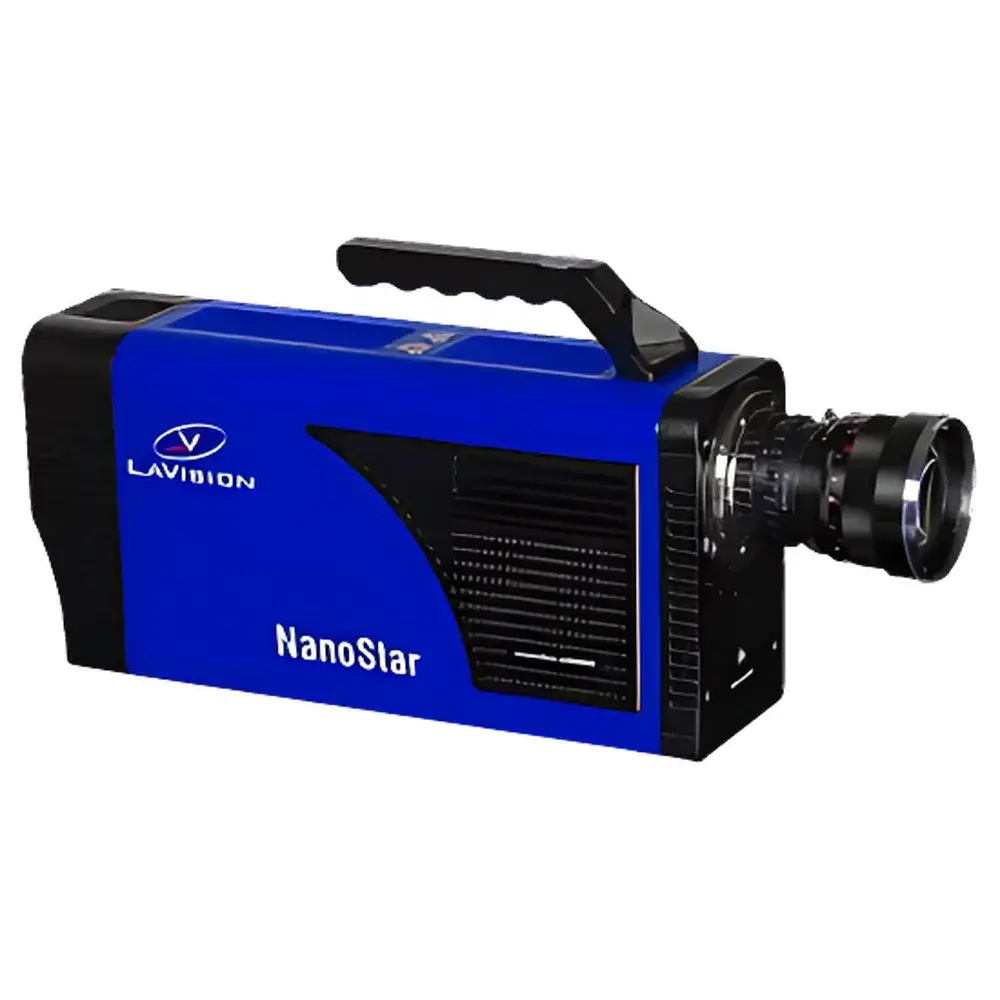
LaVision NanoStar Enhanced CCD Camera
| Brand | LaVision GmbH |
|---|---|
| Origin | Germany |
| Model | NanoStar |
| Sensor | 2048 × 2048 sCMOS, 16-bit |
| Frame Rate | 104 fps (full frame, 16-bit, uncompressed) |
| Exposure Time | 4 ns – 1 s |
| Image Intensifier | 25 mm aperture, high-resolution |
| Coupling | Optimized lens cascade coupling |
| Interface | Camera Link HS over fiber optic |
| Software Control | DaVis platform |
| Compliance | Designed for GLP/GMP- and ISO/IEC 17025-aligned laboratory environments |
Overview
The LaVision NanoStar Enhanced CCD Camera is a high-performance, ultrafast gated imaging system engineered for time-resolved scientific visualization in demanding optical diagnostics applications. Unlike conventional CCD or CMOS cameras, the NanoStar integrates a high-gain, low-noise 25 mm diameter image intensifier with a back-illuminated sCMOS sensor via an optimized multi-element lens cascade coupling architecture. This configuration preserves spatial resolution while enabling single-photon-level sensitivity and sub-nanosecond temporal gating—critical for applications such as laser-induced fluorescence (LIF), particle image velocimetry (PIV), chemiluminescence imaging, and plasma diagnostics. The camera operates on the principle of intensified charge-coupled detection: incident photons strike the photocathode of the image intensifier, generating photoelectrons that are accelerated and multiplied through a microchannel plate (MCP), then reconverted to visible light at the phosphor screen before being relayed onto the sCMOS sensor. This dual-stage amplification enables effective quantum efficiency exceeding 30% across the 200–900 nm spectral range, with minimal spatial distortion and excellent pulse-to-pulse reproducibility.
Key Features
- 2048 × 2048 pixel sCMOS sensor with true 16-bit dynamic range and <1.5 e⁻ read noise at full frame rate
- Gated exposure control from 4 nanoseconds to 1 second, programmable with ≤100 ps jitter
- 25 mm high-resolution image intensifier with P46 phosphor and GaAs photocathode option for extended NIR response
- Lens-coupled optical path ensures >75% photon transmission efficiency and <5% MTF degradation at Nyquist frequency
- Camera Link HS interface over fiber optic cable supports deterministic, zero-loss data streaming up to 104 fps at full resolution and bit depth
- Rugged aluminum housing with integrated thermal stabilization and EMI-shielded electronics for stable operation in pulsed-laser laboratories
- Hardware-triggered synchronization with external laser systems (TTL, LVDS, or optical trigger inputs)
Sample Compatibility & Compliance
The NanoStar is compatible with standard C-mount and F-mount optical train configurations and integrates seamlessly into LaVision’s modular diagnostic platforms—including PIV, PLIF, and Schlieren systems. Its optical coupling design accommodates both collimated and focused illumination geometries without requiring realignment when switching between intensifier gain settings. From a regulatory perspective, the system meets CE marking requirements for electromagnetic compatibility (EMC Directive 2014/30/EU) and low-voltage safety (LVD Directive 2014/35/EU). While not a medical device, its firmware architecture supports audit-trail logging and user-access controls required under ISO/IEC 17025:2017 for accredited testing laboratories. Data acquisition workflows comply with traceability standards recommended by ASTM E2912 and ISO 13571 for quantitative optical measurement systems.
Software & Data Management
The NanoStar is fully controlled through LaVision’s DaVis software platform—a modular, scriptable environment designed for synchronized multi-instrument experimentation. DaVis provides real-time preview, hardware-level exposure sequencing, and automated calibration routines including flat-field correction, dark-frame subtraction, and intensifier gain mapping. All acquired images are stored in HDF5 format with embedded metadata (timestamp, trigger delay, gain setting, laser energy monitor values), ensuring FAIR (Findable, Accessible, Interoperable, Reusable) data principles. The software supports batch processing pipelines compliant with FDA 21 CFR Part 11 requirements—including electronic signatures, role-based permissions, and immutable acquisition logs—making it suitable for regulated R&D environments in aerospace, combustion research, and pharmaceutical process analytics.
Applications
- Time-resolved planar laser-induced fluorescence (PLIF) for species concentration mapping in turbulent flames
- High-speed particle image velocimetry (PIV) in internal combustion engines and wind tunnels
- Ultrafast schlieren and shadowgraph imaging of shockwave propagation and detonation fronts
- Single-shot coherent anti-Stokes Raman scattering (CARS) imaging for thermometry in reactive flows
- Plasma emission imaging in fusion diagnostics and pulsed-power experiments
- Transient biofluorescence imaging in microfluidic reaction monitoring
FAQ
What is the minimum achievable gate width, and how is timing jitter managed?
The NanoStar achieves a nominal gate width of 4 ns, with RMS timing jitter below 100 ps when synchronized to an external laser trigger via LVDS input. Jitter performance is verified using calibrated streak camera cross-correlation.
Can the intensifier be operated in continuous gain mode, or is it strictly gated?
The image intensifier supports both gated (pulsed) and continuous (analog) operation modes; however, optimal signal-to-noise ratio and temporal resolution are achieved in gated mode with programmable delay and width.
Is fiber optic Camera Link HS cabling included, and what is the maximum supported cable length?
Standard delivery includes 10 m armored fiber optic Camera Link HS cable; custom lengths up to 300 m are available without signal degradation due to the differential serial architecture.
Does DaVis software support third-party hardware integration (e.g., lasers, DAQ systems)?
Yes—DaVis features open API (C++ and Python bindings), NI-DAQmx and LabVIEW driver support, and native synchronization protocols for major pulsed laser manufacturers including Quantel, Continuum, and Spectra-Physics.
What calibration documentation is provided with the system?
Each unit ships with NIST-traceable intensity responsivity calibration certificate, spatial uniformity map, and temporal response characterization report generated at LaVision’s certified metrology lab in Göttingen, Germany.





