
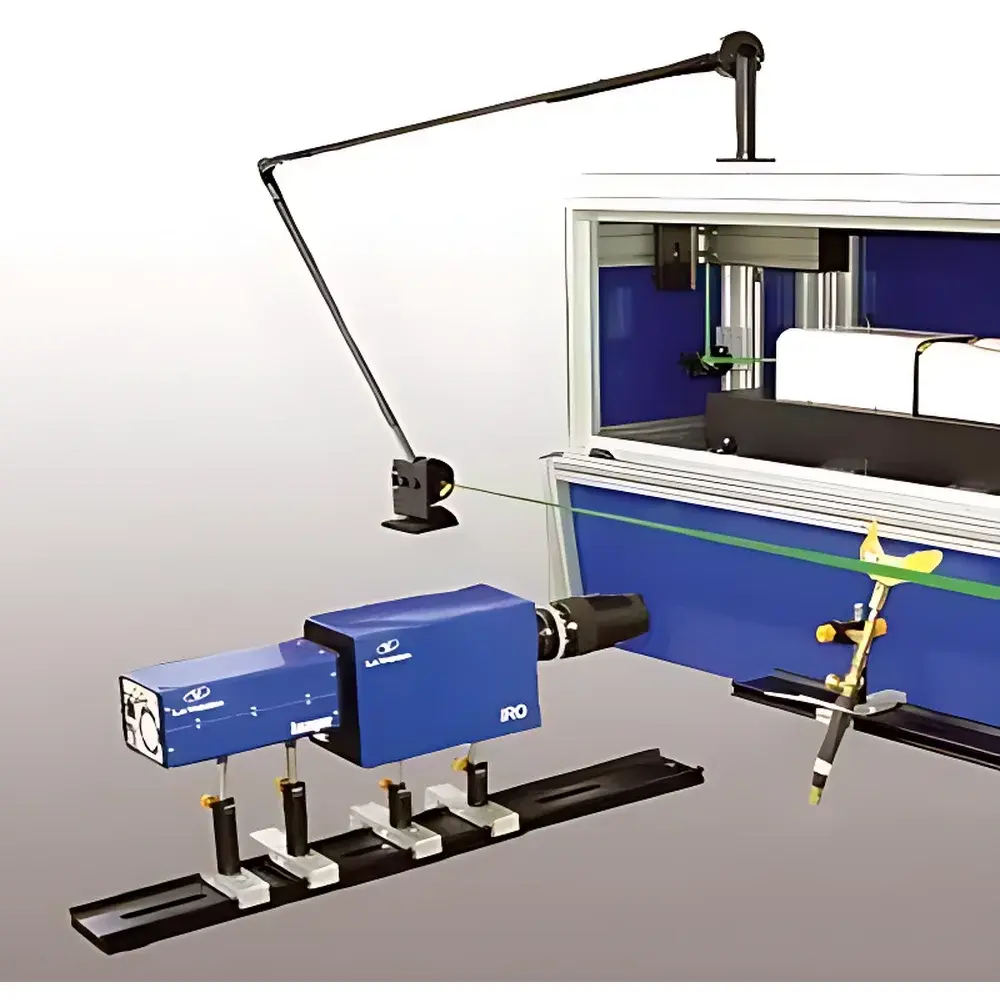
LaVision SootMaster Laser-Induced Incandescence (LII) Soot Imaging Analyzer
| Brand | LaVision GmbH |
|---|---|
| Origin | Germany |
| Model | SootMaster |
| Instrument Type | Continuous Emission Monitoring System (CEMS) for Soot |
| Application Domain | In-situ, time-resolved soot volume fraction and primary particle size distribution imaging in combustion flows |
Overview
The LaVision SootMaster is a turnkey, non-intrusive laser diagnostic system engineered for quantitative, spatially resolved measurement of soot volume fraction and primary particle size distribution in reactive and non-reactive gas-particle flows. It implements the physical principle of Laser-Induced Incandescence (LII), wherein short-pulse, high-peak-power laser light (typically 1064 nm Nd:YAG) illuminates a thin planar sheet within the measurement region. Soot particles absorb laser energy and are transiently heated to temperatures exceeding 4000 K—near their sublimation threshold—causing them to emit blackbody radiation in the visible and near-infrared spectrum. This incandescent emission is temporally gated and spectrally filtered to suppress elastic scattering and background luminescence, enabling robust quantification of soot concentration with minimal interference from flame chemiluminescence or thermal radiation from hot gases. Unlike gravimetric or filter-based sampling methods, LII provides instantaneous, two-dimensional field data without flow perturbation, making it suitable for transient engine cycles, turbulent flames, and industrial combustor diagnostics where temporal fidelity and spatial resolution are critical.
Key Features
- Real-time, planar imaging of soot volume fraction with spatial resolution down to 10 µm/pixel (system-dependent)
- Sub-10 ns temporal gating capability synchronized precisely with Q-switched laser pulses
- Integrated high-speed, thermoelectrically cooled CCD camera with programmable mechanical shutter and quantum efficiency >60% at 500–900 nm
- Customizable laser sheet optics—including cylindrical lens trains, beam homogenizers, and M² < 1.3 delivery—for uniform illumination and minimized optical aberrations
- Automated spectral filtering using narrowband interference filters (e.g., 550 ± 10 nm or 800 ± 20 nm) to isolate LII emission while rejecting Rayleigh/Mie scattering and OH* chemiluminescence
- Onboard image distortion correction via calibration with precision dot-grid targets and polynomial mapping algorithms compliant with ISO 10110-5
- Modular architecture supporting seamless integration with complementary techniques: PIV (particle image velocimetry), PLIF (planar laser-induced fluorescence) for OH/CH radicals, spontaneous Raman scattering for major species (O₂, N₂, CO₂), and emission spectroscopy
Sample Compatibility & Compliance
The SootMaster is validated for operation in high-temperature, high-pressure environments typical of internal combustion engines (diesel, GDI, HCCI), gas turbines, and laboratory-scale laminar/turbulent diffusion and premixed flames. It accommodates optical access through sapphire or fused silica windows rated up to 1000 °C and 20 bar. The system meets electromagnetic compatibility requirements per EN 61326-1 and laser safety standards IEC 60825-1 (Class 4 laser product). Data acquisition and analysis workflows support audit-trail functionality required under GLP and GMP frameworks. While not a certified CEMS under EPA Method 9 or EN 15267, the SootMaster is routinely deployed as a reference-grade research instrument for method development and validation of regulatory-compliant particulate monitoring systems. Calibration traceability follows NIST-traceable soot standards or line-of-sight extinction (LOS-E) referencing against calibrated photodiodes.
Software & Data Management
SootMaster software—built on LaVision’s DaVis platform—provides end-to-end control of laser triggering, camera exposure, filter wheel positioning, and image acquisition. It includes dedicated LII modules for automatic background subtraction, pixel-wise signal normalization, multi-wavelength ratio analysis (for primary particle sizing), and volumetric calibration using either reference aerosol generators or extinction-based scaling. All raw and processed images are stored in HDF5 format with embedded metadata (timestamp, laser energy, camera gain, filter ID, ROI coordinates). The software supports batch processing across hundreds of image pairs, statistical post-processing (mean, RMS, PDFs), and export to MATLAB, Python (via h5py), or CSV for third-party modeling (e.g., soot formation kinetics in Chemkin or OpenFOAM). Audit logs record all user actions, parameter changes, and calibration events—fully compliant with FDA 21 CFR Part 11 requirements when configured with electronic signatures and role-based access control.
Applications
- Time-resolved soot formation and oxidation dynamics in diesel and gasoline direct-injection engines across WLTC and RDE driving cycles
- Validation of soot modeling submodels (e.g., Method of Moments, Hybrid Method of Moments) in CFD simulations of gas turbine combustors
- Quantitative assessment of aftertreatment device efficiency (e.g., DPF regeneration kinetics, SCR-soot interactions)
- Fundamental studies of soot inception, surface growth, and aggregation in laminar coflow flames (e.g., ethylene, propane, biofuel surrogates)
- Industrial burner optimization for reduced PM emissions in cement kilns, waste incinerators, and steel reheating furnaces
- Development and verification of low-sooting alternative fuels (e.g., e-fuels, hydrogen-blended natural gas, sustainable aviation fuel blends)
FAQ
What is the minimum detectable soot volume fraction?
Detection limits depend on laser fluence, camera sensitivity, and integration time—but typically range from 1 × 10⁻⁸ to 5 × 10⁻⁷ (v/v) for single-shot acquisitions at 1 kHz repetition rate.
Can the system perform 3D soot reconstruction?
Yes—via sequential laser sheet scanning combined with tomographic reconstruction algorithms or stereoscopic LII using dual-camera configurations.
Is calibration required before each experiment?
Absolute calibration is performed during system commissioning using certified reference aerosols or extinction-based methods; routine checks use internal reference signals and laser energy monitoring.
Does the system support synchronization with engine position sensors or pressure transducers?
Yes—TTL-compatible trigger inputs accept crank-angle encoder signals, piezoelectric pressure pulses, or external function generator outputs for phase-locked averaging.
What maintenance is required for long-term operational stability?
Annual recalibration of laser energy meters and camera quantum efficiency; periodic inspection of optical coatings and alignment verification using HeNe alignment lasers.
Related Products







