
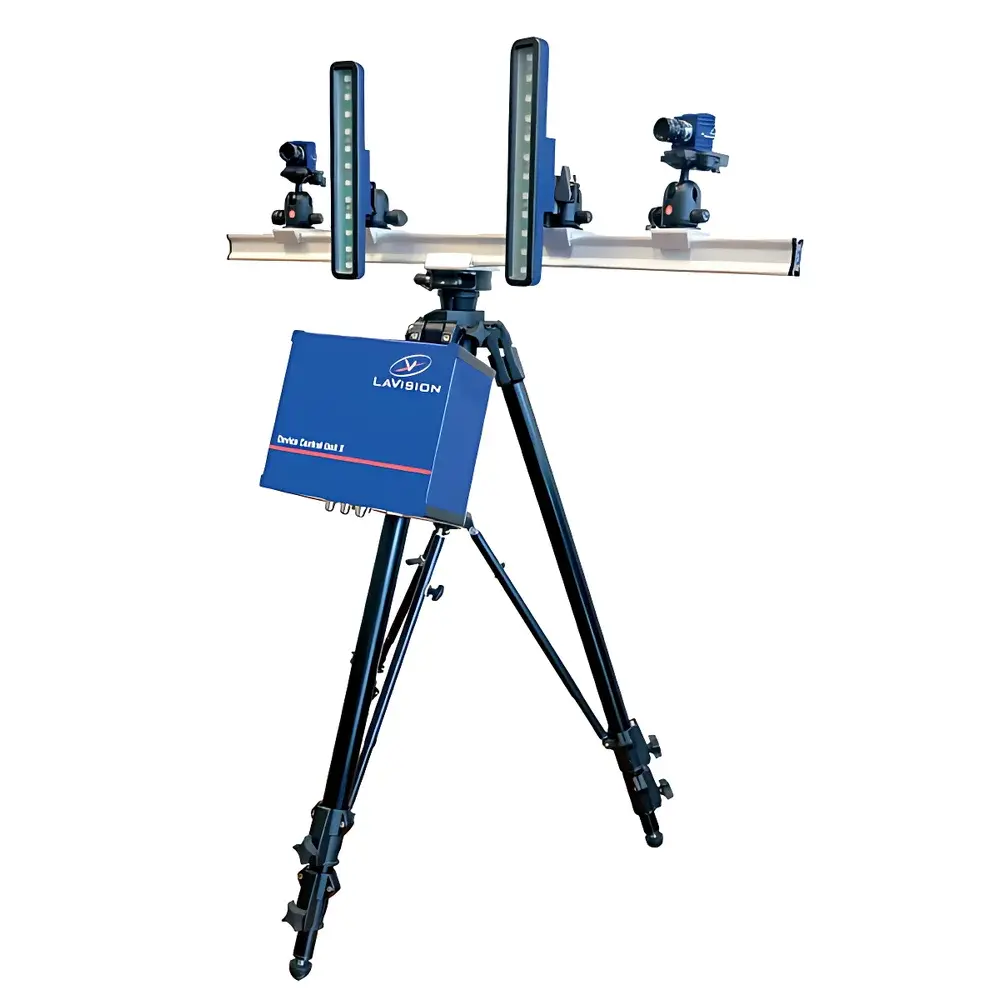
LaVision StrainM PT Portable Digital Image Correlation (DIC) System
| Brand | LaVision GmbH |
|---|---|
| Origin | Germany |
| Model | StrainM PT |
| System Type | Turnkey Portable Digital Image Correlation System |
| Camera Configuration | Dual high-sensitivity Imager E-Lite cameras |
| Illumination | Cold LED illumination system |
| Computing Platform | Integrated industrial-grade laptop |
| Software | StrainMaster PT v5.x with guided workflow and real-time 3D surface height & displacement calculation |
| Application Scope | Full-field shape, deformation, and strain measurement on static and quasi-static specimens |
| Compliance | Designed for ISO/IEC 17025-aligned testing environments |
Overview
The LaVision StrainM PT Portable Digital Image Correlation (DIC) System is a field-deployable, turnkey optical metrology platform engineered for full-field, non-contact measurement of surface shape, in-plane and out-of-plane displacement, and strain distribution on solid materials. Based on stereo digital image correlation—a robust photomechanics technique—the system captures synchronized high-resolution images from two calibrated, high-sensitivity Imager E-Lite cameras under controlled cold LED illumination. Sub-pixel image registration algorithms compute displacement vectors across the entire region of interest by tracking naturally occurring or applied surface texture patterns. Unlike point-based sensors or strain gauges, the StrainM PT delivers spatially continuous, quantitative deformation maps with micrometer-level resolution and sub-pixel displacement accuracy—enabling rigorous mechanical characterization without physical contact or specimen modification.
Key Features
- Compact, battery-compatible portable architecture: All core components—including dual cameras, illumination unit, calibration hardware, and control laptop—are integrated into a ruggedized transport case for rapid deployment in labs, production floors, or field sites.
- Guided experimental workflow: StrainMaster PT software provides step-by-step setup assistance—from camera alignment and calibration to subset definition, mesh generation, and result export—reducing operator dependency and minimizing procedural errors.
- Real-time 3D surface reconstruction: Combines stereo triangulation with adaptive surface fitting to compute instantaneous topography, z-displacement, and curvature changes during loading, supporting both static and slow-rate quasi-static tests.
- High-fidelity imaging chain: Imager E-Lite cameras feature global shutter CMOS sensors with low noise, high dynamic range (>70 dB), and programmable exposure/gain—optimized for low-contrast surfaces and ambient-light-variable environments.
- Traceable metrology framework: Built-in NIST-traceable calibration procedures ensure geometric accuracy compliant with ISO 12232 (image sensor performance) and VDI/VDE 2634 Part 2 (optical 3D measuring systems).
Sample Compatibility & Compliance
The StrainM PT accommodates specimens ranging from small-scale coupons (≥25 mm × 25 mm FOV) to large structural components (up to 2 m × 1.5 m with optional lens kits). Surface preparation is flexible: natural texture, stochastic speckle patterns, or commercial DIC coatings均可 be used—no embedded sensors or wiring required. The system is routinely deployed in aerospace component validation (per ASTM E837, E139), automotive crash-test analysis (SAE J211), civil infrastructure monitoring (ACI 444R), and biomedical device mechanics (ISO 14242-1). Data acquisition and storage adhere to principles outlined in FDA 21 CFR Part 11 for electronic records, including user authentication, audit trails, and immutable result archiving when configured with validated software modules.
Software & Data Management
StrainMaster PT v5.x serves as the unified interface for acquisition, processing, visualization, and reporting. It supports batch processing of multi-load-step experiments, automated ROI selection via edge detection or CAD overlay, and export of displacement/strain tensors in standard formats (HDF5, ASCII, CSV, and ParaView-compatible VTK). All raw images, calibration metadata, and processing parameters are embedded in project files for full traceability. For regulated environments, optional validation packages include IQ/OQ documentation, software verification reports, and SOP templates aligned with ISO/IEC 17025 and GxP quality systems.
Applications
- Mechanical testing laboratories: Tensile, compression, bending, and fatigue tests with full-field strain localization at notches, welds, or composite interfaces.
- Structural health monitoring: In situ assessment of thermal expansion, bolt preload relaxation, or settlement-induced deformation in bridges and wind turbine blades.
- Material development: Quantification of anisotropic yielding, plastic strain partitioning in AM alloys, and viscoelastic recovery in polymers.
- Failure analysis: Mapping crack-tip deformation fields, identifying shear band initiation, and correlating microstructural evolution (via synchrotron or SEM-DIC integration) with macroscopic response.
- Education and research: Hands-on teaching of continuum mechanics concepts, including strain tensor decomposition, principal strain orientation, and von Mises yield criteria visualization.
FAQ
What is the minimum measurable strain resolution of the StrainM PT system?
Strain resolution is application-dependent and governed by subset size, image quality, and speckle density—but typical in-plane engineering strain resolution is ≤50 µε under optimal conditions (1024×1024 pixel ROI, 50 µm/pixel scale, high-contrast speckle).
Can the system operate outdoors or in uncontrolled lighting environments?
Yes—the cold LED illumination system provides stable, shadow-free, spectrally neutral lighting; combined with high-dynamic-range cameras and automatic exposure balancing, it enables reliable operation under variable ambient light, including partial daylight.
Is the StrainM PT compatible with existing LaVision hardware or software platforms?
It shares core algorithms and file structures with the StrainMaster Lab and Istra 4D platforms, enabling seamless cross-platform data comparison and script reuse via Python API (PyStrainMaster SDK).
Does the system support real-time feedback during mechanical testing?
While primary processing occurs post-capture for maximum accuracy, the software includes a live preview mode with near-real-time (≤2 Hz) displacement vector overlay for qualitative guidance during load ramping.
What calibration standards does LaVision provide for metrological traceability?
Each system ships with a certified 3D calibration target (VDI/VDE 2634-compliant), accompanied by a factory calibration certificate referencing NPL/NIST traceable length standards and uncertainty budgets per ISO/IEC 17025 Annex A.3.



