
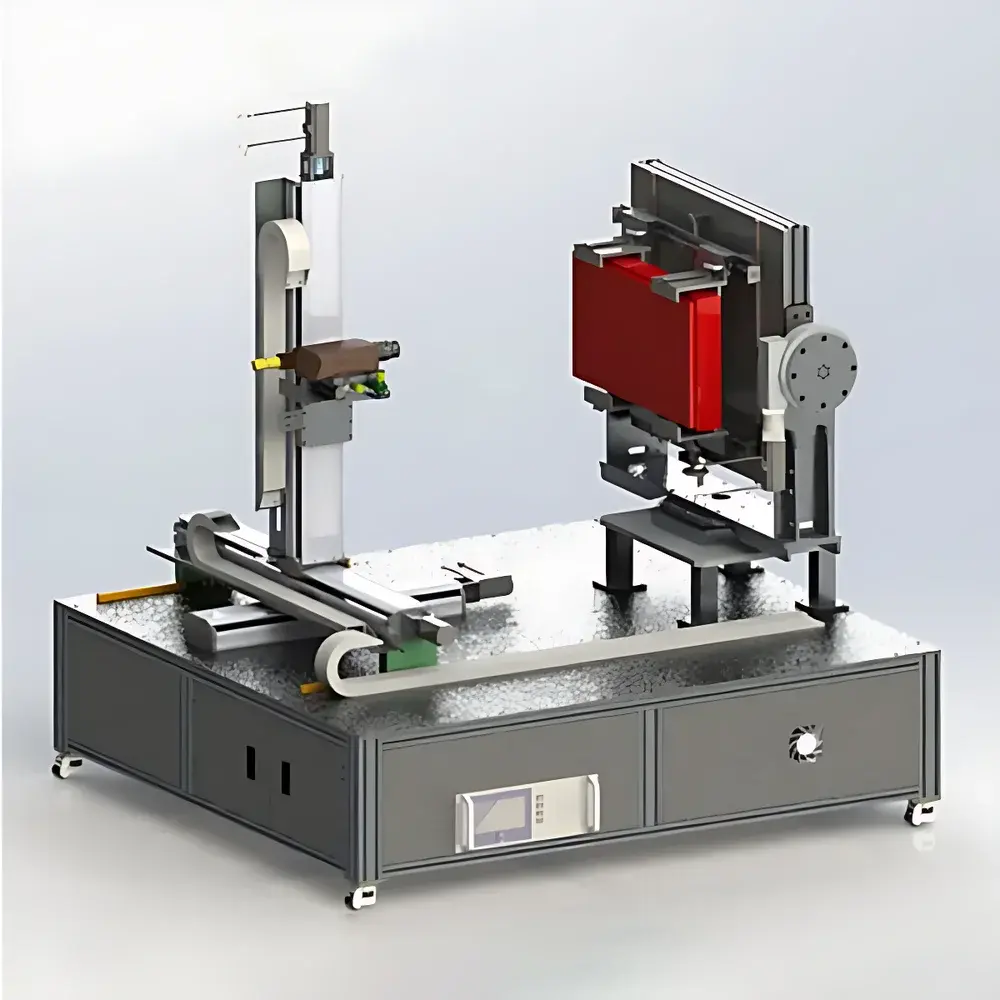
LCD Optical and Color Performance Integrated Test System
| Brand | ZOLIX |
|---|---|
| Origin | Beijing, China |
| Model | LCD |
| Price Range | USD 7,000 – 70,000 |
| Sample Size Compatibility | 32″–120″ displays |
| Angular Coverage | Horizontal 360°, Vertical ±90° |
| Rotational Accuracy | < 0.1° |
| Linear Positioning Accuracy | ±0.02 mm |
| Viewing Angle Measurement Capability | Full hemispherical (azimuthal and polar) |
| Optional ACR Module | Ambient Contrast Ratio measurement per ICDM/ISO 13406-2 Annex B |
| Measurement Principles | Luminance/Chromaticity via calibrated CCD-based imaging photometry |
Overview
The LCD Optical and Color Performance Integrated Test System is a fully automated, goniometric imaging photometry platform engineered for comprehensive evaluation of emissive flat-panel displays—including LCD, LED-backlit LCD, and direct-view LED video walls. It operates on the principle of calibrated CCD-based imaging photometry combined with precision motorized angular positioning, enabling spatially resolved luminance (cd/m²), chromaticity (CIE x,y or u′,v′), gamma response, contrast, uniformity, and viewing-angle-dependent performance across the full visible spectrum (380–780 nm). Unlike spot-metering systems, this platform captures full-field data at each angular position, supporting both industry-standard single-point metrics and advanced spatial analysis (e.g., ΔE₂₀₀₀ maps, luminance falloff profiles, color shift vectors). Its vertical measurement geometry replicates real-world viewing conditions—critical for validating human-centric visual performance in conferencing, broadcast, and digital signage applications.
Key Features
- Motorized dual-axis goniometer with 360° azimuthal and ±90° polar rotation, repeatability < 0.1°, enabling full-hemispherical optical characterization.
- High-resolution scientific CCD camera with NIST-traceable photometric calibration, integrated V(λ)-matched filter and f/1.4 lens optimized for low-light display emission.
- Long-stroke linear motion stage using precision gear-rack actuation, positional accuracy ±0.02 mm—enabling accurate center-of-rotation compensation for panels of varying thickness (5–100 mm).
- Integrated programmable signal generator supporting HDMI 2.1, DisplayPort 1.4, and custom timing patterns for dynamic gamma, flicker, and response time assessment.
- Automated CCD-based alignment system ensuring pixel-accurate registration between measurement ROI and panel active area—eliminating manual setup drift.
- Modular architecture: optional Ambient Contrast Ratio (ACR) unit compliant with ISO 13406-2 Annex B and ICDM 2022 test protocols, featuring calibrated ambient light simulation (0–10,000 lux, CCT 2700K–10,000K).
Sample Compatibility & Compliance
The system accommodates rigid flat-panel displays from 32″ to 120″ diagonal, including edge-lit and full-array local dimming LCDs, OLEDs, and microLED modules. Mounting fixtures are configurable for VESA 75/100/200/400 standards and support tilt/pan adjustment within ±5°. All optical measurements adhere to CIE S 026/E:2015 (photometry), CIE 15:2018 (colorimetry), and ISO 9241-307:2018 (display ergonomics). Data traceability meets GLP requirements: each measurement includes embedded metadata (calibration certificate ID, operator, timestamp, environmental temperature/humidity), and raw image archives are stored in TIFF-6.0 format with EXIF-compliant photometric tags. System validation reports include ASTM E308-22 spectral interpolation verification and CIE TR 204-2021 goniophotometer uncertainty budget documentation.
Software & Data Management
Control and analysis are executed via ZOLIX DisplayTest Suite—a Windows 10/11 application built on Qt and Python (NumPy, SciPy, OpenCV). The software provides scriptable test sequences (Python API), real-time luminance/chromaticity heatmaps, and automated report generation in PDF/XLSX formats compliant with FDA 21 CFR Part 11 (electronic signatures, audit trails, role-based access control). Raw data is stored in HDF5 containers with hierarchical metadata indexing, supporting post-acquisition reprocessing (e.g., recalculating CIEDE2000 with updated reference illuminants). Export modules include CSV (for MATLAB/Python ingestion), JSON-LD (for LIMS integration), and DICOM-SR (for medical display certification workflows).
Applications
- Display manufacturing QA/QC: batch-level uniformity screening (luminance deviation < ±3%, chromaticity Δu′v′ < 0.005), factory calibration verification, and burn-in monitoring.
- R&D validation: angular color shift analysis for wide-gamut quantum-dot films, micro-lens array efficacy testing, and HDR tone-mapping verification under variable ambient illumination.
- Third-party certification: preparation of test reports for TÜV Rheinland Display Quality Certification, UL 62368-1 Annex Q, and ENERGY STAR Program Requirements Version 8.0.
- Academic research: spatio-angular BRDF/BTDF modeling of anti-glare coatings, temporal response profiling under variable refresh rates (48–240 Hz), and perceptual uniformity studies using CIECAM16.
FAQ
What display interfaces does the integrated signal generator support?
HDMI 2.1 (up to 48 Gbps), DisplayPort 1.4a (HBR3), and custom LVDS/TTL timing patterns—configurable via GUI or Python script.
Is the system compliant with FDA 21 CFR Part 11 for regulated environments?
Yes. Audit trail logging, electronic signatures, and user permission tiers are enabled by default; full validation documentation package available upon request.
Can the system measure OLED pixel-level non-uniformity (Mura)?
Yes—using sub-pixel ROI analysis and normalized luminance deviation mapping at native resolution, with detection threshold ≤ 0.5% ΔL*.
Does the ACR module meet ISO 13406-2 requirements for ambient contrast assessment?
Yes—the optional ACR unit includes spectrally tunable LED ambient source, calibrated irradiance sensor, and measurement protocol aligned with ISO 13406-2 Annex B and ICDM 2022 Standard Practice.
What is the typical measurement cycle time for a full 360° × ±90° viewing angle scan at 5° resolution?
Approximately 42 minutes for a 65″ UHD panel, including auto-alignment, exposure optimization, and radiometric correction—scalable via multi-threaded acquisition and GPU-accelerated processing.




