
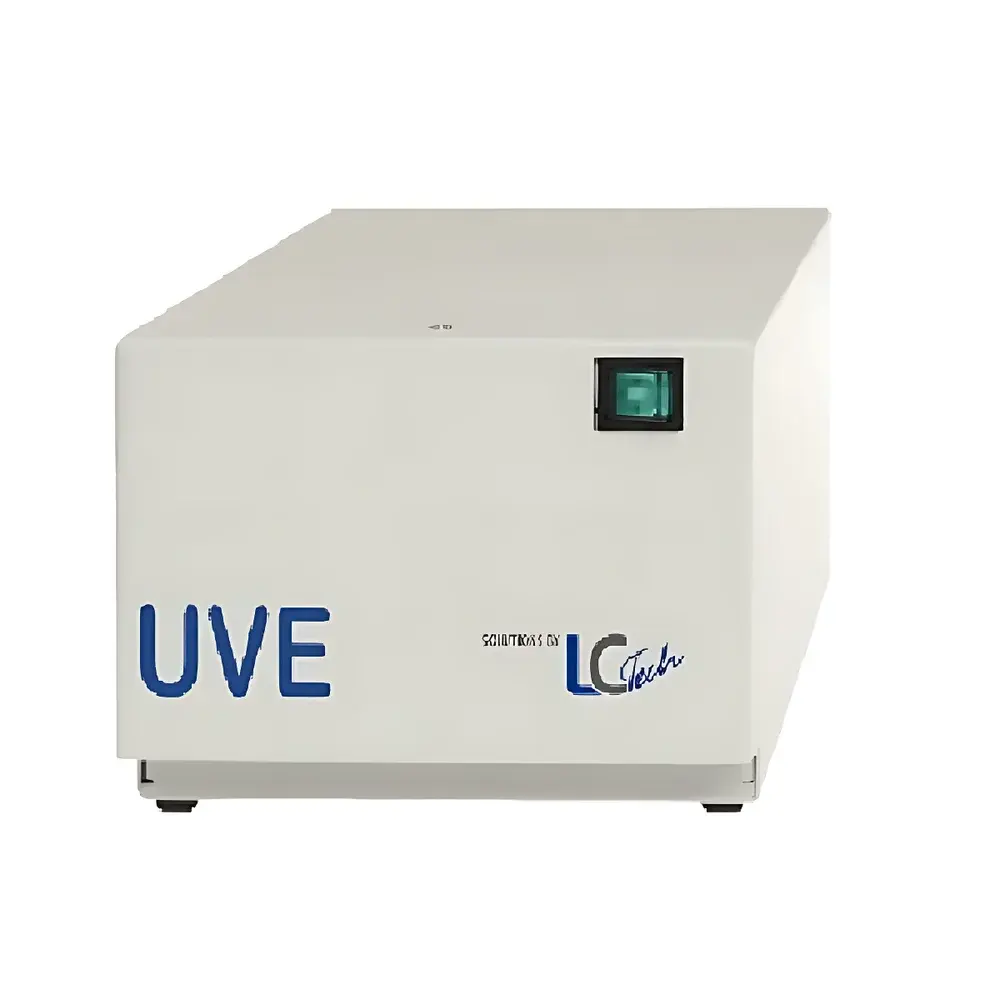
LCTech UVE Photochemical Derivatization System
| Brand | LCTech |
|---|---|
| Origin | Germany |
| Model | UVE |
| Temperature Range | Ambient |
| Derivatization Flow Rate | 1.2 mL/min |
| Reaction Coil Volume | 1 mL |
| Regulatory Certifications | CE, DIN ISO 9001 |
| Method Recognition | AOAC Official Method |
Overview
The LCTech UVE Photochemical Derivatization System is a robust, CE- and DIN ISO 9001–certified post-column derivatization module engineered for high-sensitivity HPLC analysis of aflatoxins—particularly aflatoxin B₁ and G₁—in food, feed, and environmental matrices. Unlike conventional chemical derivatization methods requiring hazardous reagents (e.g., bromine, iodine, or chloramine-T), the UVE employs 254 nm ultraviolet irradiation to induce photochemical carboxylation of aflatoxin B₁ and G₁ directly within the flow stream. This reaction converts the weakly fluorescent parent compounds into highly fluorescent derivatives—specifically, B₂a and G₂a—enabling detection at sub-parts-per-trillion (ppt) levels using standard fluorescence detectors (ex: 365 nm / em: 425 nm). The system operates at ambient temperature with no active heating or cooling, eliminating thermal degradation risks and ensuring compatibility with gradient elution and reversed-phase HPLC separations. Its design adheres to principles of green analytical chemistry: zero consumption of toxic derivatizing agents, minimal solvent demand, and full integration into existing chromatographic workflows without hardware modification.
Key Features
- 254 nm low-pressure mercury UV lamp with >3,000-hour service life and stable spectral output—no lamp alignment or recalibration required during routine operation
- Optimized 1 mL fused-silica reaction coil with precise residence time control at 1.2 mL/min flow rate, ensuring complete photochemical conversion (≥98% derivatization efficiency per AOAC validation data)
- No chemical reagent delivery system: water or aqueous mobile phase serves as both carrier and reaction medium—eliminating reagent pumps, mixing tees, and associated maintenance
- Modular, plug-and-play interface compatible with all major HPLC platforms (Agilent, Waters, Shimadzu, Thermo Fisher) via standard 1/16″ PEEK tubing connections
- Passive thermal management architecture—no fans, chillers, or external power supplies beyond standard 100–240 V AC input
- Full compliance with AOAC Official Method 2005.08 for aflatoxin analysis in corn, peanuts, and dairy products
Sample Compatibility & Compliance
The UVE system supports liquid samples prepared by standard extraction protocols (e.g., immunoaffinity cleanup, solid-phase extraction, or QuEChERS) followed by HPLC separation on C18 columns. It is validated for use with regulatory-compliant workflows under EU Commission Regulation (EC) No 1881/2006, FDA Guidance for Industry (Aflatoxin in Food and Feed), and China GB 2761–2023. All components meet RoHS and REACH requirements. The device carries CE marking per Directive 2014/30/EU (EMC) and 2014/35/EU (LVD), and its quality management system is certified to DIN ISO 9001:2015. No method-specific validation is required when implemented per AOAC 2005.08; however, laboratories performing GLP or GMP-regulated testing may configure audit trails and electronic signatures via integrated HPLC data systems compliant with 21 CFR Part 11.
Software & Data Management
As a hardware-only derivatization module, the UVE does not include proprietary software or onboard data storage. It functions transparently within the host HPLC data system (e.g., OpenLab CDS, Empower, LabSolutions), where peak area ratios (B₁/B₂a, G₁/G₂a) and retention time stability are monitored per ICH Q2(R2) guidelines. Users retain full control over integration parameters, baseline correction, and calibration curve generation. For laboratories requiring full traceability, the UVE’s operational status (lamp on/off, runtime hours) can be logged externally via optional TTL signal output synchronized with detector acquisition triggers.
Applications
- Quantitative determination of aflatoxin B₁, B₂, G₁, and G₂ in cereals, nuts, spices, milk powder, and pet food per ISO 16050 and AOAC 994.02
- Method transfer between regulatory labs due to reagent-free operation and minimal inter-laboratory variability
- High-throughput screening in contract testing laboratories seeking reduced consumables cost and lower waste disposal burden
- Supporting LC-MS/MS confirmatory workflows where photoderivatization enhances selectivity prior to tandem MS detection
- Research applications in mycotoxin metabolism studies requiring artifact-free derivatization without redox interference
FAQ
Does the UVE require any consumable reagents or gases?
No. Only the aqueous mobile phase (e.g., water or buffered solution) passes through the reaction coil—no bromine, iodine, or ozone generators are involved.
Can the UVE be used with UHPLC systems operating above 600 bar?
Yes. The reaction coil is rated for pressures up to 1,000 bar; backpressure is negligible (<0.5 bar at 1.2 mL/min), making it fully compatible with UHPLC instrumentation.
Is lamp intensity monitoring built into the system?
No real-time intensity sensor is included; however, lamp output stability is verified during factory calibration, and end-of-life is indicated by ≥20% decline in peak response—typically after 3,000+ hours of continuous use.
How is method equivalence demonstrated versus chemical derivatization?
Per AOAC 2005.08, recovery studies (spike levels 0.1–20 µg/kg) show ≥95% mean recovery and RSD <5% across five independent labs—meeting criteria for method equivalency under ISO/IEC 17025.
What maintenance is required beyond lamp replacement?
None. The quartz UV window and reaction coil require only periodic rinsing with methanol/water (1:1) after extended use with complex matrices; no cleaning solvents or tools are specified.
Related Products





