
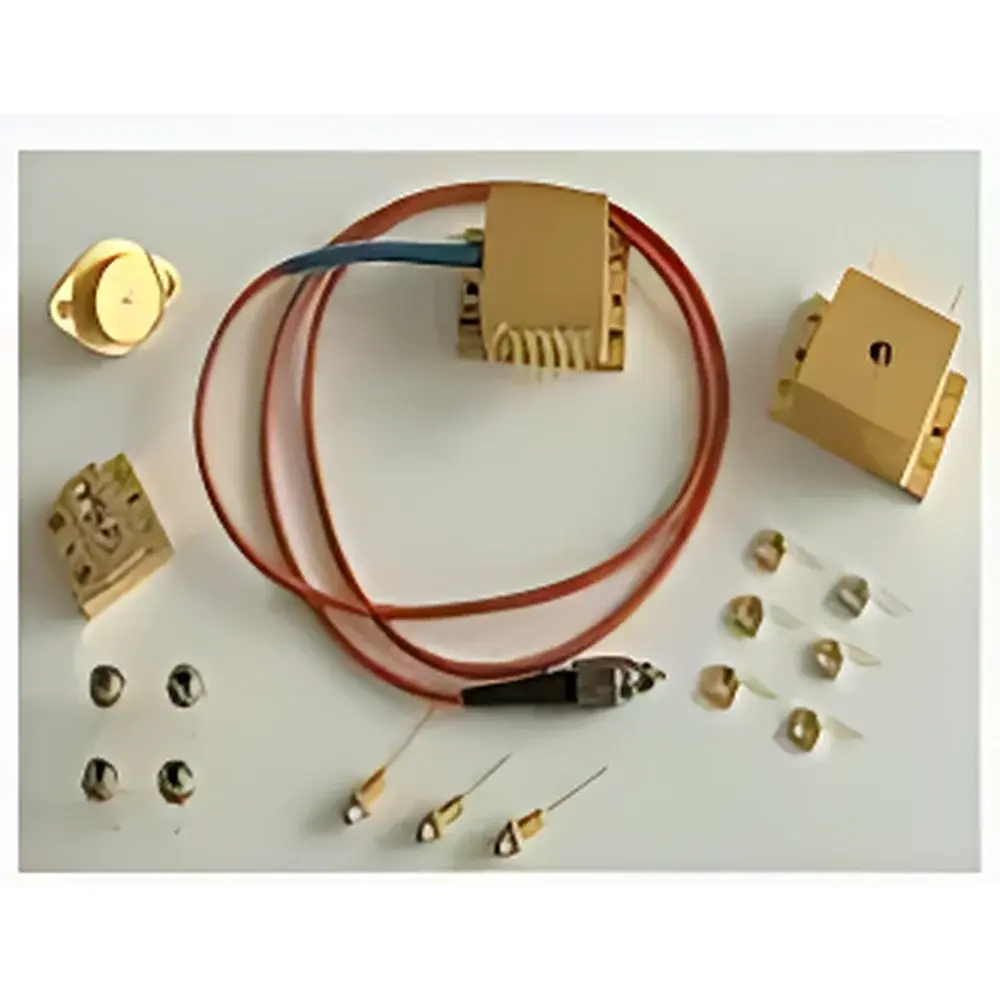
LDX Optronics Semiconductor Laser Diodes
| Brand | LDX Optronics |
|---|---|
| Origin | USA |
| Manufacturer Type | Authorized Distributor |
| Import Status | Imported |
| Model Series | LDX-2xxx / LDX-3xxx / LDX-4xxx |
| Wavelength Range | 445–1850 nm |
| Output Power Range | 150 mW – 10 W |
| Emitter Dimensions | 20–400 µm (width) × 19–300 µm (length) |
| Package Options | C-mount, D-mount, Q-mount, TO-18, TO-3, TO-3 with TEC, 9 mm, 9 mm SMA, HHL free-space, laser bar package, 9 mm fiber-coupled, HHL fiber-coupled, butterfly fiber-coupled |
Overview
LDX Optronics Semiconductor Laser Diodes are high-reliability, single-emitter and multi-emitter laser sources engineered for precision optical systems requiring stable, narrow-linewidth emission across the visible to near-infrared spectrum. Based on III–V compound semiconductor heterostructure technology (e.g., AlGaInP, InGaN, AlGaAs, InGaAs), these diodes operate via stimulated emission under forward bias, delivering diffraction-limited beam quality when integrated with appropriate collimation or fiber-coupling optics. Designed for continuous-wave (CW) operation in laboratory, industrial, and OEM environments, they support demanding applications including spectroscopy, flow cytometry, confocal microscopy, photodynamic therapy, and pumping of solid-state and fiber lasers. All devices comply with RoHS and REACH directives and undergo 100% burn-in and spectral verification prior to shipment.
Key Features
- Wide spectral coverage from 445 nm (blue) to 1850 nm (short-wave infrared), enabling selection of optimal excitation or pumping wavelengths for diverse photonics workflows.
- Power scalability from 150 mW to 10 W per emitter or bar—achieved through optimized epitaxial design, thermal management architecture, and facet passivation.
- Multiple standardized mechanical packages—including industry-familiar C-mount, TO-can variants (TO-18, TO-3), HHL modules, and butterfly housings—ensuring seamless integration into existing optical benches or custom optomechanical assemblies.
- Fiber-coupled configurations available with SMF-28, HI1060, or PM fibers (FC/PC, FC/APC, SMA905 interfaces), supporting alignment-free system integration and improved beam delivery stability.
- Thermoelectrically cooled (TEC) TO-3 packages provide active temperature stabilization (±0.1 °C), critical for wavelength-sensitive applications such as Raman excitation or absorption spectroscopy.
- OEM-ready form factors with defined electrical pinouts, thermal interface specifications, and mounting torque recommendations—facilitating rapid prototyping and volume production deployment.
Sample Compatibility & Compliance
These laser diodes are compatible with standard driver electronics supporting TTL/analog modulation (up to 100 kHz for most models), constant-current operation, and safety interlock inputs. Devices meet IEC 60825-1:2014 Class 3B or Class 4 laser safety requirements depending on output power and collimation; full compliance documentation—including LSO reports and divergence data—is supplied with each batch. For regulated environments (e.g., medical device manufacturing or pharmaceutical analytical labs), LDX diodes support traceable calibration records and can be qualified under ISO 13485–aligned processes. While not intrinsically FDA-cleared, they serve as critical components in Class II and Class III medical laser systems compliant with 21 CFR Part 1040.10 and IEC 60601-2-22.
Software & Data Management
LDX Optronics provides comprehensive technical documentation—including spectral response curves, L-I-V (light-current-voltage) characterization plots, far-field intensity distributions, and thermal derating tables—for every model variant. No proprietary control software is bundled; instead, devices are designed for interoperability with third-party laser controllers (e.g., Thorlabs LDCxx, ILX Lightwave LDP-3700 series) and DAQ platforms (NI PXI, Keysight U1242B). All test data is archived with unique serial-number traceability and conforms to GLP-compliant record retention practices. Optional firmware-enabled digital monitoring (via integrated thermistor and photodiode feedback) supports closed-loop power stabilization in automated systems.
Applications
- Spectroscopic Excitation: Narrow-band 635 nm, 785 nm, and 1064 nm diodes serve as compact, low-noise sources for portable Raman spectrometers and absorption-based gas analyzers.
- Biophotonics Instrumentation: 445 nm and 660 nm emitters power fluorescence lifetime imaging (FLIM) and flow cytometry systems requiring high peak brightness and pulse fidelity.
- Fiber Laser Pumping: 808 nm, 915 nm, and 976 nm diodes in 9 mm fiber-coupled or HHL packages deliver >5 W into 105/125 µm fibers for Yb-doped and Er/Yb co-doped amplifiers.
- Industrial Processing: High-power 808 nm and 940 nm arrays (up to 40 W) enable direct-diode welding, plastic soldering, and selective heating in automated assembly lines.
- Scientific Research: Custom-wavelength variants (e.g., 1350 nm, 1470 nm, 1550 nm) support nonlinear optics experiments, OCT light sources, and atmospheric transmission studies.
FAQ
What is the typical lifetime of LDX semiconductor laser diodes under rated operating conditions?
Mean time to failure (MTTF) exceeds 10,000 hours at 25 °C case temperature and 80% of maximum rated current, per Telcordia GR-468-CORE reliability testing protocols. Lifetime scales inversely with junction temperature—derating curves are provided in the datasheet.
Do you offer spectral or spatial beam profiling data for individual units?
Yes—each shipped unit includes a certificate of conformance listing measured center wavelength (±0.5 nm accuracy), spectral width (FWHM), fast/slow axis divergence, and near-field emitter geometry. Full beam propagation analysis (M² < 1.3 for collimated single-mode variants) is available upon request.
Can LDX diodes be modulated at frequencies above 1 MHz?
Standard DC-coupled models support analog modulation up to ~100 kHz. For high-speed applications (>1 MHz), edge-emitting designs with low capacitance (<1 pF) and RF-compatible packages (e.g., butterfly with RF pins) are available—contact engineering support for impedance-matching guidance.
Are custom wavelengths outside the published range feasible?
Yes—LDX Optronics maintains flexible epitaxial growth and wafer processing capabilities. Wavelengths between 405 nm and 2000 nm are technically achievable; lead times and minimum order quantities apply for non-standard offerings.
How is electrostatic discharge (ESD) protection implemented?
All devices incorporate integrated Zener diode protection (IEC 61000-4-2 Level 4 compliant) and are handled under ANSI/ESD S20.20-certified cleanroom protocols. Recommended handling includes grounded wrist straps, conductive foam storage, and current-limited drivers with soft-start functionality.




