
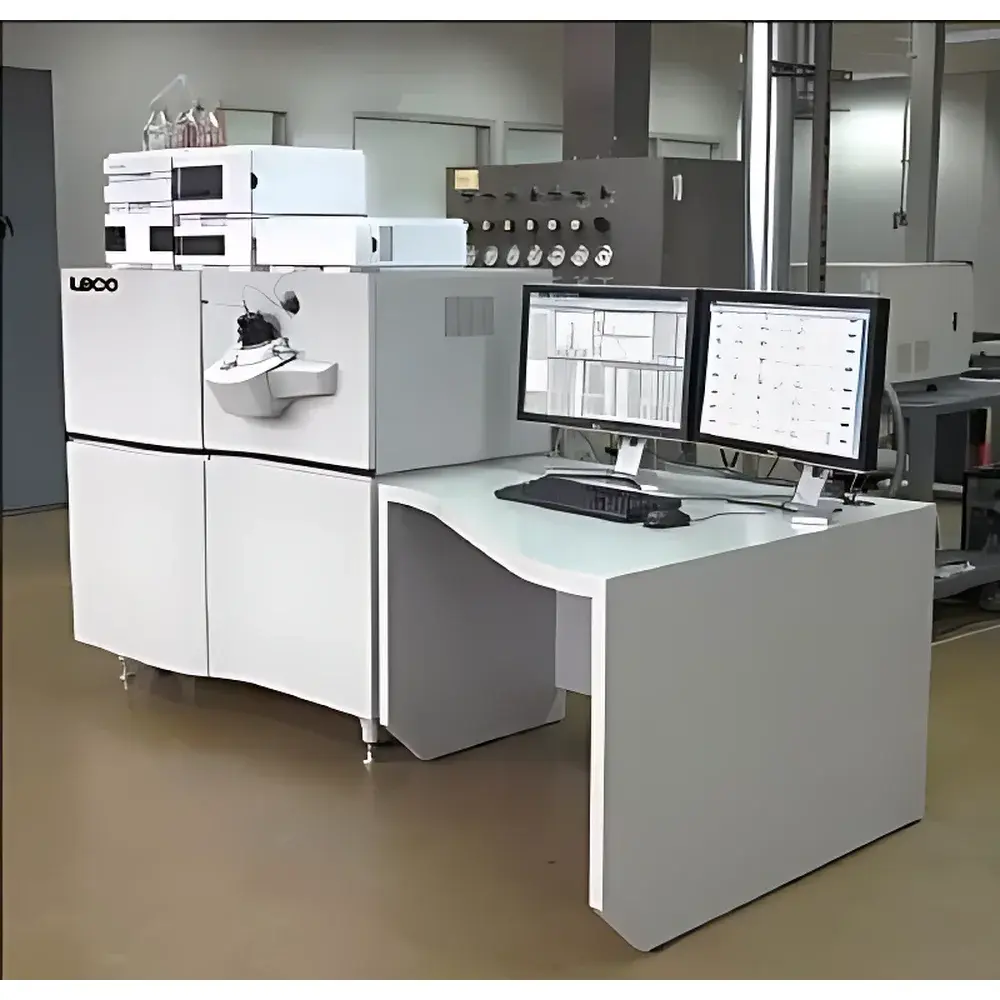
LECO Citius HRT High-Resolution Liquid Chromatography Time-of-Flight Mass Spectrometer
| Brand | LECO |
|---|---|
| Origin | USA |
| Manufacturer Type | Original Equipment Manufacturer (OEM) |
| Origin Category | Imported |
| Model | Citius HRT |
| Instrument Type | Time-of-Flight (TOF) Mass Spectrometer |
| Resolution | 100,000 (FWHM at m/z 500) |
| Acquisition Rate | 100–200 full-spectrum scans per second |
| Mass Accuracy | < 1 ppb (rms, external calibration) |
| Dynamic Range | 10⁵–10⁶ |
| Ion Sources | ESI, APCI, DESI compatible |
| Flight Path Length | 64 m (folded via FFP™ technology) |
| Calibration Modes | External standard, continuous internal standard, pseudo-external |
Overview
The LECO Citius HRT is a high-resolution liquid chromatography time-of-flight mass spectrometer engineered for uncompromised performance in untargeted and targeted qualitative and quantitative analysis of complex liquid samples. Unlike conventional linear TOF instruments with flight paths limited to 1–2 meters, the Citius HRT implements LECO’s proprietary Folded Flight Path™ (FFP™) architecture — a compact, multi-reflection “flight box” design that extends the effective ion flight distance to 64 meters while maintaining thermal stability and mechanical rigidity. This innovation enables true high-resolution TOF mass measurement based on precise time-of-flight discrimination, eliminating the resolution–speed trade-off endemic to traditional designs. The system delivers 100,000 resolving power (FWHM at m/z 500), sub-ppb mass accuracy across the full mass range (e.g., 50–2,000 Da), and acquisition rates up to 200 full-spectrum scans per second — parameters validated under routine LC gradient conditions. Its orthogonal acceleration ion source interface ensures efficient coupling with UHPLC systems, preserving chromatographic peak fidelity while enabling high data-point density (>20 points per narrow peak). Designed for compliance-critical environments, the Citius HRT operates without grid-based reflectron elements, achieving >80% ion transmission efficiency through its gridless, dynamically focused multi-reflection optics.
Key Features
- Folded Flight Path™ (FFP™) technology: Patented multi-reflection ion optics delivering 64 m effective flight path in a benchtop footprint, enabling 100,000 resolution without thermal drift or mechanical instability.
- Three-user-selectable resolution modes: Switch in real time between 2,500, 50,000, and 100,000 (FWHM), optimized for speed, sensitivity, or ultra-high mass accuracy without hardware reconfiguration.
- KADAS® (Kinetic Adaptive Data Acquisition System): Real-time, event-driven data capture engine that dynamically adjusts dwell times, trigger thresholds, and centroiding algorithms to preserve isotopic fidelity and signal-to-noise across wide dynamic ranges.
- Dynamic Signal Tracking (DST): Continuous ion signal monitoring and feedback-controlled detector gain stabilization, ensuring consistent response across concentration gradients and minimizing saturation artifacts.
- Triple calibration flexibility: Supports external calibration (single-point or multi-point), continuous internal standard calibration (e.g., lock-mass infusion), and pseudo-external calibration for robust long-run mass stability under GLP/GMP workflows.
- Gridless reflectron design with ion beam compression: Maintains >80% transmission efficiency and sub-microsecond time dispersion, critical for high-duty-cycle LC-MS applications.
Sample Compatibility & Compliance
The Citius HRT interfaces natively with electrospray ionization (ESI), atmospheric pressure chemical ionization (APCI), and desorption electrospray ionization (DESI) sources, supporting polar, semi-polar, and thermally labile analytes across pharmaceuticals, environmental extracts, metabolomics biofluids, and food matrices. Its wide linear dynamic range (10⁵–10⁶) accommodates co-eluting high- and low-abundance species without signal suppression or detector saturation. From a regulatory standpoint, the system supports 21 CFR Part 11-compliant audit trails via ChromaTOF® software, including electronic signatures, user access controls, and immutable raw data archiving. Method validation protocols align with ICH Q2(R2), USP , and ISO/IEC 17025 requirements. All firmware and acquisition logic are deterministic and traceable, enabling full GxP audit readiness for QC laboratories operating under FDA, EMA, or PMDA oversight.
Software & Data Management
ChromaTOF® 5.3 (or later) serves as the unified control, acquisition, processing, and reporting platform. It integrates instrument control, real-time spectral visualization, peak deconvolution, elemental composition assignment (with confidence scoring), and batch-aligned comparative analysis in a single GUI. Raw data files (.cdb) are stored in a structured, vendor-neutral binary format compliant with mzML 1.1 specifications. Batch processing workflows support automated retention time alignment, background subtraction, normalization (TIC, total ion current; or internal standard), and statistical filtering (PCA, PLS-DA). All processing steps are scriptable via Python API and fully auditable — changes to integration parameters, mass tolerance windows, or noise thresholds are logged with timestamps and operator IDs. Export options include .csv, .xlsx, and .mzTab for submission to public repositories (e.g., MetaboLights, PRIDE).
Applications
The Citius HRT is deployed in core analytical laboratories for high-confidence small-molecule identification in drug metabolism studies (e.g., phase I/II metabolite profiling), non-targeted screening of environmental contaminants (PFAS, pesticides, emerging toxins), structural elucidation of natural products, and comprehensive lipidomics using shotgun or LC-coupled workflows. Its combination of speed and resolution enables detection of isobaric species (e.g., leucine/isoleucine, C₃H₇NO₂ vs. C₂H₅NO₃) and accurate mass differentiation of ¹³C/¹²C isotopologues — essential for tracer-based flux analysis. In regulated settings, it supports impurity profiling per ICH Q3B(R3), extractables/leachables characterization per USP , and peptide mapping for biologics comparability studies.
FAQ
What distinguishes the Citius HRT from conventional linear TOF instruments?
Its Folded Flight Path™ architecture achieves 64 m effective flight distance in a compact enclosure, delivering 100,000 resolution without thermal expansion artifacts or vacuum path limitations inherent in meter-scale linear tubes.
Can the Citius HRT perform both qualitative and quantitative analysis?
Yes — its wide dynamic range (10⁵–10⁶), sub-ppb mass accuracy, and reproducible ion transmission support validated quantitation (e.g., using stable isotope-labeled internal standards) alongside confident formula assignment.
Is the system compatible with existing UHPLC platforms?
Fully compatible with all major UHPLC systems (Waters, Thermo, Agilent, Shimadzu) via standard ESI/APCI source interfaces and analog/digital trigger synchronization.
How does the KADAS® system improve data quality in fast LC gradients?
KADAS® dynamically modulates acquisition parameters — such as transient averaging, threshold-triggered scanning, and adaptive centroiding — to maintain spectral integrity during rapid elution events where dwell time is constrained.
Does the Citius HRT support 21 CFR Part 11 compliance?
Yes — ChromaTOF® provides role-based access control, electronic signatures, complete audit trail generation, and raw data immutability features required for FDA-regulated submissions.
Related Products





