
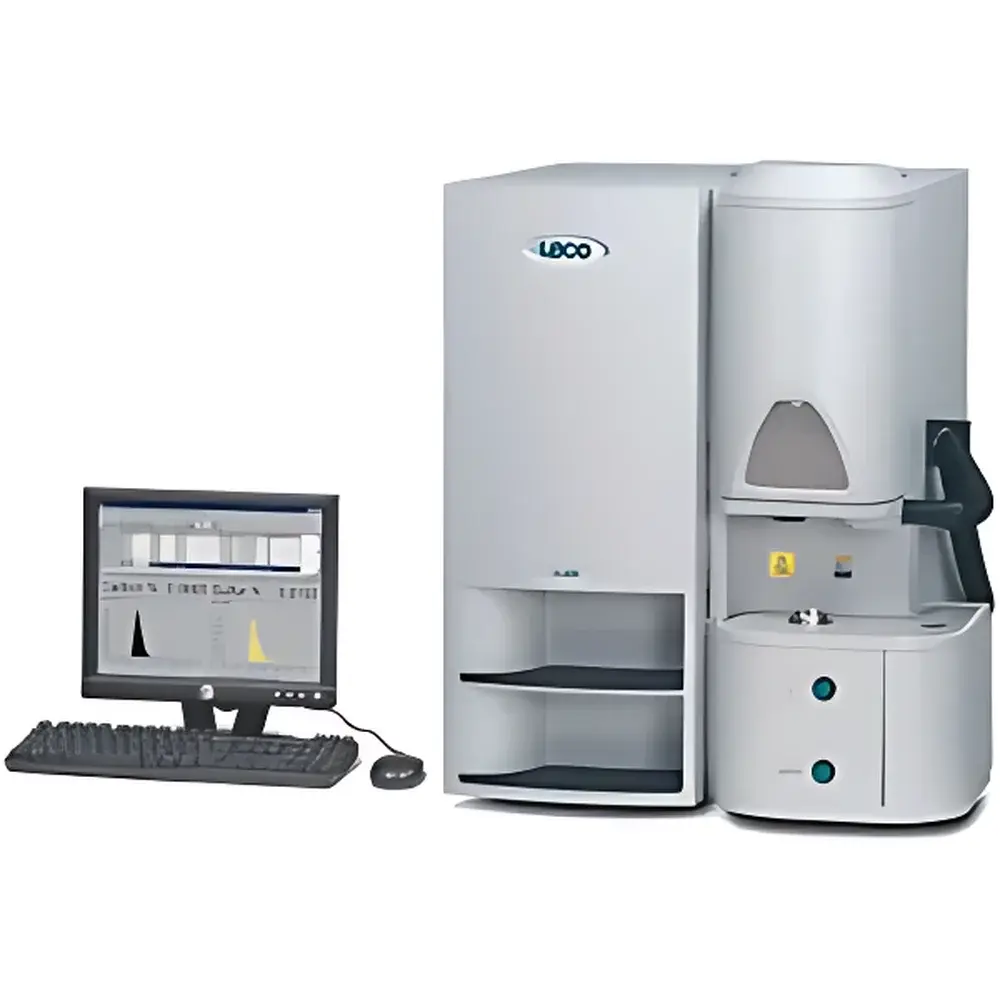
LECO CS600 High-Precision Carbon-Sulfur Analyzer
| Brand | LECO |
|---|---|
| Origin | USA |
| Manufacturer Type | Original Equipment Manufacturer (OEM) |
| Product Origin | Imported |
| Model | CS600 |
| Measurement Principle | Infrared Absorption Spectroscopy |
| Heating System | High-Frequency Induction Furnace |
| Measurement Range | Not Specified |
| Sensitivity | Not Specified |
| Precision | Not Specified |
| Analysis Time | Not Specified |
Overview
The LECO CS600 High-Precision Carbon-Sulfur Analyzer is an industrial-grade elemental combustion analyzer engineered for the quantitative determination of total carbon (C) and total sulfur (S) in solid metallic and inorganic materials. It employs high-frequency induction combustion coupled with dual-channel non-dispersive infrared (NDIR) detection—a method standardized under ASTM E1019, ISO 15350, and JIS G 1211. During analysis, a precisely weighed sample is combusted in a pure oxygen atmosphere at temperatures exceeding 1,700 °C within a ceramic crucible, ensuring complete oxidation of carbon to CO₂ and sulfur to SO₂. The resulting gases are swept through a dust filter and moisture trap before entering dedicated NDIR cells calibrated for each analyte. Signal intensity, proportional to gas concentration, is converted into mass percent via factory-established calibration curves traceable to NIST-certified reference materials.
Key Features
- High-frequency induction furnace with closed-loop power control for stable, reproducible combustion across diverse sample matrices—including ferrous alloys, stainless steels, superalloys, ceramics, and geological samples.
- Dual NDIR optical modules with thermoelectrically cooled detectors and narrow-band interference filters, minimizing cross-sensitivity between CO₂ and SO₂ absorption bands.
- Integrated carrier gas management system featuring automated oxygen flow regulation, pressure monitoring, and leak detection to ensure analytical integrity and operator safety.
- Modular furnace chamber design with quick-release crucible holder and ceramic liner—enabling rapid maintenance and reducing downtime during high-throughput laboratory operations.
- Robust hardware architecture compliant with IEC 61000-4 electromagnetic compatibility standards and UL/CSA electrical safety requirements for continuous operation in QA/QC and metallurgical labs.
Sample Compatibility & Compliance
The CS600 accommodates solid samples ranging from 0.1 g to 1.0 g, including cast iron, low-alloy steel, aluminum alloys, copper-based materials, refractory oxides, and slag. Sample preparation requires only minimal grinding or drilling to achieve particle size ≤ 100 µm; no acid digestion or solvent extraction is necessary. The instrument supports compliance workflows aligned with ISO/IEC 17025 accreditation requirements, including documented calibration verification, system suitability testing (SST), and routine performance checks using certified reference materials (CRMs) such as NIST SRM 1261a (low-carbon steel) and LECO CRM-30 (high-sulfur cast iron). Data integrity adheres to FDA 21 CFR Part 11 principles when operated with optional audit-trail-enabled software.
Software & Data Management
Control and data acquisition are managed via LECO’s proprietary OmniStar™ software platform (v5.2 or later), installed on a Windows-based host PC connected via Ethernet. The interface provides real-time combustion profile visualization, automatic peak integration, multi-point calibration curve generation, and statistical reporting per batch (mean, SD, RSD, confidence intervals). Raw spectral data and metadata—including operator ID, sample ID, date/time stamp, furnace temperature history, and gas flow logs—are stored in encrypted binary format with optional export to CSV, XML, or LIMS-compatible formats. Software validation documentation (IQ/OQ/PQ protocols) and electronic signature support are available for regulated environments operating under GLP or GMP frameworks.
Applications
- Metallurgical process control: Monitoring carbon equivalency in weldability assessments and sulfur segregation in hot-rolled coil production.
- Scrap metal sorting: Rapid qualification of incoming feedstock for recycling facilities based on C/S ratios.
- Research and development: Quantifying interstitial impurities in advanced powder metallurgy components and additive manufacturing feedstocks.
- Third-party testing laboratories: Delivering accredited reports for ASTM A751, EN 10347, and GB/T 20123 compliance verification.
- Failure analysis: Correlating sulfur-induced hot shortness or carbon-related embrittlement with mechanical test results in root cause investigations.
FAQ
What types of samples can be analyzed on the CS600?
Solid conductive and non-conductive inorganic materials—including metals, alloys, ores, cements, and refractories—provided they are homogeneous and free of organic binders or coatings.
Is helium required for operation?
No. The CS600 operates exclusively with high-purity oxygen (≥99.995%) as both combustion and carrier gas; helium is not used in this configuration.
How often must the IR detectors be recalibrated?
Detector response stability is verified daily via zero/gain checks; full optical calibration using certified gas standards is recommended every 6 months or after major maintenance.
Can the CS600 be integrated into a laboratory information management system (LIMS)?
Yes—via configurable ODBC drivers or HL7-compliant API modules included in the OmniStar™ Enterprise edition.
Does the system meet environmental regulatory requirements for emissions monitoring?
No. The CS600 is designed for laboratory-based compositional analysis only and is not certified for stack gas or ambient air monitoring applications.




