
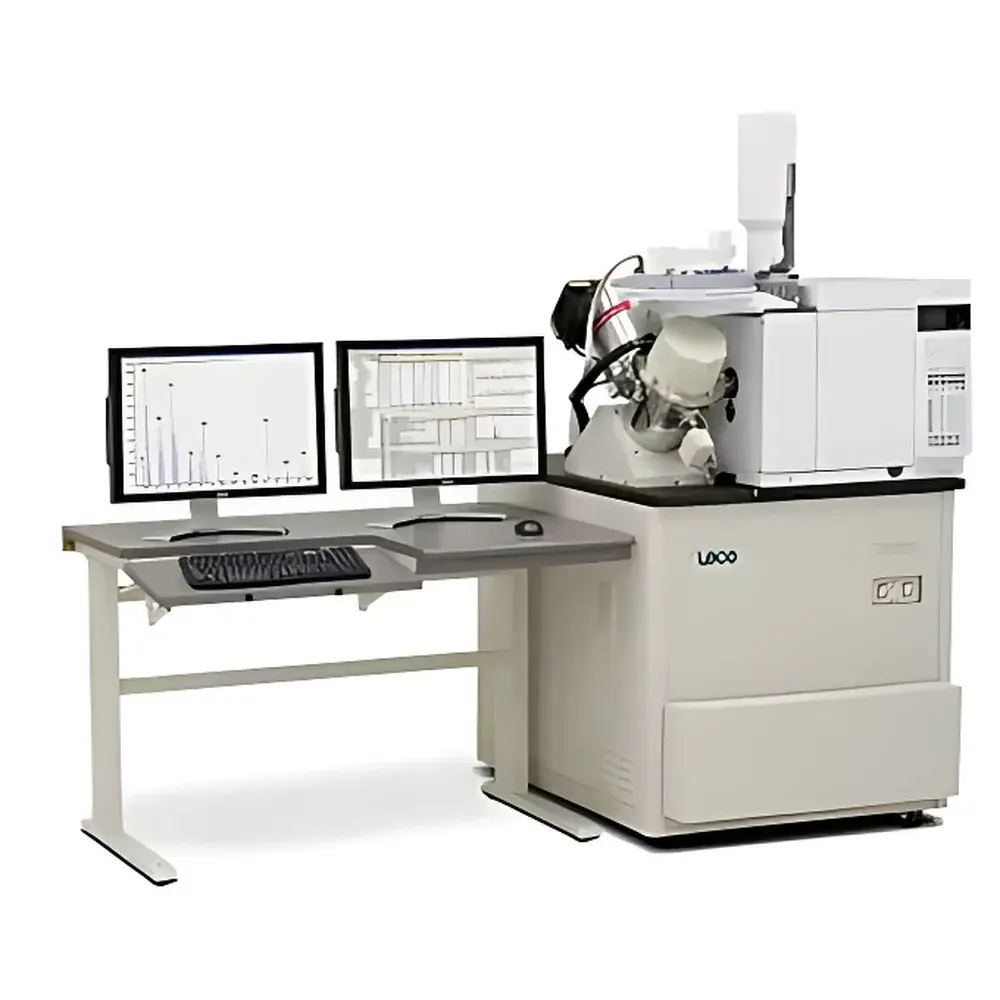
LECO Pegasus HT Gas Chromatography Time-of-Flight Mass Spectrometer
| Brand | LECO |
|---|---|
| Origin | USA |
| Manufacturer | LECO Corporation |
| Instrument Type | GC-TOFMS |
| Model | Pegasus HT |
| Mass Range | 5–1000 m/z |
| Sensitivity | 1 pg octafluoronaphthalene (OFN) |
| Acquisition Speed | 500 full spectra per second |
| Detector | Microchannel Plate (MCP) Detector |
Overview
The LECO Pegasus HT Gas Chromatography Time-of-Flight Mass Spectrometer (GC-TOFMS) is a high-performance analytical platform engineered for comprehensive, untargeted analysis of volatile and semi-volatile organic compounds. Unlike quadrupole or triple-quadrupole MS systems operating in selected ion monitoring (SIM) or tandem MS (MS/MS) modes—which deliver targeted, limited-scope data—the Pegasus HT acquires full-spectrum, high-fidelity mass spectra at up to 500 Hz, enabling simultaneous qualitative identification and quantitative measurement across the entire chromatographic elution profile. Its orthogonal time-of-flight design ensures high mass accuracy ( 4,000 FWHM at m/z 500), and intrinsic duty-cycle efficiency—critical for preserving peak shape integrity during fast GC separations (e.g., 10–30 cm × 0.1 mm ID columns with ramp rates > 20 °C/min). The system integrates seamlessly with Agilent 7890A GC and compatible autosamplers (7683, CTC CombiPAL), supporting both routine QC workflows and discovery-driven research in complex matrices.
Key Features
- High-Speed Full-Spectrum Acquisition: 500 spectra/second acquisition rate maintains ≥15 data points across narrow GC peaks (FWHM < 0.5 s), eliminating undersampling artifacts and ensuring robust spectral deconvolution.
- True Signal Deconvolution™: Proprietary algorithm performs real-time, retention-time-resolved spectral deconvolution—resolving co-eluting peaks with as little as 0.01 s retention time difference and extracting clean, library-matchable spectra.
- Automated Peak Finding & Annotation: ChromaTOF software detects peaks below baseline noise using adaptive signal-to-noise thresholds and customizable width constraints; identifies >100,000 peaks per run without manual intervention.
- Matrix Management: Enables high-throughput, non-targeted screening in samples with wide dynamic concentration ranges (e.g., environmental extracts with ppt-level dioxins amid µg/g lipid matrix), suppressing false positives via background-adaptive baseline modeling.
- Robust EI Ion Source: Electron ionization source operates continuously without routine cleaning, delivering stable sensitivity over extended sequences—validated for >1,000 injections under GLP-compliant conditions.
- Comprehensive QC Monitoring: Automated instrument performance checks include MS tune verification, retention index calibration, internal standard recovery tracking, peak tailing assessment, and blank subtraction—log files compliant with FDA 21 CFR Part 11 audit trail requirements.
Sample Compatibility & Compliance
The Pegasus HT is validated for analysis of thermally labile and semi-volatile compounds across diverse sample types: petroleum hydrocarbons (C5–C40), environmental POPs (PCBs, PCDD/Fs, PBDEs), food volatiles (flavor compounds, contaminants), tobacco smoke condensates, traditional Chinese medicine essential oils, and biological metabolites (urine, plasma, tissue extracts). It meets ASTM D7167 (dioxin analysis), EPA Method 1613/8270, ISO 18856 (wastewater), and USP chromatographic system suitability criteria. Data acquisition and processing workflows support 21 CFR Part 11 electronic signatures, audit trails, and role-based access control when deployed in regulated GMP/GLP environments.
Software & Data Management
ChromaTOF v5.x provides end-to-end workflow automation—from instrument control and real-time spectral acquisition to post-run batch processing, compound identification, and report generation. Peak tables export directly to Excel (copy-paste enabled), CSV, or mzXML formats; spectral libraries include NIST, Wiley, and custom-built databases. Batch processing supports automated relative quantitation (internal standard normalization), statistical comparison (PCA, PLS-DA), and differential abundance analysis across sample groups. All processing parameters are saved as reusable method templates, ensuring inter-laboratory reproducibility and method transfer compliance.
Applications
- Petroleum fingerprinting and biomarker profiling in crude oil and refined products
- Untargeted metabolomics in clinical and preclinical studies
- Residue screening in food and feed (pesticides, mycotoxins, processing contaminants)
- Environmental monitoring of persistent organic pollutants (POPs), including dioxins, furans, and chlorinated biphenyls
- Characterization of fragrance compositions and adulteration detection in cosmetics and essential oils
- Chemical profiling of tobacco smoke, e-cigarette aerosols, and herbal medicines
- Forensic toxicology screening for novel psychoactive substances (NPS)
FAQ
What is the mass accuracy and resolution specification of the Pegasus HT?
Mass accuracy is typically < 3 ppm RMS over m/z 50–500; resolution exceeds 4,000 FWHM at m/z 500 under standard operating conditions.
Does the system support quantitative analysis with internal standards?
Yes—ChromaTOF includes fully automated relative and absolute quantitation modules compatible with isotopically labeled internal standards and external calibration curves.
Can the Pegasus HT be integrated into existing LIMS or ELN infrastructure?
Data export formats (CSV, Excel, mzXML) and REST API interfaces enable seamless integration with major laboratory informatics systems.
Is method validation documentation available for regulated applications?
LECO provides IQ/OQ documentation packages, system suitability test protocols, and 21 CFR Part 11 implementation guides upon request.
What GC configurations are certified for use with the Pegasus HT?
Agilent 7890A/B GCs with 7683/CTC CombiPAL autosamplers are fully supported; column oven temperature programming up to 450 °C and pressure control to 100 psi are validated.





