
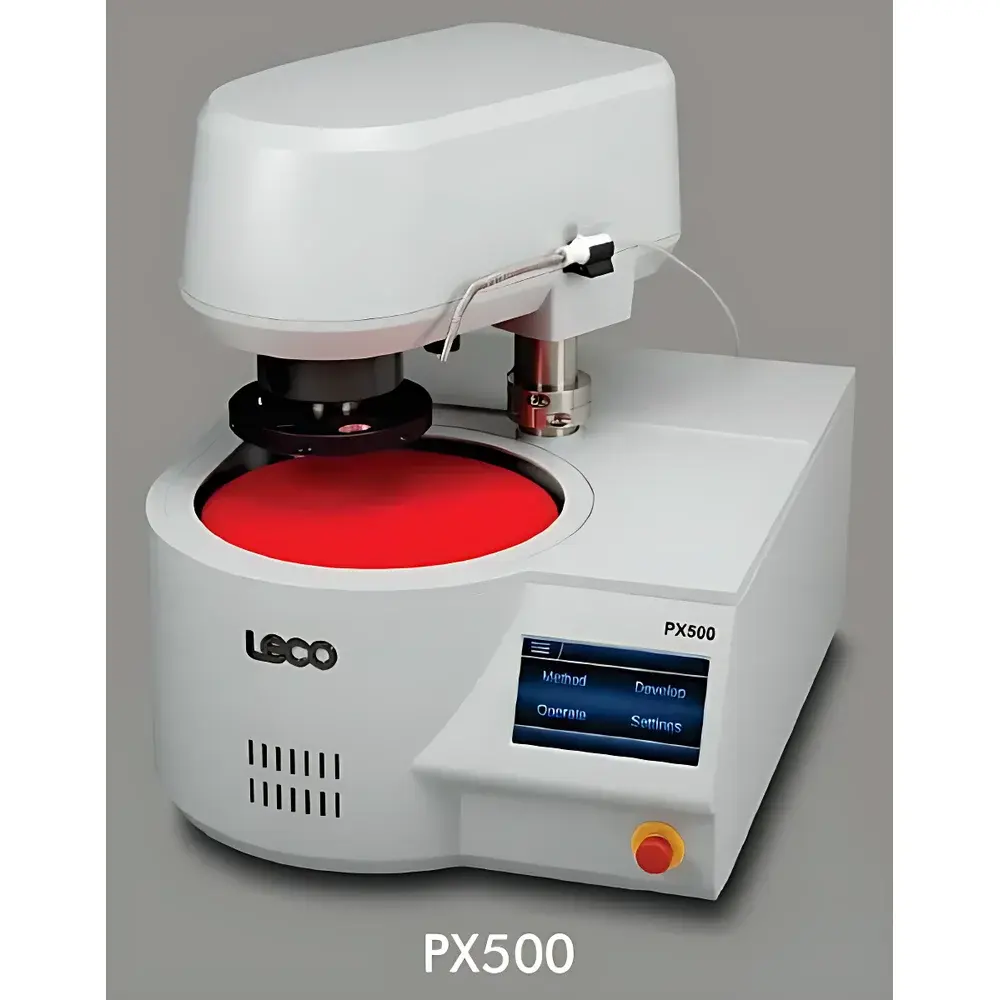
LECO PX500 Automated Polishing and Grinding System
| Brand | LECO |
|---|---|
| Origin | USA |
| Manufacturer | LECO Corporation |
| Type | Imported Equipment |
| Model | PX500 |
| Dimensions (L×W×D) | 635 mm × 533 mm × 711 mm |
| Number of Platen Stations | 1 |
| Platen Diameter Options | 10 in, 12 in, 250 mm, 300 mm |
| Speed Range | 0–600 rpm (adjustable in 25-rpm increments) |
| Fluid Dispensing | Programmable 5-channel reagent metering system for polishing slurries and abrasives |
| Control Interface | Capacitive touchscreen with icon-based navigation |
| Safety | Dedicated emergency stop button located directly below display |
| Base Design | Helical bowl-shaped base with integrated self-cleaning mechanism |
| Sample Holder Motion | Programmable slow-rotation mode for safe mounting/dismounting of mounted specimens |
Overview
The LECO PX500 Automated Polishing and Grinding System is a precision-engineered, single-platen metallographic sample preparation instrument designed for reproducible, high-throughput surface conditioning of embedded metallic, ceramic, and composite specimens. Built upon LECO’s decades-long expertise in materials characterization instrumentation, the PX500 implements controlled rotational grinding and polishing using standardized cup-and-cone kinematics, where specimen rotation relative to the platen follows ASTM E3 and ISO 16489-compliant motion profiles. Its architecture integrates mechanical stability, fluid dynamics control, and programmable motion sequencing to minimize edge rounding, relief, and pull-out—critical parameters in microstructural analysis for failure analysis, quality control, and R&D laboratories operating under GLP or ISO/IEC 17025 frameworks.
Key Features
- Single-station platen configuration with selectable diameters (10 in / 250 mm or 12 in / 300 mm), enabling flexibility across standard metallographic workflows without mechanical reconfiguration.
- Variable-speed motor drive delivering precise speed control from 0 to 600 rpm in 25-rpm increments, supporting both coarse grinding (e.g., SiC paper at 150–300 rpm) and fine polishing (e.g., diamond suspension at 150–200 rpm) per ASTM E3 protocols.
- Integrated 5-channel programmable fluid dispensing system, calibrated for volumetric accuracy ±2% across slurry types—including alumina, colloidal silica, diamond suspensions, and lubricating oils—ensuring consistent abrasive delivery and minimizing operator variability.
- Capacitive touchscreen interface with intuitive icon-driven navigation, preloaded with customizable method templates, real-time parameter monitoring, and password-protected user roles for audit trail compliance.
- Dedicated emergency stop switch positioned immediately beneath the display panel, wired to a redundant hardware circuit that halts platen rotation, fluid dispensing, and holder motion within <100 ms.
- Helical bowl-style base housing engineered to direct abrasive debris and slurry runoff toward central drainage channels; incorporates a self-flushing rinse cycle activated post-process to prevent sediment accumulation and cross-contamination between samples.
- Programmable low-speed specimen holder rotation (≤10 rpm) during loading/unloading phases, reducing manual handling risk and enabling ergonomic integration into automated sample tracking systems.
Sample Compatibility & Compliance
The PX500 accommodates standard 25 mm, 30 mm, and 40 mm diameter mounted specimens, including thermosetting resins (epoxy, phenolic), thermoplastic mounts (acrylic), and cold-mounting compounds. It supports sequential multi-step preparation protocols—from rough grinding on silicon carbide papers to final colloidal silica polishing—without requiring manual platen changes. The system meets CE marking requirements for machinery safety (2006/42/EC), complies with IEC 61000-6-2/6-4 electromagnetic compatibility standards, and supports documentation traceability aligned with FDA 21 CFR Part 11 when paired with LECO’s optional LabLink™ software suite.
Software & Data Management
Method storage, execution logging, and parameter archiving are managed via the onboard firmware with non-volatile memory supporting ≥1,000 saved protocols. Optional LabLink™ software enables remote monitoring, electronic signature capture, version-controlled method libraries, and export of CSV-formatted logs—including timestamped speed, fluid volume dispensed per channel, duration per step, and operator ID—for integration into LIMS or QMS platforms. All data entries include automatic time/date stamps and support full audit trail generation required under ISO 17025 Clause 7.5 and GLP Principle 5.
Applications
The PX500 serves core functions in metallurgical laboratories performing routine QC on castings, welds, and heat-treated components; failure analysis labs investigating fatigue cracks, intergranular corrosion, or inclusion morphology; and academic research facilities conducting phase quantification via image analysis (e.g., ASTM E112 grain size, ISO 643 ferrite content). Its repeatable surface finish supports reliable EBSD indexing, microhardness testing (ASTM E384), and SEM/EDS preparation where topographical integrity and minimal subsurface deformation are prerequisites.
FAQ
Is the PX500 compatible with third-party polishing cloths and consumables?
Yes—the system accepts industry-standard cloth backing plates and is agnostic to vendor-specific pads, papers, and slurries, provided they conform to dimensional and torque-load specifications outlined in the operator manual.
Can multiple operators store and access individual method profiles?
Yes—user accounts with configurable permissions allow up to 32 unique logins; each may save, modify, and lock methods with digital signature enforcement.
Does the helical bowl base require periodic disassembly for cleaning?
No—integrated rinse cycles utilize pressurized water jets to evacuate residue through sealed drainage pathways; scheduled maintenance is limited to quarterly inspection of O-rings and fluid tubing.
What electrical supply and exhaust requirements apply?
The PX500 operates on 100–240 VAC, 50/60 Hz, 16 A; no dedicated fume hood is required, though local ventilation is recommended when using volatile organic solvents.
Is service support available outside North America?
Yes—LECO maintains authorized service partners in over 40 countries, with spare parts logistics coordinated through regional distribution hubs in Germany, Singapore, and Brazil.



