
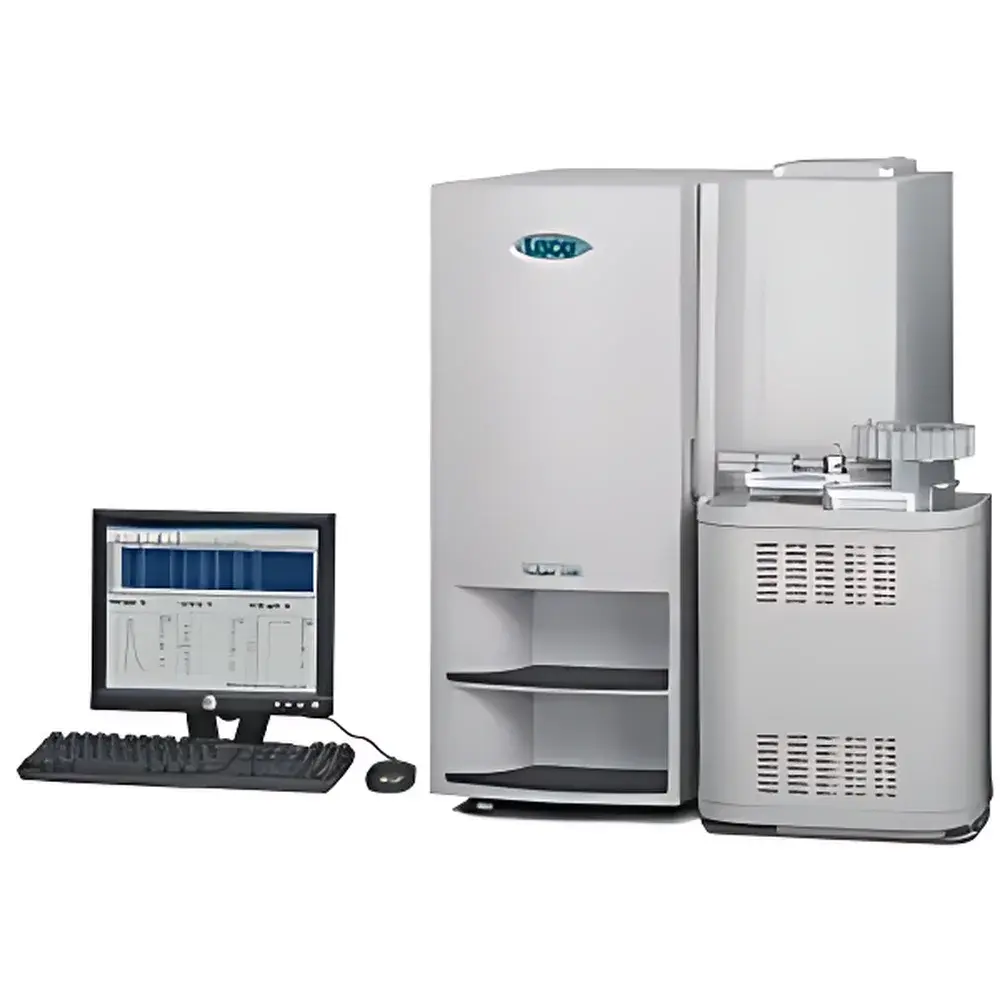
LECO TruSpec® Series Dumas Combustion Elemental Analyzer
| Brand | LECO |
|---|---|
| Origin | USA |
| Manufacturer | LECO Corporation |
| Instrument Type | Dumas Combustion-Based Elemental Analyzer |
| Application Focus | Total Nitrogen, Protein, Carbon, Sulfur, and/or Oxygen Determination in Organic and Inorganic Matrices |
| Model Family | TruSpec® Micro, TruSpec® Soil, TruSpec® CHN, TruSpec® CS, TruSpec® CNS (Configurable per application) |
| Compliance | ASTM D5142, D6347/D6347M, D7329, ISO 13878, AOAC 992.15, 993.13, 2001.11, USP <467>, EPA Method 440.1, EN ISO 13878 |
Overview
The LECO TruSpec® Series is a family of high-precision, combustion-based elemental analyzers engineered for rapid, accurate, and fully automated determination of nitrogen, carbon, sulfur, oxygen, and hydrogen in diverse solid and liquid samples. Utilizing the Dumas high-temperature combustion principle—where samples are flash-combusted in a pure oxygen environment at up to 1,150 °C—the system quantifies evolved gases (N₂, CO₂, SO₂, CO, H₂O) via high-sensitivity thermal conductivity detection (TCD) and/or infrared (IR) absorption. This physicochemical approach eliminates wet chemistry, distillation, and catalyst poisoning concerns associated with Kjeldahl methods, delivering true total nitrogen content—including nitrate, nitrite, and heterocyclic forms—without sample-specific method revalidation. Designed for routine QC/QA laboratories, agricultural testing centers, food safety labs, and environmental monitoring facilities, the TruSpec® platform delivers robust performance across matrices ranging from cereal grains and meat products to soil, fertilizers, pharmaceutical excipients, and polymer additives.
Key Features
- Modular furnace architecture with independent temperature zoning (combustion, reduction, and purification zones), enabling precise thermal control and extended catalyst lifetime.
- Automated solid and liquid sample introduction via programmable autosampler (up to 60 positions), supporting weighed-in or pre-weighed capsule loading with integrated balance interface.
- Dual-detector configuration options: TCD for nitrogen and carbon; IR cells for sulfur, carbon dioxide, and water vapor—ensuring simultaneous multi-element quantification in a single run.
- Catalyst management system with real-time consumption monitoring and automatic regeneration cycles, minimizing downtime and operator intervention.
- Integrated gas purification train featuring copper oxide, magnesium perchlorate, and ascarite™ beds to remove halogens, moisture, and acidic interferences prior to detection.
- Self-diagnostic firmware with continuous pressure, flow, and temperature logging—supporting instrument qualification (IQ/OQ/PQ) and preventive maintenance scheduling.
Sample Compatibility & Compliance
The TruSpec® Series accommodates heterogeneous samples including ground cereals, freeze-dried tissues, homogenized feedstuffs, powdered soils, digested sludge, and pharmaceutical tablets. Sample mass ranges from 0.1 mg to 1,000 mg depending on matrix and target element concentration. All configurations comply with internationally recognized standards for elemental analysis, including ASTM D5142 (total nitrogen in coal and coke), ASTM D6347/D6347M (nitrogen in petroleum products), ISO 13878 (soil nitrogen), AOAC Official Methods 992.15 (crude protein in feed), 993.13 (nitrogen in dairy), and USP (residual solvents and elemental impurities). The system supports 21 CFR Part 11–compliant audit trails, electronic signatures, and data integrity protocols when operated with LECO’s optional ChromaTOF® or Reveal™ software suites.
Software & Data Management
Controlled via LECO’s Windows-based Reveal™ software, the TruSpec® platform provides method-driven workflow automation, real-time chromatogram visualization, peak integration with baseline correction algorithms, and customizable calibration curve management (linear, quadratic, or multi-point non-linear). Data export conforms to ASTM E1382 and ASTM E1461 formats, with native compatibility for LIMS integration via ODBC and HL7 interfaces. All analytical records—including raw signals, processed results, instrument parameters, and user actions—are timestamped and stored in a secure, encrypted database with configurable retention policies. Software validation packages (including IQ/OQ documentation templates and test scripts) are available for GxP-regulated environments.
Applications
- Food & Agriculture: Crude protein calculation (N × 6.25 or matrix-specific factors) in grains, legumes, dairy, pet food, and aquafeed; compliance with Codex Alimentarius and EU Regulation (EC) No 152/2009.
- Environmental: Total Kjeldahl nitrogen (TKN)-equivalent nitrogen in wastewater biosolids, compost, and agricultural runoff; carbon sequestration assessment in soil organic matter studies.
- Pharmaceuticals: Nitrogen content verification in active pharmaceutical ingredients (APIs) and excipients per ICH Q5C; residual catalyst screening in synthetic intermediates.
- Materials Science: Carbon and sulfur profiling in graphite electrodes, carbon black, and metal alloys; oxygen determination in ceramics and refractory materials.
- Research: High-throughput elemental mapping in plant phenotyping, nutritional genomics, and metabolic flux analysis using isotopically labeled substrates (¹⁵N, ¹³C).
FAQ
What sample preparation is required prior to analysis?
Minimal preparation is needed: samples must be homogenized and dried to constant weight. Solid samples are encapsulated in tin or silver boats; liquids are loaded into sealed vials or weighed directly into tin capsules. No acid digestion or derivatization is required.
Can the TruSpec® analyze volatile or thermally labile compounds?
Yes—optimized combustion parameters (e.g., lower oxygen flow, staged heating) and specialized catalysts enable reliable nitrogen recovery from nitrocellulose, ammonium nitrate, and certain explosives without decomposition artifacts.
Is method transfer possible between different TruSpec® models?
Method files, calibration curves, and sequence protocols are fully portable across the TruSpec® family, provided detector configurations and furnace modules are equivalent.
How is system performance verified daily?
Daily verification uses certified reference materials (CRMs) traceable to NIST or BAM, such as EDTA, urea, or thiourea, with acceptance criteria defined by internal SOPs aligned with ISO/IEC 17025 proficiency requirements.
Does LECO provide regulatory support for FDA or EMA submissions?
Yes—LECO offers comprehensive validation documentation, including URS, FRS, DQ/IQ/OQ/PQ protocols, and 21 CFR Part 11 readiness assessments, supported by qualified field application scientists and global service engineers.






