
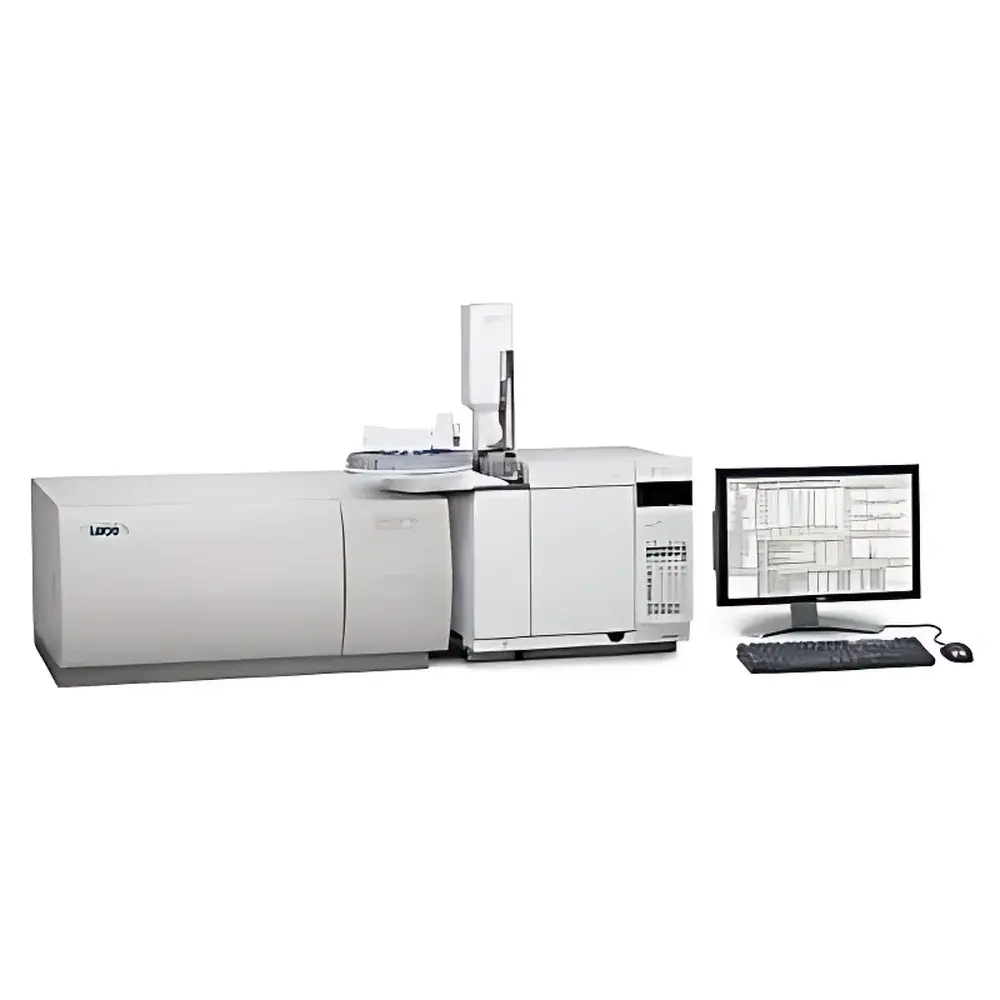
LECO TruTOF HT Gas Chromatography Time-of-Flight Mass Spectrometer
| Brand | LECO |
|---|---|
| Origin | USA |
| Manufacturer Type | Original Equipment Manufacturer (OEM) |
| Origin Category | Imported |
| Model | TruTOF HT |
| Instrument Type | Time-of-Flight Mass Spectrometer (TOF-MS) |
| Acquisition Rate | 80 full-scan spectra/sec |
| Data Transfer Rate | 20,000 spectra/sec |
| Mass Range | m/z 5–1000 |
| Resolution (FWHM) | 2000 |
| Ionization Modes | Electron Ionization (EI) and Chemical Ionization (CI) with rapid switching |
| Ion Source | Field-serviceable design |
| Dynamic Signal Tracking | Yes |
| Quantitation Limit | Sub-pg level for target analytes |
| Regulatory Compliance | EPA-certified for environmental and food safety applications |
| Form Factor | Benchtop |
Overview
The LECO TruTOF HT is a high-performance benchtop gas chromatography time-of-flight mass spectrometer (GC-TOFMS) engineered for comprehensive, untargeted analysis of complex chemical matrices. Unlike scanning-based instruments such as quadrupole or ion trap mass spectrometers, the TruTOF HT acquires full-spectrum data at 80 Hz—capturing every eluting peak across the entire chromatographic window without duty cycle loss. Its orthogonal time-of-flight analyzer delivers high mass accuracy (< 3 ppm RMS), unit-mass resolution (2000 FWHM), and wide dynamic linear range enabled by proprietary Dynamic Signal Tracking technology. This architecture supports both qualitative identification and quantitative profiling in a single run, making it especially suited for laboratories transitioning from legacy GC-MS platforms to meet evolving regulatory expectations in environmental monitoring, food safety, forensic toxicology, and metabolomics research.
Key Features
- High-Speed Full-Scan Acquisition: 80 full-scan spectra per second with real-time data transfer at 20,000 spectra/sec ensures no chromatographic peak is undersampled—even under ultra-fast GC conditions (e.g., 1–2 min run times).
- Robust Ion Source Design: Modular, field-serviceable EI/CI source enables rapid mode switching and minimizes instrument downtime during routine maintenance.
- True Signal Deconvolution™: Advanced spectral deconvolution algorithm resolves co-eluting compounds with high fidelity, preserving isotopic patterns and enabling confident compound identification even in highly congested chromatograms.
- Automated Peak Finding™: Intelligent chromatogram processing detects, integrates, and aligns peaks across sample batches without manual intervention—reducing analyst bias and improving reproducibility.
- Benchtop Integration: Compact footprint accommodates standard laboratory workspaces while maintaining vacuum integrity and thermal stability required for high-resolution TOF operation.
- EPA-Validated Performance: Certified for use in U.S. Environmental Protection Agency Method 8270-compliant analyses, including semivolatile organic compounds (SVOCs) in soil, water, and air matrices.
Sample Compatibility & Compliance
The TruTOF HT interfaces seamlessly with all major GC platforms via standard electron ionization (EI) and chemical ionization (CI) sources. It supports volatile and semi-volatile organic compounds (VOCs/SVOCs), pesticides, polycyclic aromatic hydrocarbons (PAHs), phthalates, flame retardants, and emerging contaminants—including those requiring soft ionization for molecular ion preservation. The system complies with ISO/IEC 17025:2017 requirements for testing laboratories and supports audit-ready data handling per FDA 21 CFR Part 11 when deployed with compliant software configurations. All spectral libraries (NIST, Wiley, LECO-specific) are integrated into the data system with automated matching confidence scoring.
Software & Data Management
ChromaTOF® software provides end-to-end workflow control—from method development and acquisition to post-run deconvolution, library searching, and report generation. Raw data files (.tdf) are stored in an open, non-proprietary format supporting third-party reprocessing. Built-in batch processing tools enable alignment across hundreds of samples with retention time correction, peak area normalization, and statistical outlier detection. Audit trails record all user actions, parameter changes, and processing steps, satisfying GLP/GMP documentation requirements. Export options include CSV, mzML, and SIRIUS-compatible formats for downstream chemometric analysis.
Applications
- Environmental analysis: Screening of PFAS, dioxins/furans, PCBs, and petroleum hydrocarbons in wastewater, sediment, and biota.
- Food safety: Residue analysis of multi-class pesticides, mycotoxins, and adulterants in fruits, vegetables, dairy, and infant formula.
- Clinical & forensic toxicology: Untargeted screening of drugs of abuse, novel psychoactive substances (NPS), and endogenous metabolites in urine and blood.
- Materials science: Off-gassing profiling of polymers, adhesives, and electronic components using thermal desorption-GC-TOFMS.
- Academic research: Discovery-phase metabolomics and exposomics studies requiring high mass accuracy, broad dynamic range, and reproducible peak detection.
FAQ
What distinguishes TruTOF HT from conventional quadrupole GC-MS systems?
Unlike quadrupole instruments limited to selected ion monitoring (SIM) or low-speed full-scan modes, the TruTOF HT captures complete spectral information at 80 Hz—enabling retrospective analysis, improved compound identification, and superior quantitation linearity.
Is the TruTOF HT compatible with existing GC hardware?
Yes—it connects to any standard GC via a universal transfer line interface and supports common column dimensions (0.18–0.32 mm ID) and carrier gases (He, H₂, N₂).
How does Dynamic Signal Tracking improve quantitative performance?
This patented analog-to-digital conversion technique maintains linearity over six orders of magnitude, eliminating saturation effects and extending the lower limit of quantitation (LLOQ) without sacrificing high-abundance signal fidelity.
Can ChromaTOF software be validated for regulated environments?
Yes—ChromaTOF v5.2+ includes 21 CFR Part 11-compliant features such as electronic signatures, role-based access control, and immutable audit logs suitable for FDA, EMA, and ISO 17025 audits.
What maintenance intervals are recommended for the TOF analyzer?
Under typical usage (≤ 8 hrs/day), the reflectron and detector require calibration every 6 months; ion source cleaning is recommended after every 500 injections or as indicated by sensitivity drift.
Related Products





