
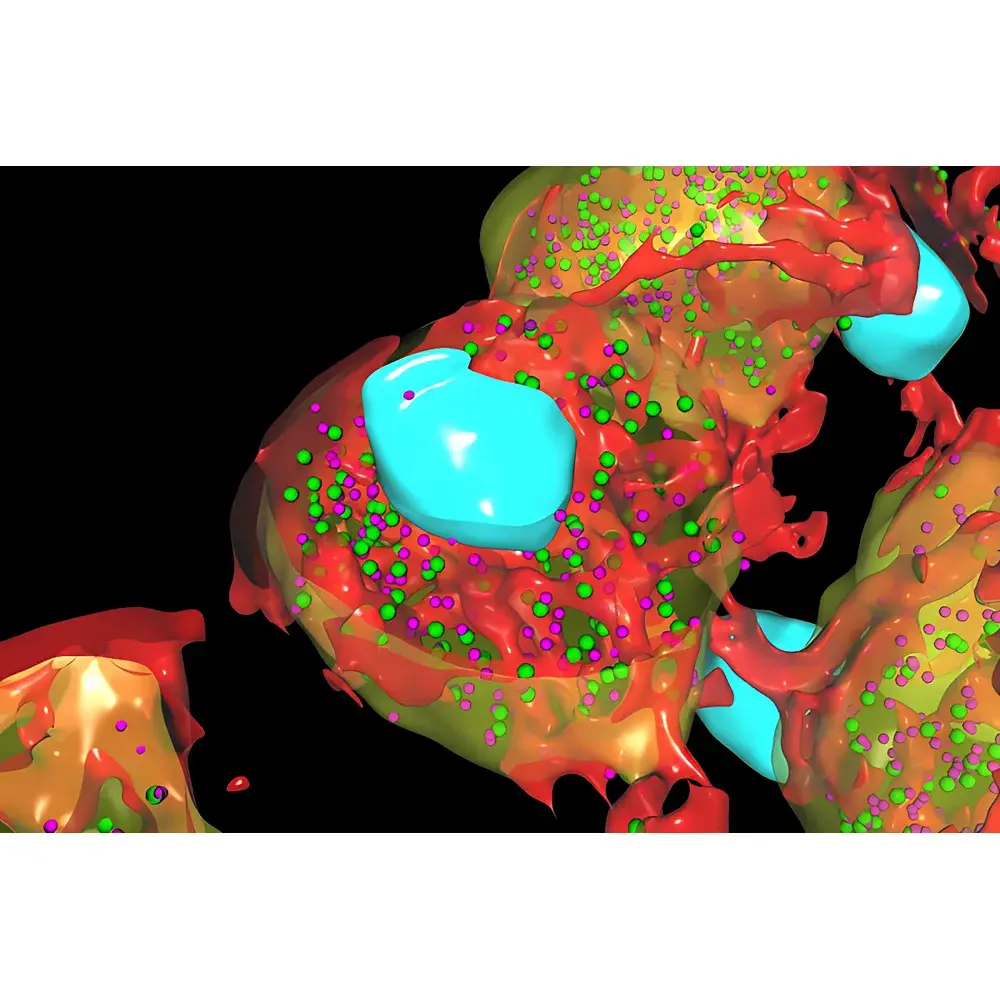
Leica Aivia AI-Powered Microscopic Image Analysis Software
| Brand | Leica |
|---|---|
| Origin | Germany |
| Manufacturer Type | Authorized Distributor |
| Origin Category | Imported |
| Model | Aivia |
| Pricing | Upon Request |
Overview
Leica Aivia is a purpose-built, AI-native software platform engineered for quantitative, reproducible, and biologically informed analysis of 2D to 5D microscopic image data. Unlike conventional image analysis tools relying on threshold-based or rule-driven segmentation—methods inherently sensitive to noise, intensity variation, and user bias—Aivia leverages deep learning architectures trained on expert-annotated biological ground truth. Its core measurement principle integrates supervised and semi-supervised learning with domain-aware feature extraction, enabling robust object detection, instance segmentation, subcellular classification, and spatiotemporal tracking without manual parameter tuning. Designed explicitly for life science laboratories, Aivia bridges the gap between advanced computational imaging and routine microscopy workflows, supporting high-content screening, live-cell dynamics, volumetric neuroimaging, and multiplexed tissue analysis—all within a single, unified software environment compliant with modern data integrity standards.
Key Features
- AI-first architecture with 20 pre-trained deep learning models for segmentation, denoising, super-resolution, and virtual staining—validated across >250,000 expert-curated inference runs
- Parameter-free segmentation engine that adapts to biological context (e.g., nuclei, membranes, synaptic puncta, organelles) without requiring user-defined thresholds or morphological assumptions
- Native support for 45+ microscope file formats—including Leica LAS X, Zeiss CZI, Nikon ND2, Olympus OIR, and open standards like OME-TIFF and TIFF stacks—ensuring vendor-agnostic interoperability
- Dual deployment mode: local installation (Windows/Linux) for latency-sensitive processing or cloud-enabled AiviaWeb via secure HTTPS browser access (Chrome, Edge, Firefox)
- Integrated 2D–5D visualization engine with GPU-accelerated rendering, time-series alignment, multi-channel colocalization quantification, and interactive 3D neuron reconstruction tools
- Comprehensive application suite comprising 22 domain-specific modules—from mitotic phase classification and cell migration tracking to 3D spheroid growth modeling and synaptic density mapping
Sample Compatibility & Compliance
Aivia supports analysis of fixed and live-cell samples imaged across widefield, confocal, light-sheet, STED, and expansion microscopy modalities. It accommodates diverse specimen types including adherent monolayers, organoids, brain slices, zebrafish embryos, and FFPE tissue sections. The software complies with data management requirements under GLP and GMP-aligned research environments: audit trails record all processing steps (including model version, training dataset ID, and user metadata), and raw image–derived results are stored with immutable provenance. While not certified as a medical device, Aivia meets essential criteria referenced in ISO/IEC 17025 (for testing laboratories) and aligns with FAIR data principles (Findable, Accessible, Interoperable, Reusable). All cloud operations adhere to GDPR-compliant data residency policies and TLS 1.3 encryption.
Software & Data Management
Aivia implements a structured project-based workspace with hierarchical metadata tagging, version-controlled analysis pipelines, and export-ready reporting templates (PDF, CSV, PNG, SVG). The platform enforces traceability through embedded digital signatures for each analytical step—fully compatible with FDA 21 CFR Part 11 requirements when deployed in regulated environments using validated configurations. Users can retrain or fine-tune models using custom annotations via intuitive drag-and-drop labeling tools; trained models are exportable as portable .onnx files for cross-platform reuse. Data synchronization between local workstations and AiviaCloud is managed via encrypted REST APIs, enabling collaborative review across geographically distributed teams while preserving local data sovereignty.
Applications
- High-throughput phenotypic screening in drug discovery: automated quantification of cellular morphology, proliferation, apoptosis, and organelle redistribution
- Neuroscience research: 3D reconstruction of dendritic arbors, synapse counting in serial EM or light-sheet datasets, and calcium transient kinetics in time-lapse volumetric recordings
- Developmental biology: embryonic cell lineage tracing, tissue morphogenesis modeling, and mitotic spindle orientation analysis
- Cancer biology: tumor spheroid invasion metrics, immune cell infiltration scoring in multiplex IHC/IF, and spatial heterogeneity mapping
- Quality control in core imaging facilities: standardized pipeline execution across users, reducing inter-operator variability and accelerating turnaround for shared-resource users
FAQ
Does Aivia require programming knowledge to operate?
No. Aivia features a fully graphical interface with zero-code workflow assembly. All AI models are preconfigured and accessible via point-and-click interaction—no Python, MATLAB, or command-line expertise is needed.
Can Aivia be integrated into existing LIMS or ELN systems?
Yes. Aivia provides RESTful API endpoints and supports standard data exchange formats (JSON, OME-XML, CSV), enabling bidirectional integration with common laboratory informatics platforms.
Is raw image data processed on-premise or in the cloud by default?
Processing occurs locally unless explicitly routed to AiviaCloud. Users retain full administrative control over data routing, compute allocation, and retention policies.
How does Aivia ensure reproducibility across different users and sessions?
Every analysis generates a self-contained pipeline file (.aivia) embedding model weights, preprocessing parameters, and execution history—guaranteeing identical output when re-run on the same input dataset.
What validation documentation is available for regulated use?
Leica provides IQ/OQ documentation packages, installation qualification checklists, and performance verification protocols aligned with ISO 13485 and GxP expectations—available upon request for qualified institutions.




