
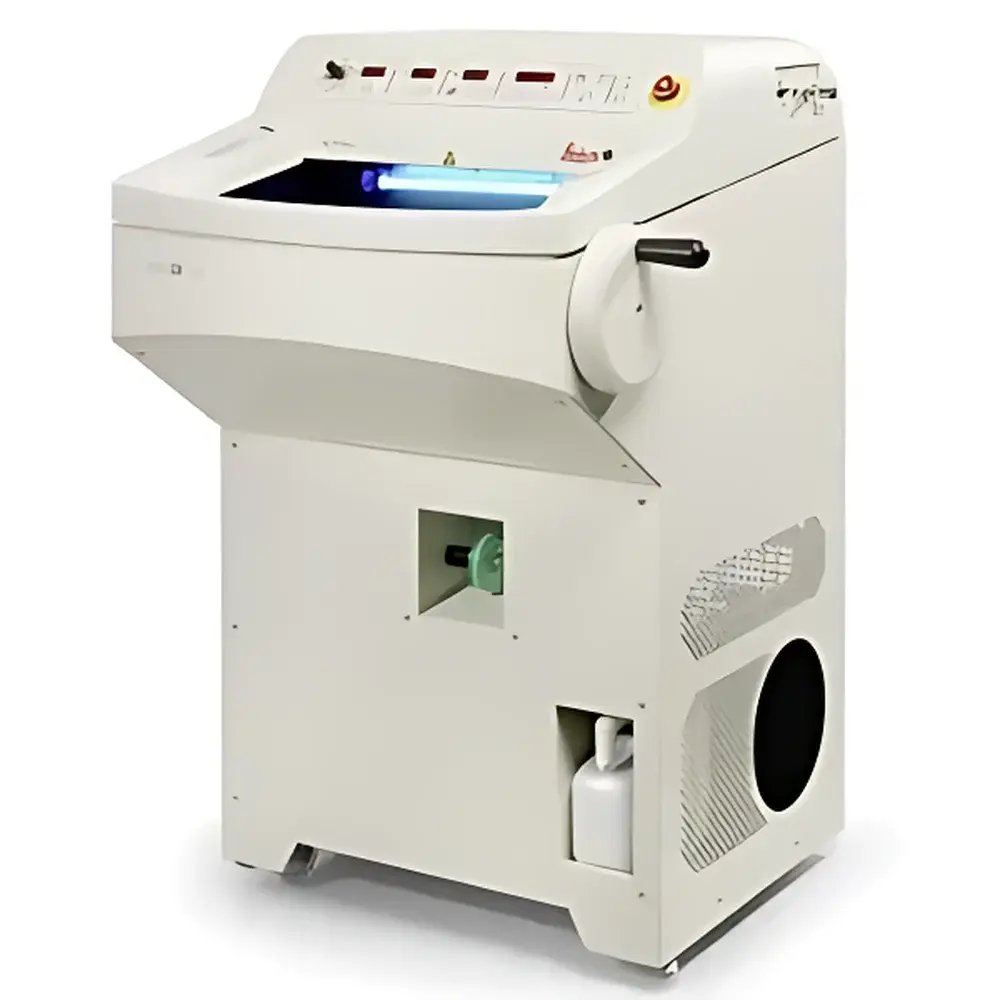
Leica CM1950 Cryostat Microtome
| Brand | Leica |
|---|---|
| Origin | Germany |
| Model | CM1950 |
| Maximum Specimen Size | 50 × 80 mm |
| Section Thickness Range | 1–100 µm |
| Sectioning Increment | 25 µm + 1 µm fine adjustment |
Overview
The Leica CM1950 Cryostat Microtome is a precision-engineered, refrigerated microtomy system designed for high-fidelity frozen sectioning of biological tissues in clinical diagnostics, translational research, and pharmaceutical development laboratories. Operating on the principle of cryo-sectioning—where specimens are rapidly frozen to sub-zero temperatures (typically −20 °C to −30 °C) to maintain structural integrity and antigenicity—the CM1950 enables consistent, artifact-free sections for downstream histopathological analysis, immunohistochemistry (IHC), and fluorescence microscopy. Its modular architecture integrates thermoelectric cooling, vibration-damped specimen stage mechanics, and calibrated knife advance mechanisms to ensure reproducible section thickness across heterogeneous tissue types—including fatty, fibrous, or calcified samples—without compromising cellular morphology.
Key Features
- Thermally stable cryo-chamber with independent temperature control for specimen head (−20 °C to −30 °C) and knife (−5 °C to −15 °C), minimizing thermal drift during prolonged operation.
- Motorized specimen advance with dual-step increment: coarse 25 µm and fine 1 µm adjustment, enabling precise calibration for serial sectioning protocols required in stereology and 3D reconstruction.
- UVC germicidal irradiation system integrated into the chamber lid, delivering ≥99.9% inactivation of DNA/RNA viruses, bacteria, and spores on exposed surfaces between sessions—supporting biosafety Level 2 (BSL-2) compliance.
- AgProtect® nanosilver antimicrobial coating applied uniformly across all external polymer housings and user-contact surfaces, providing continuous surface-level bioburden reduction per ISO 22196 standards.
- Optional vacuum-assisted section removal module featuring a concealed primary mesh filter (stainless steel, 100 µm pore) and secondary HEPA-grade air filtration (H13 class, ≥99.95% efficiency at 0.3 µm), reducing airborne particulate exposure during routine sectioning.
- Patented disposable blade holder with dovetail mounting interface ensures repeatable blade alignment, increased working distance (≥35 mm), and minimized lateral deflection—critical for maintaining parallelism across large-format (50 × 80 mm) specimens.
Sample Compatibility & Compliance
The CM1950 accommodates standard OCT-embedded tissue blocks up to 50 mm (W) × 80 mm (D), compatible with both manual and automated staining workflows. It supports common cryo-embedding media (e.g., Tissue-Tek O.C.T., Sakura Finetek NEG-50) and accepts stainless-steel, tungsten-carbide, and disposable polypropylene blades. The system meets essential safety and performance requirements under IEC 61010-1 (electrical safety), EN 61326-1 (EMC), and ISO 13485:2016 (medical device quality management). UVC and AgProtect® features align with CDC/NIH biosafety guidelines for handling potentially infectious specimens, while optional HEPA filtration supports adherence to local occupational health regulations (e.g., OSHA 1910.1200, EU Directive 2004/37/EC).
Software & Data Management
While the CM1950 operates as a standalone electromechanical instrument without embedded touchscreen software, it includes a standardized RS-232 interface for integration with laboratory information systems (LIS) and digital pathology platforms. All operational parameters—including section thickness, chamber temperature, knife temperature, and UVC exposure duration—are logged via optional external data acquisition modules compliant with FDA 21 CFR Part 11 requirements (audit trail, electronic signature, and data integrity controls). Routine maintenance events and calibration records can be exported in CSV format for GLP/GMP audit readiness.
Applications
- Intraoperative frozen section diagnosis in surgical pathology departments, supporting rapid tumor margin assessment.
- Preclinical toxicology studies requiring serial sectioning of rodent or non-human primate tissues for histomorphometric quantification.
- Biomarker discovery workflows involving multi-omics correlation, where antigen preservation in frozen sections is critical for subsequent spatial transcriptomics or multiplex IHC.
- Neuropathology labs performing amyloid-beta or tau immunostaining on post-mortem brain tissue, where cold-induced epitope masking must be minimized.
- Biobanking facilities implementing standardized cryosectioning SOPs aligned with ISBER Best Practices and NCBI Biorepository Standards.
FAQ
What is the minimum achievable section thickness with the CM1950, and how is repeatability ensured?
The CM1950 achieves a nominal minimum section thickness of 1 µm using fine-adjustment mode. Repeatability is maintained through a hardened linear encoder coupled to the specimen advance mechanism and verified by traceable NIST-calibrated micrometers during factory acceptance testing.
Can the CM1950 be used for hard-tissue cryosectioning, such as decalcified bone?
While optimized for soft biological tissues, the CM1950 may accommodate lightly decalcified bone specimens when paired with tungsten-carbide blades and reduced sectioning speed; however, dedicated hard-tissue microtomes (e.g., Leica SM2010R) are recommended for routine mineralized tissue work.
Is the UVC system validated for specific pathogens, and what is its service life?
The UVC lamp is rated for 8,000 hours of operation and has been validated per ISO 15714 for log4 reduction of MS2 bacteriophage—a surrogate for non-enveloped viruses—under controlled chamber conditions.
Does the AgProtect® coating require reapplication or maintenance?
No. AgProtect® is a sputter-deposited, non-leaching nanosilver layer permanently bonded to polymer surfaces during manufacturing and remains effective throughout the instrument’s service lifetime without degradation or replenishment.



