
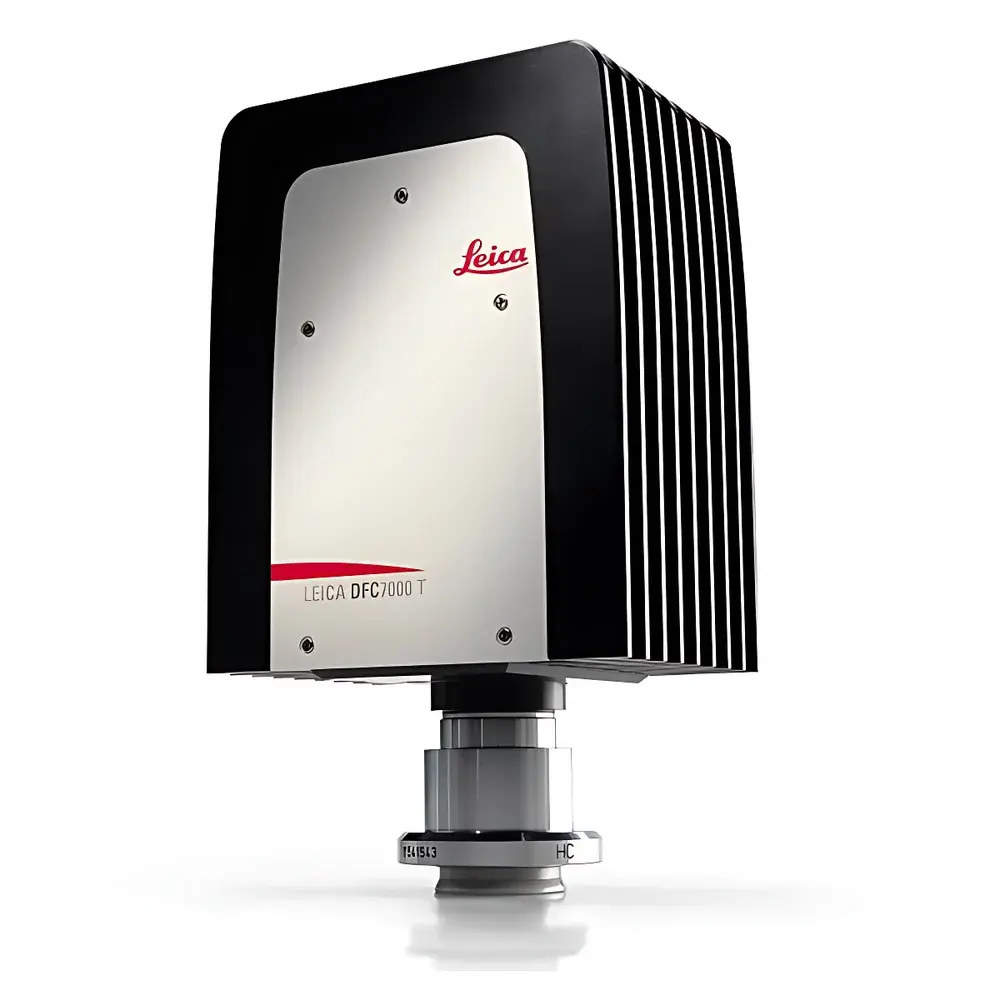
Leica DFC7000 T Scientific CMOS Microscope Camera
| Brand | Leica |
|---|---|
| Origin | Germany |
| Model | DFC7000 T |
| Sensor Type | Scientific CMOS |
| Resolution | 2.8 MP (1920 × 1440) |
| Pixel Size | 4.54 µm |
| Cooling | Peltier-cooled (ΔT ≈ −15 °C below ambient) |
| Frame Rate | Up to 40 fps at full resolution |
| Color Interpolation | Proprietary “TrueColor” demosaicing algorithm |
| Spectral Sensitivity | 350–1000 nm (peak QE > 75% at 550 nm) |
| Bit Depth | 12-bit ADC |
| Interface | USB 3.0 |
| Compliance | CE, FCC, RoHS |
| Software Compatibility | Leica LAS X (v3.6+), LAS (v4.12+), third-party support via TWAIN/DCAM |
Overview
The Leica DFC7000 T is a high-performance scientific CMOS microscope camera engineered for quantitative brightfield and multichannel fluorescence imaging in life science and biomedical research laboratories. Unlike legacy interline CCD architectures, the DFC7000 T employs a back-illuminated scientific CMOS sensor with on-chip correlated double sampling (CDS), enabling simultaneous high sensitivity, low read noise (73 dB). Its optical design integrates seamlessly with Leica DM series upright and inverted microscopes—leveraging native C-mount coupling and precise mechanical registration to preserve parfocality across illumination modes. The camera operates on a fundamental principle of photon-limited detection: quantum efficiency optimization across the visible-to-NIR spectrum (350–1000 nm), combined with thermoelectric cooling (Peltier-based, ΔT ≈ −15 °C below ambient), ensures stable dark current suppression (<0.005 e⁻/pixel/s at 20 °C ambient). This architecture supports both static acquisition and time-resolved kinetics—making it suitable for live-cell tracking, FRET quantification, and developmental biology workflows where phototoxicity minimization and temporal fidelity are critical.
Key Features
- 2.8 MP resolution (1920 × 1440) with 4.54 µm square pixels—optimized for diffraction-limited imaging with NA ≥ 0.75 objectives
- Proprietary TrueColor interpolation algorithm that dynamically adapts color matrix coefficients to illumination source (halogen, LED, or mercury arc), preserving hue accuracy without post-acquisition correction
- Real-time binning modes: 5×5 pixel merging enables up to 120 fps in monochrome mode; full-resolution streaming at 40 fps via USB 3.0 interface
- Thermally stabilized sensor housing with passive heatsink design—fanless operation eliminates mechanical vibration and acoustic interference during long-exposure acquisitions
- Dynamic hot-pixel correction with non-volatile lookup table (NVLUT), updated automatically during calibration routines—no user intervention required between sessions
- Hardware-triggered acquisition synchronized with external devices (shutters, filter wheels, stage controllers) via TTL I/O port compliant with IEEE 1394/USB3 Vision timing standards
Sample Compatibility & Compliance
The DFC7000 T is validated for use with fixed and live biological specimens—including tissue sections, cultured mammalian cells, zebrafish embryos, C. elegans, and Drosophila preparations. Its spectral response covers standard fluorophores (DAPI, FITC, TRITC, Cy3, Cy5, Cy5.5) and extends into the near-infrared (up to 950 nm), supporting multiplexed labeling strategies involving tandem dyes and fluorescent proteins (eGFP, mCherry, tdTomato, iRFP670). The camera meets ISO 13406-2 Class I requirements for image uniformity and complies with IEC 61000-6-3 (EMC emission limits) and IEC 61000-6-2 (immunity). For regulated environments, LAS X software supports audit trails, electronic signatures, and 21 CFR Part 11-compliant metadata embedding—including timestamped exposure parameters, objective ID, and environmental log data.
Software & Data Management
The DFC7000 T is fully integrated with Leica’s LAS X platform (v3.6 or later), offering modular acquisition modules for tiling, Z-stacking, multi-position time-lapse, and spectral unmixing. Raw image data is saved in TIFF format with embedded EXIF-compatible metadata (including gain, exposure, binning, temperature, and lens magnification). LAS X supports DICOM export for clinical pathology integration and HDF5 container output for large-scale computational analysis pipelines. User access levels can be configured via role-based permissions—restricting novice users from modifying analog gain, black balance offsets, or color matrix parameters while retaining full functionality for senior researchers. All calibration files (flat-field, dark-frame, pixel defect maps) are stored in encrypted binary format and version-controlled within the LAS X project database.
Applications
- Quantitative histopathology: High-fidelity color reproduction enables reproducible assessment of H&E, Masson’s trichrome, and immunohistochemical stains under standardized lighting conditions
- Live-cell dynamics: Sub-second frame rates facilitate calcium transient mapping, mitochondrial fission/fusion events, and membrane trafficking studies without motion blur
- Multiplexed fluorescence imaging: Simultaneous capture of ≥4 channels using sequential LED excitation and hardware-triggered acquisition—eliminating filter wheel latency and cross-talk
- Developmental biology: Thermal stability across +5 °C to +50 °C ambient permits long-term imaging of thermosensitive models (e.g., heat-shock-induced protein expression in fly embryos)
- Preclinical imaging: Wide field-of-view coverage (up to 4.5 mm diagonal at 10× objective) accelerates mosaic acquisition for whole-organism screening assays
FAQ
Does the DFC7000 T support hardware triggering for synchronization with external equipment?
Yes—it features a dedicated TTL-compatible I/O port supporting input trigger, output exposure sync, and bidirectional shutter control with programmable delay (1 µs resolution).
Can the camera operate in environments outside typical lab temperature ranges?
Yes—the sensor housing is rated for continuous operation between +5 °C and +50 °C ambient, with active thermal regulation maintaining consistent dark current performance.
Is raw data export supported for third-party analysis platforms?
Yes—TIFF and HDF5 formats are natively supported, including full metadata serialization (exposure, gain, temperature, objective ID) compatible with Python (scikit-image, napari), MATLAB, and ImageJ/Fiji.
How does the TrueColor algorithm differ from conventional Bayer interpolation?
It applies illumination-aware chromatic adaptation using real-time spectral weighting derived from Leica’s internal lamp calibration profiles—reducing metamerism errors in mixed-light conditions.
What maintenance is required for long-term calibration stability?
No routine recalibration is needed—the camera performs automatic dark-frame and flat-field correction at startup; NVLUT-based hot-pixel mapping persists across firmware updates and power cycles.




