
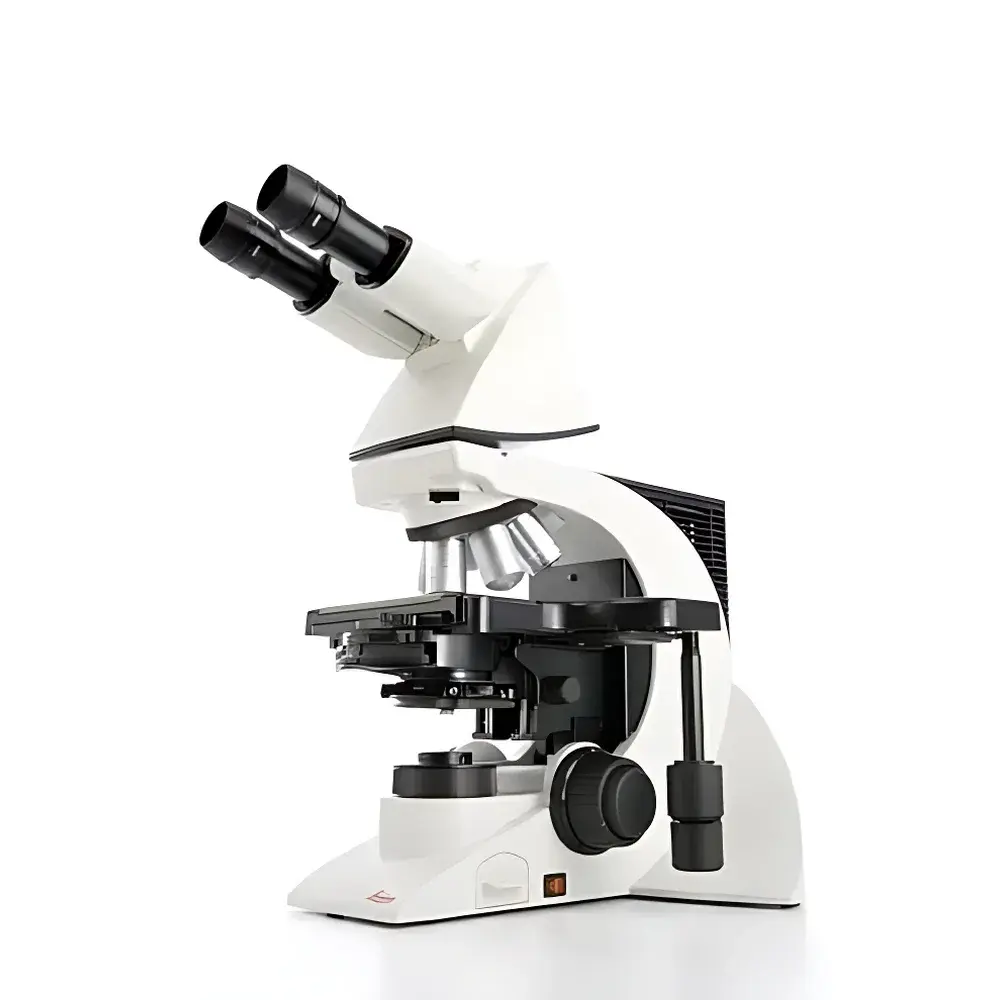
Leica DM2000 Upright Biological Microscope
| Brand | Leica |
|---|---|
| Origin | Shanghai, China |
| Manufacturer Type | Authorized Distributor |
| Origin Category | Domestic Production |
| Model | DM2000 |
| Price Range | USD 7,000 – 14,000 |
| Instrument Type | Upright Microscope |
| Eyepiece Configuration | Binocular |
| Illumination | Halogen (30 W) or LED (DM2000 LED variant) |
| Observation Modes | Brightfield, Darkfield, Phase Contrast, Polarization, Fluorescence |
| Objective Turret | 7-position |
| Ergonomic Features | Adjustable focus knobs, tiltable binocular tube (fixed or variable angle), height-adjustable stage controls, symmetrical control layout |
| Fluorescence Compatibility | Standard Leica filter cubes with zero-pixel-shift technology |
| Software Integration | Leica DMshare V3 (wireless image streaming to iOS/Android tablets), Leica LAS X-compatible image management and analysis modules |
| Compliance | Designed to support GLP/GMP workflows |
Overview
The Leica DM2000 is a high-performance upright biological microscope engineered for routine and advanced life science applications—including histopathology, cytology, hematology, and in vivo tissue assessment. Built on Leica Microsystems’ proven optical architecture, it employs Köhler illumination as the foundational standard for uniform brightness and optimal contrast across all observation modes. Its modular design supports brightfield, darkfield, phase contrast, polarization, and fluorescence microscopy—enabling seamless transitions between modalities without mechanical realignment. The system’s optical path is optimized for minimal chromatic aberration and high transmission efficiency, particularly critical in fluorescence imaging where signal-to-noise ratio directly impacts detection sensitivity. Unlike entry-level platforms, the DM2000 integrates research-grade components—including Leica’s zero-pixel-shift fluorescence filter sets—ensuring spatial fidelity and repeatability essential for longitudinal studies and regulatory documentation.
Key Features
- Ergonomic workstation design: Fully adjustable focus knobs (height and rotational resistance configurable in 2- or 3-step increments), tiltable binocular tube (fixed 25° or continuously variable 0–35°), and symmetrically positioned X/Y stage controls reduce musculoskeletal strain during extended use.
- 7-position objective turret: Accommodates Leica’s full range of Plan Apochromat and HCX objectives (4× to 100× oil), enabling rapid, repeatable magnification changes with mechanical indexing precision.
- Intelligent illumination management: Synchronized light intensity adjustment across objectives eliminates manual re-balancing when switching magnifications—minimizing phototoxicity and observer visual fatigue.
- Dual illumination options: Standard 30 W halogen lamp with drawer-style replacement mechanism or optional long-life LED module delivering daylight-balanced (~5,600 K) illumination at <15 W power draw, eliminating bulb degradation drift over time.
- Fluorescence-ready platform: Integrated fluorescence nosepiece with five-position filter cube holder; compatible with Leica’s certified fluorescence filter sets featuring anti-bleed coatings and pixel-registered alignment for quantitative multi-channel imaging.
Sample Compatibility & Compliance
The DM2000 accommodates standard glass slides (1 × 3 inches), petri dishes (up to 100 mm diameter), and live-cell chambers with integrated temperature/humidity control ports. Its stage travel (76 × 52 mm) and coarse/fine focus range (25 mm vertical travel, 1 µm fine step resolution) support both thin-sectioned tissues and thicker 3D specimens. The system meets ISO 10993 biocompatibility guidelines for non-invasive sample handling interfaces and complies with IEC 61000-6-3 EMC standards. When paired with Leica LAS X software under validated configuration, it supports audit trail generation, electronic signature capture, and user-access-controlled workflow permissions—aligning with FDA 21 CFR Part 11 and EU Annex 11 requirements for regulated laboratories.
Software & Data Management
Leica DMshare V3 enables real-time wireless streaming of live microscope images to iPadOS and Android tablets—facilitating collaborative review, remote mentoring, and digital annotation without dedicated workstations. Image metadata (objective ID, exposure time, illumination mode, date/time stamp) is embedded automatically. For structured analysis, the DM2000 integrates natively with Leica LAS X Core and LAS X Life Science Edition—supporting batch processing, measurement scripting (e.g., cell counting, area fraction quantification), and DICOM export for PACS integration. All software modules are installable on Windows-based acquisition PCs and support networked deployment with centralized license management.
Applications
The DM2000 serves as a primary diagnostic instrument in clinical pathology labs performing H&E, Gram, and Giemsa staining evaluations. In academic research, its phase contrast and fluorescence capabilities support live-cell imaging of transfected constructs, organelle dynamics, and immunofluorescent labeling protocols. Hematology departments utilize its high-contrast brightfield optics for peripheral blood smear analysis and reticulocyte enumeration. Its mechanical stability and thermal inertia also make it suitable for time-lapse imaging of adherent cultures over multi-hour intervals—particularly when combined with environmental chamber accessories.
FAQ
Is the DM2000 compatible with third-party cameras?
Yes—Leica provides standardized C-mount and F-mount adapters for integration with scientific CMOS and sCMOS cameras from major vendors (e.g., Hamamatsu, Andor, Basler), provided they support USB 3.0 or GigE Vision protocols.
Can fluorescence filter cubes be customized for non-standard fluorophores?
Leica offers OEM filter design services; custom cubes can be manufactured to match excitation/emission profiles of emerging dyes (e.g., CF dyes, Janelia Fluor series) upon specification of spectral curves.
Does the DM2000 support motorized components?
The base model is manually operated; however, motorized Z-focus, XY-stage, and filter turret modules are available as field-upgradable options via Leica Service Centers.
What maintenance is required for the LED illumination system?
No scheduled maintenance is required—the LED module has a rated lifetime of >50,000 hours with <10% lumen depreciation; firmware-based intensity calibration is performed automatically during startup.
How is user training and technical support delivered?
Leica provides on-site installation qualification (IQ), operator training workshops, and remote diagnostics via Leica Remote Assist; service contracts include annual performance verification per ISO/IEC 17025 guidelines.




