
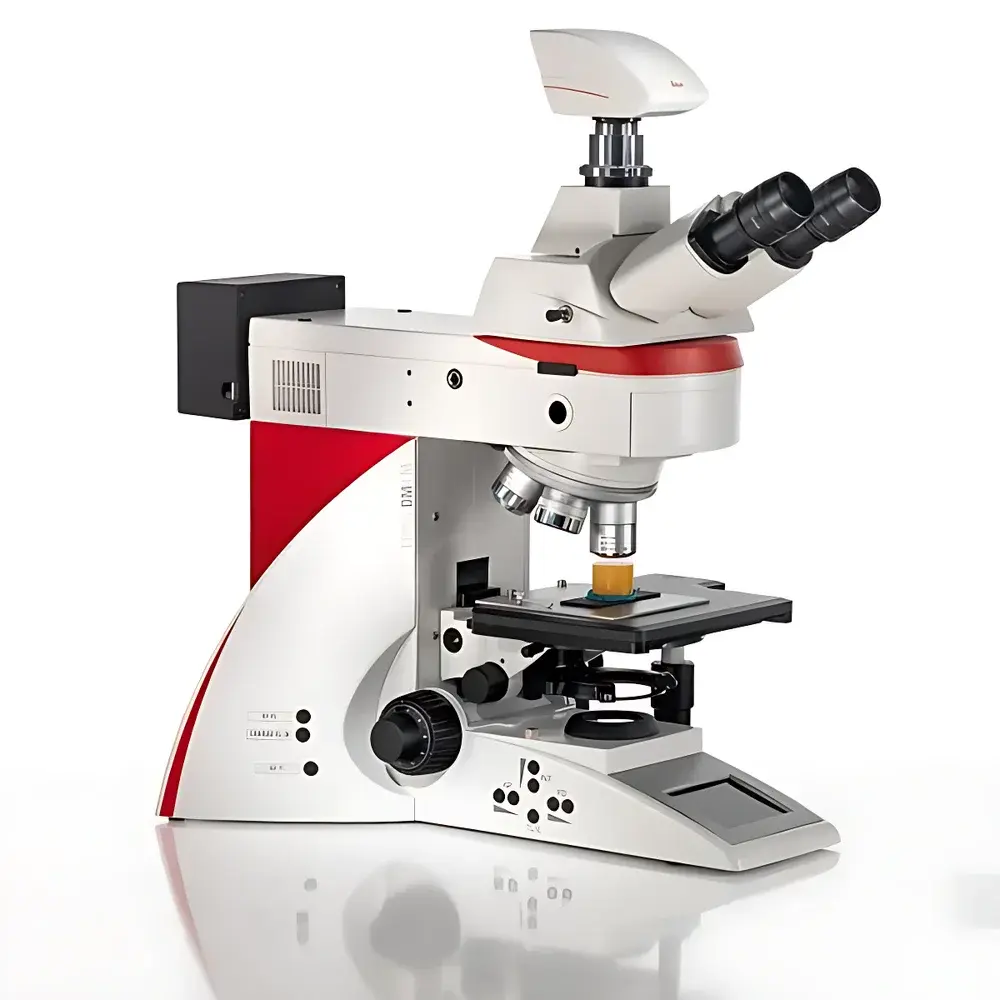
Leica DM4 M Upright Metallurgical Microscope
| Brand | Leica |
|---|---|
| Origin | Germany |
| Model | DM4 M |
| Configuration | Upright |
| Total Magnification | 600× |
| Imaging System | Integrated Digital Image Analysis Module |
| Objective Type | 32 mm Industrial-Grade Infinity-Corrected Objectives |
| Illumination | High-Stability LED with Constant CCT (Correlated Color Temperature) |
| Contrast Modes | Brightfield (BF), High-Dynamic Darkfield (HDF), Differential Interference Contrast (DIC), Polarization (POL), Fluorescence (FL) |
| Automation Features | Illumination Manager, Contrast Manager, Save & Recall Functionality via Leica LAS Software |
| Compliance | Designed for GLP/GMP-aligned workflows |
| Lifetime LED Source | ≥25,000 hours |
Overview
The Leica DM4 M is an upright metallurgical microscope engineered for precision, repeatability, and operational efficiency in industrial quality control and materials science laboratories. Built on Leica Microsystems’ proven optical architecture, it employs infinity-corrected optics with 32 mm industrial-grade objectives to deliver high-resolution, aberration-controlled imaging across metallographic, ceramic, and composite specimens. Its core measurement principle relies on transmitted and reflected light path optimization—supporting both incident illumination (for opaque samples) and optional transmitted-light modules (for semi-transparent or thin-sectioned materials). The system integrates hardware-level automation with software-defined protocols to ensure that every imaging session adheres to predefined, traceable parameters—critical for standardized metallurgical assessments such as ASTM E112 (grain size determination), ASTM E1245 (inclusion rating), and ISO 643 (microstructural analysis).
Key Features
- Upright configuration optimized for bulk metallic samples, castings, welds, and polished cross-sections—no sample inversion required.
- Automated illumination management: Illumination Manager dynamically adjusts LED intensity, aperture diaphragm, and field diaphragm based on selected objective and contrast mode (BF, HDF, DIC, POL, FL).
- Contrast Manager detects installed contrast accessories (e.g., DIC prisms, polarizers) and configures optical train alignment without manual recalibration.
- Save & Recall functionality embedded in Leica Application Suite (LAS) software preserves full microscope state—including objective position, illumination settings, camera exposure, white balance, and annotation overlays—and synchronizes them with acquired images.
- Constant correlated color temperature (CCT) LED illumination eliminates spectral drift during brightness modulation, removing the need for repeated camera white-balance correction and ensuring chromatic fidelity across sessions.
- 25,000-hour LED lifetime minimizes downtime, reduces consumables cost, and maintains photometric stability over extended validation cycles—aligned with ISO 9001 maintenance planning guidelines.
Sample Compatibility & Compliance
The DM4 M accommodates standard 25 mm–76 mm diameter metallographic mounts, including hot-pressed, vacuum-impregnated, and epoxy-embedded specimens. Its rigid mechanical stage supports repeatable XY positioning with vernier-scale readouts and optional motorized Z-focus encoding for depth profiling. The system meets key regulatory expectations for documented microscopy: image metadata (objective ID, magnification, illumination mode, timestamp, user ID) is embedded in TIFF/OME-TIFF files and exportable for audit trails. When deployed with Leica LAS X Core or LAS X Navigator, it supports 21 CFR Part 11-compliant electronic signatures and role-based access control—enabling use in FDA-regulated QC environments where traceability of microstructural evaluation is mandatory.
Software & Data Management
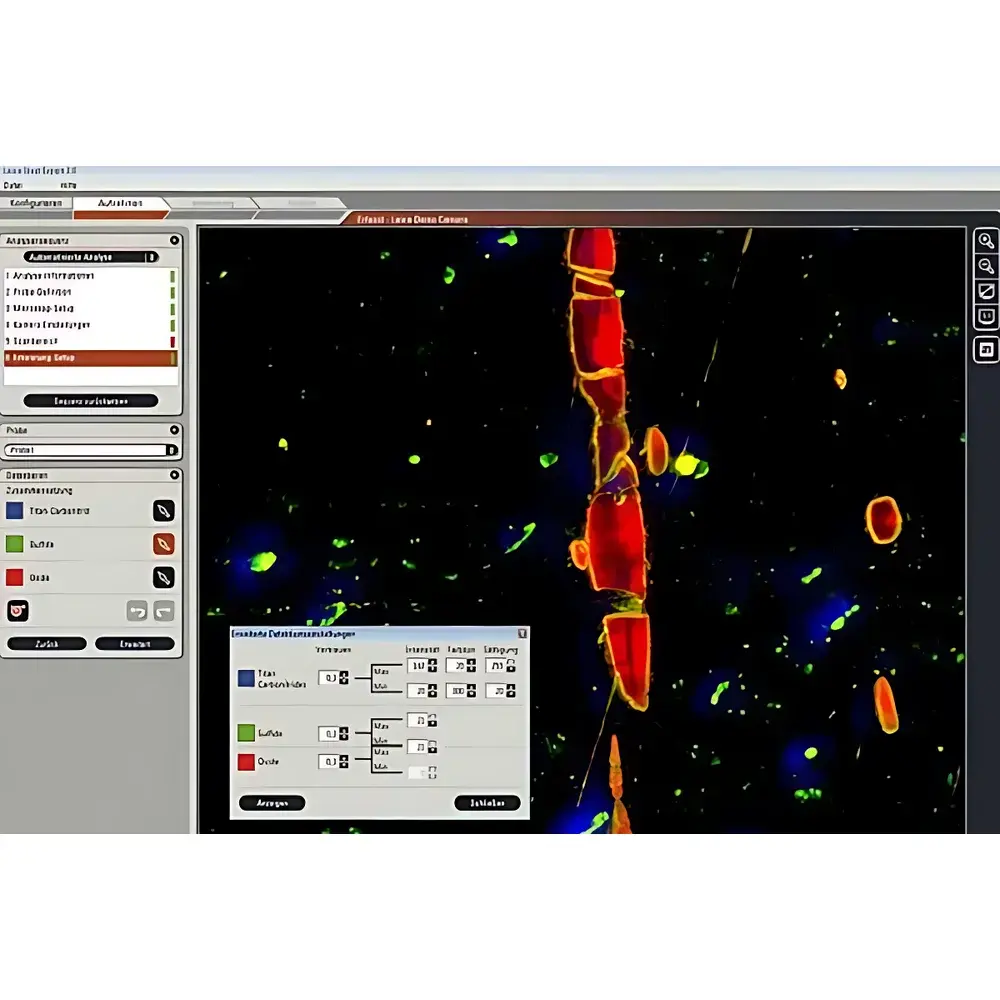
Leica LAS software provides a unified interface for acquisition, measurement, and reporting. The integrated image analysis module supports particle counting, phase fraction quantification, grain boundary tracing, and inclusion classification per ASTM E1245 Annex A. All microscope parameters are stored within image headers using standardized EXIF and OME metadata schemas. Batch processing workflows allow consistent application of thresholding, filtering, and measurement templates across large sample sets. Data exports comply with ISO/IEC 17025 documentation requirements: reports include instrument ID, calibration status, environmental conditions (if logged externally), and operator credentials. Optional LAS X Navigator enables remote monitoring, multi-user collaboration, and integration with LIMS via HL7 or RESTful API.
Applications
- Quantitative metallography: grain size distribution analysis (ASTM E112), inclusion rating (ASTM E45/E1245), and phase fraction mapping in steels, aluminum alloys, and superalloys.
- Failure analysis: crack propagation assessment, porosity quantification, and intergranular corrosion evaluation in aerospace and power-generation components.
- Coating and surface treatment verification: thickness uniformity, adhesion defect detection, and diffusion zone characterization in PVD/CVD coatings and case-hardened surfaces.
- Quality assurance in foundries and forging plants: rapid pass/fail screening of microstructure against internal specifications or customer-facing standards (e.g., SAE AMS, EN 10204).
- Research applications: time-series microstructural evolution studies under thermal cycling or mechanical loading when coupled with environmental stages (optional).
FAQ
Does the DM4 M support automated focus mapping for rough or tilted samples?
Yes—when equipped with the optional motorized Z-drive and Leica LAS X Navigator, the system performs autofocus-based height profiling and generates topographic maps for quantitative surface roughness estimation.
Can I export measurement data directly into Excel or statistical process control (SPC) software?
All quantitative results (e.g., grain size distributions, inclusion counts, phase area percentages) are exportable as CSV or XML files compatible with Minitab, JMP, and industry-standard SPC platforms.
Is calibration of the measurement scale traceable to national standards?
Yes—Leica provides NIST-traceable stage micrometer certificates and supports user-performed calibration validation per ISO/IEC 17025 Clause 6.5.2 using certified reference materials.
How does the system handle multi-contrast workflow switching during routine inspection?
Contrast Manager automatically reconfigures the optical path—including turret position, analyzer orientation, and DIC slider insertion—based on pre-saved contrast profiles, eliminating manual alignment steps between BF, POL, and DIC inspections.
What cybersecurity measures are implemented in LAS software for networked deployment?
Leica LAS X Core supports Windows Group Policy enforcement, TLS 1.2+ encrypted communications, and integration with enterprise Active Directory—ensuring compliance with IEC 62443-3-3 for industrial control system security.




