
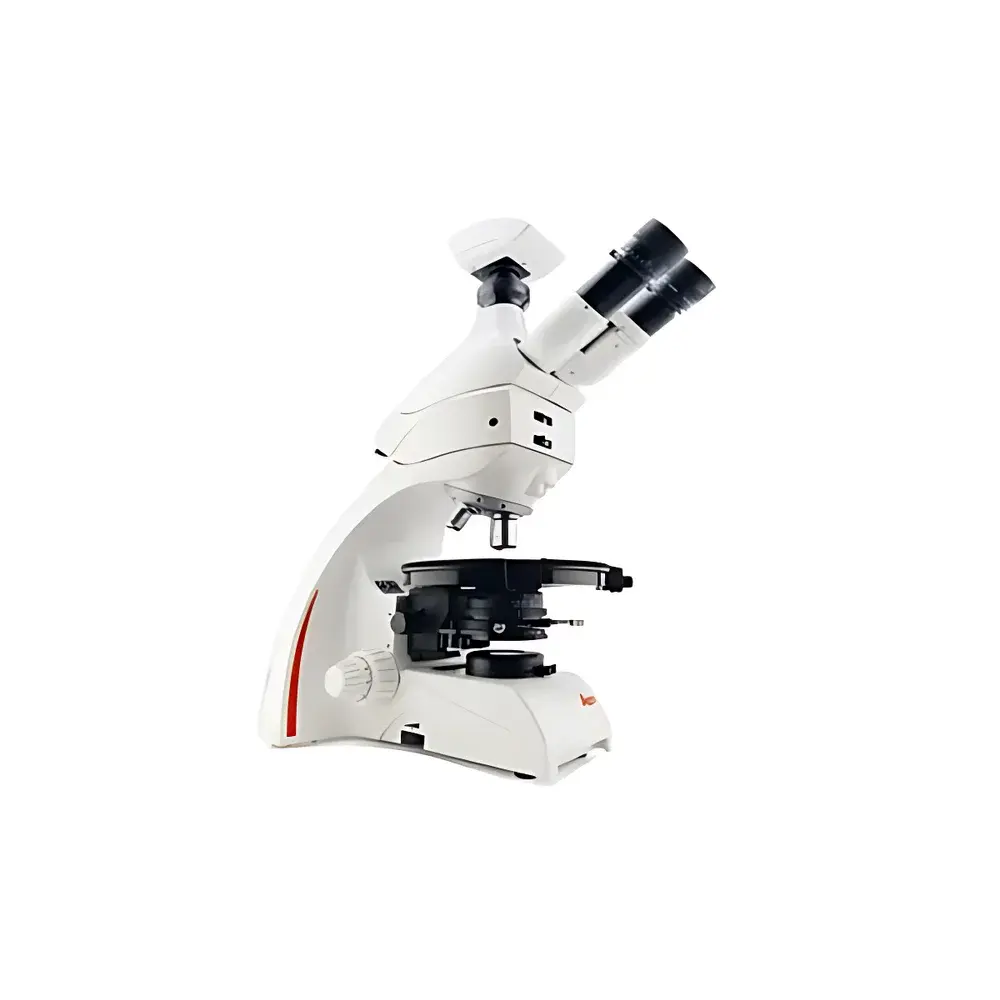
Leica DM750P Polarizing Microscope
| Brand | Leica |
|---|---|
| Origin | Germany |
| Model | DM750P |
| Illumination | 35 W halogen lamp (2000 h lifetime) |
| Eyepiece | Widefield 10×, 20 mm field number, crosshair reticle with 90°/45° orientation marks |
| Objective Turret | 4-position, centerable, compatible with polarized objectives from 2.5× to 100× |
| Stage | 178 mm diameter circular stage with laser-etched scale |
| Camera Port | Trinocular head (50/50 beam splitter), C-mount standard |
| Optional Modules | Reflected-light illumination unit, Bertrand lens, fluorescence filter cubes |
Overview
The Leica DM750P Polarizing Microscope is an education- and research-optimized instrument engineered for quantitative petrographic, crystallographic, and advanced materials characterization. Built upon Leica’s proven optical platform shared with professional-grade research microscopes, the DM750P delivers high-fidelity polarization contrast, precise conoscopic observation, and robust mechanical stability—essential for teaching optical mineralogy, identifying birefringent phases in composites, and analyzing stress-induced anisotropy in polymers and thin films. Its optical design conforms to Köhler illumination principles and supports both orthoscopic (plane-polarized light) and conoscopic (convergent-beam) observation modes, enabling rigorous determination of extinction angles, interference figures, and optic sign—core competencies required in geoscience curricula and ISO/ASTM-compliant materials testing laboratories.
Key Features
- Optically matched to Leica’s research-grade microscope architecture—ensuring consistent color fidelity, flatness of field, and chromatic correction across the full magnification range (2.5×–100×).
- EZStore™ vertical-handling system: Integrated ergonomic handle and front-stage recess enable secure two-handed transport; vertically oriented power cable routing prevents disconnection during relocation or storage.
- AgTreat™ antimicrobial surface treatment applied to all frequently contacted components—including focus knobs, stage controls, and eyepiece tubes—to reduce microbial colonization in shared academic and core facility environments.
- 178 mm diameter precision-machined circular stage with permanent laser-etched angular and linear graduations—resistant to wear, solvent exposure, and repeated cleaning cycles typical in teaching labs.
- High-intensity 35 W halogen illumination with 2000-hour rated lamp life, delivering stable color temperature (~3200 K) and uniform brightness across the field—critical for reproducible retardation measurements using compensators.
- Köhler-adjustable field diaphragm ensures optimal illumination control for both brightfield and polarized imaging, minimizing glare and maximizing contrast without compromising resolution.
Sample Compatibility & Compliance
The DM750P accommodates standard 26 mm and 32 mm diameter thin sections, polished metallographic specimens up to 17 mm in thickness (with optional reflected-light module), and bulk anisotropic samples mounted on glass slides. Its modular design supports ASTM D4125 (optical analysis of coal petrography), ISO 10112 (microscopy of fiber-reinforced composites), and USP (polarized light microscopy for pharmaceutical excipient identification). The instrument meets IEC 61000-6-3 EMC standards and carries CE marking for laboratory use within the EU. All mechanical adjustments—including fine focus travel (0.1 µm graduation), stage movement repeatability (<2 µm), and analyzer rotation accuracy (±0.5°)—are traceable to internal calibration protocols aligned with GLP documentation requirements.
Software & Data Management
The DM750P integrates seamlessly with Leica Application Suite (LAS) X software via USB 3.0 or GigE interface. LAS X provides full hardware control—including motorized polarizer/analyzer rotation, intensity adjustment, and objective turret positioning—enabling automated acquisition of interference figure stacks, slow-scan time-lapse sequences under thermal stages, and multi-channel polarimetric image registration. Measurement tools support quantitative birefringence calculation (Δn), extinction angle annotation, and calibrated linear/angular dimensioning compliant with ISO 9276-2. Audit trails, user-defined metadata tagging, and DICOM-compatible export ensure compatibility with institutional LIMS and FDA 21 CFR Part 11–enabled data governance frameworks.
Applications
- Petrographic analysis of igneous, metamorphic, and sedimentary thin sections—identification of mineral assemblages, texture classification, and strain history reconstruction.
- Characterization of liquid crystal alignment, polymer crystallinity, and residual stress distribution in injection-molded thermoplastics.
- Quality control of optically active pharmaceutical ingredients (APIs), including chiral crystal form verification and hydrate/solvate differentiation.
- Failure analysis of composite laminates, ceramic coatings, and semiconductor packaging materials using stress-induced birefringence mapping.
- Undergraduate and graduate pedagogy in structural geology, materials science, and solid-state physics—supporting hands-on development of optical mineral identification and symmetry analysis skills.
FAQ
Does the DM750P support both transmitted and reflected polarized light observation?
Yes—transmitted-light configuration is standard; a field-upgradeable reflected-light illumination module enables brightfield, polarized, and Bertrand lens observation of opaque or highly scattering samples.
Is the analyzer rotation calibrated and lockable?
Yes—the analyzer rotates continuously from 0° to 360° with engraved 1° increments and a mechanical locking mechanism for repeatable angular positioning during extinction angle measurement.
Can the DM750P be used for fluorescence imaging?
Yes—optional fluorescence filter cube sets (e.g., DAPI, FITC, TRITC) are mechanically compatible with the reflected-light module and maintain polarization integrity when used with polarized excitation filters.
What is the maximum specimen height clearance with the standard stage?
With the 178 mm circular stage and standard condenser, upright clearance is 42 mm; with the optional high-clearance reflected-light module, specimens up to 17 mm thick can be observed in reflected mode.
Is LAS X software included with purchase?
A perpetual license for LAS X Basic is bundled with the microscope; LAS X Advanced (with polarimetric analysis modules and automation scripting) is available as a validated, separately licensed option.





