
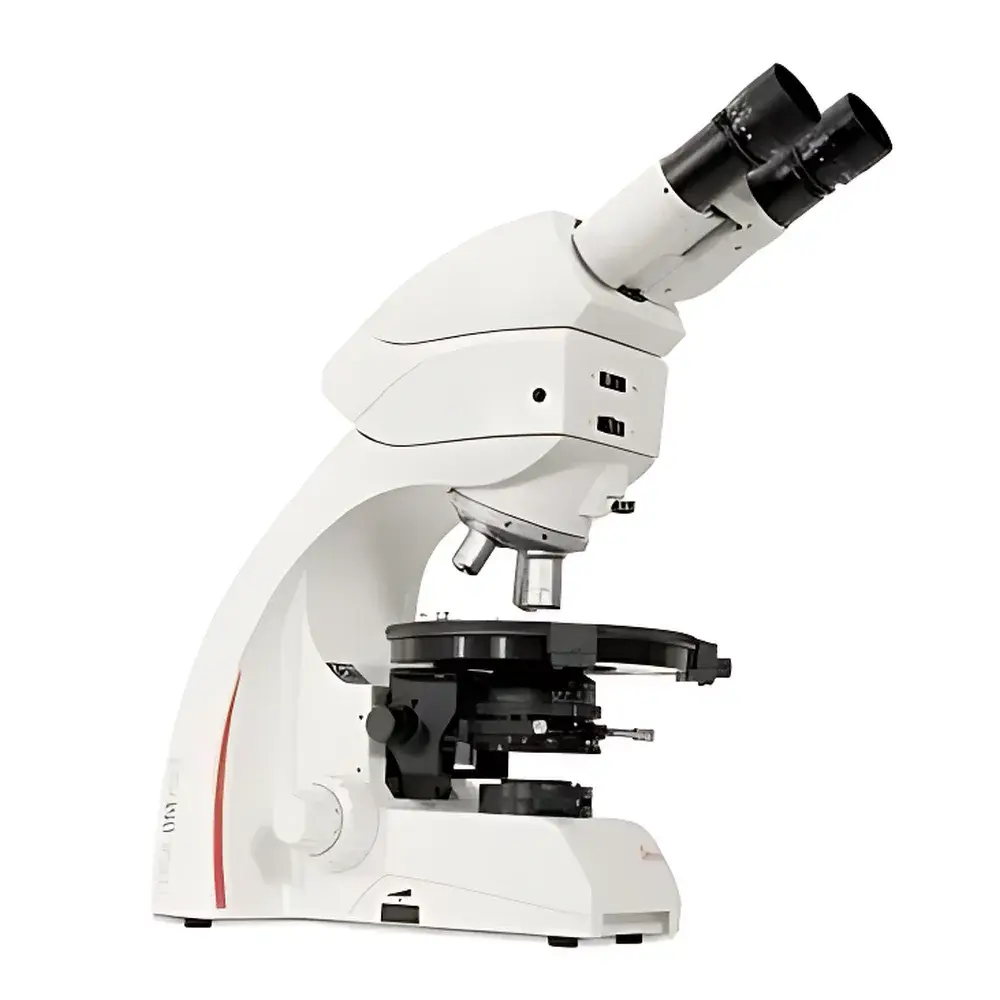
Leica DM750P Polarizing Microscope
| Brand | Leica |
|---|---|
| Origin | Germany |
| Model | DM750 P |
| Optical Path | 20 mm Field of View |
| Rotating Stage | 360° Precision Mechanical Stage |
| Observation Modes | Brightfield, Crossed Polarized Light (XPL), Conoscopic Imaging |
| Objective Turret | 4-Position, Individual Centering per Objective |
| Illumination | LED Transmitted & Reflected Light Source |
| Eyepiece Tube | 360° Rotatable Binocular Tube |
| Polarization Components | Strain-Free Optics, Rotatable Analyzer, Bertrand Lens, λ/4 and λ Compensators |
| Imaging Options | Integrated ICC50 Digital Camera Module (Built-in) or External C-Mount Camera Interface |
| Compliance | Designed for ISO 9001–certified manufacturing |
Overview
The Leica DM750P is a research-grade upright polarizing microscope engineered specifically for quantitative birefringence analysis and routine teaching applications in geoscience, materials science, and polymer engineering. Its optical architecture is based on strain-free Köhler illumination and a fully corrected polarized light path—compliant with DIN EN ISO 10110-7 for stress-free optical elements—ensuring that observed retardation arises exclusively from the specimen, not residual stress in lenses or prisms. The system employs a fixed 20 mm field number optical path, enabling high-fidelity wide-field imaging without vignetting, while maintaining consistent magnification calibration across all objectives. Designed for reproducible quantitative work, the DM750P integrates calibrated mechanical rotation (±0.1° resolution) of both the stage and analyzer, supporting precise orientation-dependent measurements such as optic axis determination, extinction angle quantification, and interference figure acquisition via the built-in Bertrand lens.
Key Features
- Strain-free optical train compliant with ISO 10110-7 specifications—critical for eliminating artifact birefringence in high-sensitivity applications
- Motorized or manual 360° precision rotating mechanical stage with vernier scale and locking mechanism for repeatable sample alignment
- Dual-mode illumination: High-stability white LED transmitted light (with adjustable intensity and centering) and optional reflected LED illumination for opaque or coated samples
- 4-position objective turret with independent centering screws per objective—enabling rapid, parfocal switching between 5×, 10×, 20×, and 50× strain-free polarizing objectives
- Rotatable 360° binocular observation tube—facilitates collaborative instruction, ergonomic group viewing, and seamless integration with digital documentation workflows
- Integrated polarization control suite: Linear polarizer (fixed), rotatable analyzer (0–360°, graduated scale), removable Bertrand lens for conoscopic observation, and standardized slot for λ/4 and full-wave compensators
Sample Compatibility & Compliance
The DM750P accommodates standard 26 mm and 46 mm diameter thin sections (e.g., petrographic slides), polished metallographic mounts, glass stress plates, polymer films, liquid crystal cells, and anisotropic biological specimens (e.g., collagen fibers, starch granules). All optical components—including condenser, objectives, and eyepieces—are certified free of internal stress per DIN 58885 and ISO 10110-7. The system supports compliance with ASTM D4100 (standard test method for birefringence of plastics), ISO 6508-1 (hardness testing of metallic materials using Vickers method where optical alignment is critical), and USP (polarized light microscopy for pharmaceutical particulate identification). For regulated environments, optional audit-trail-enabled firmware upgrades align with FDA 21 CFR Part 11 requirements when paired with Leica Application Suite (LAS X) software.
Software & Data Management
The DM750P is natively compatible with Leica LAS X Core and LAS X Life Science editions. When equipped with the integrated ICC50 imaging module—a 5 MP CMOS sensor embedded within the trinocular port—the system delivers real-time live imaging with hardware-based exposure control, automatic white balance, and timestamped metadata embedding (objective ID, magnification, polarization state, stage coordinates). Image datasets are stored in TIFF or Leica’s proprietary LIF format, preserving EXIF-compliant acquisition parameters. LAS X supports GLP/GMP-compliant workflows via user access levels, electronic signatures, and full audit trail logging—including changes to measurement annotations, calibration records, and polarization component configurations. Export options include CSV for retardation quantification, PDF reports with embedded scale bars and annotation layers, and direct DICOM export for cross-platform archival.
Applications
- Geological petrography: Identification of mineral optical properties (extinction angles, interference colors, optic sign) in thin sections under crossed polars and conoscopic illumination
- Materials failure analysis: Detection of residual stress in tempered glass, injection-molded polymers, and composite laminates via isoclinic/isochromatic fringe mapping
- Pharmaceutical solid-state characterization: Polymorph differentiation, crystallinity assessment, and chiral domain imaging in active pharmaceutical ingredients (APIs)
- Forensic fiber analysis: Birefringence profiling of synthetic textiles (e.g., nylon, polyester) and natural fibers (e.g., cotton, wool) for evidentiary comparison
- Academic teaching labs: Structured pedagogy modules for undergraduate optics courses—covering Malus’ law verification, quarter-wave plate calibration, and uniaxial/biaxial crystal classification
FAQ
Is the DM750P suitable for quantitative retardation measurement?
Yes—when used with calibrated compensators (e.g., Berek, Brace-Köhler, or quartz wedge) and LAS X’s integrated retardation analysis tools, it supports semi-quantitative to quantitative retardation mapping with ±2 nm resolution under optimized conditions.
Can the DM750P be upgraded for fluorescence observation?
Yes—via optional Leica LED fluorescence modules (e.g., GFP, TRITC, DAPI filter sets) mounted on the reflected light path; all filters are certified for polarization preservation and exhibit <0.1% stray light transmission.
Does the system support motorized stage or focus automation?
Motorized Z-focus and XY-stage options are available as factory-installed accessories; however, the base DM750P configuration is manually operated to prioritize mechanical stability and cost-efficiency for teaching environments.
What is the maximum usable magnification under crossed polars?
With the 50× strain-free objective and 10× wide-field eyepieces, the system achieves 500× total magnification while maintaining sufficient working distance and depth of field for routine birefringence evaluation.
How is thermal stability managed during extended observation sessions?
The LED illumination system operates at <35°C surface temperature, and the aluminum alloy optical body incorporates passive heat dissipation channels—ensuring <0.02% drift in image centering over 4-hour continuous use.




