
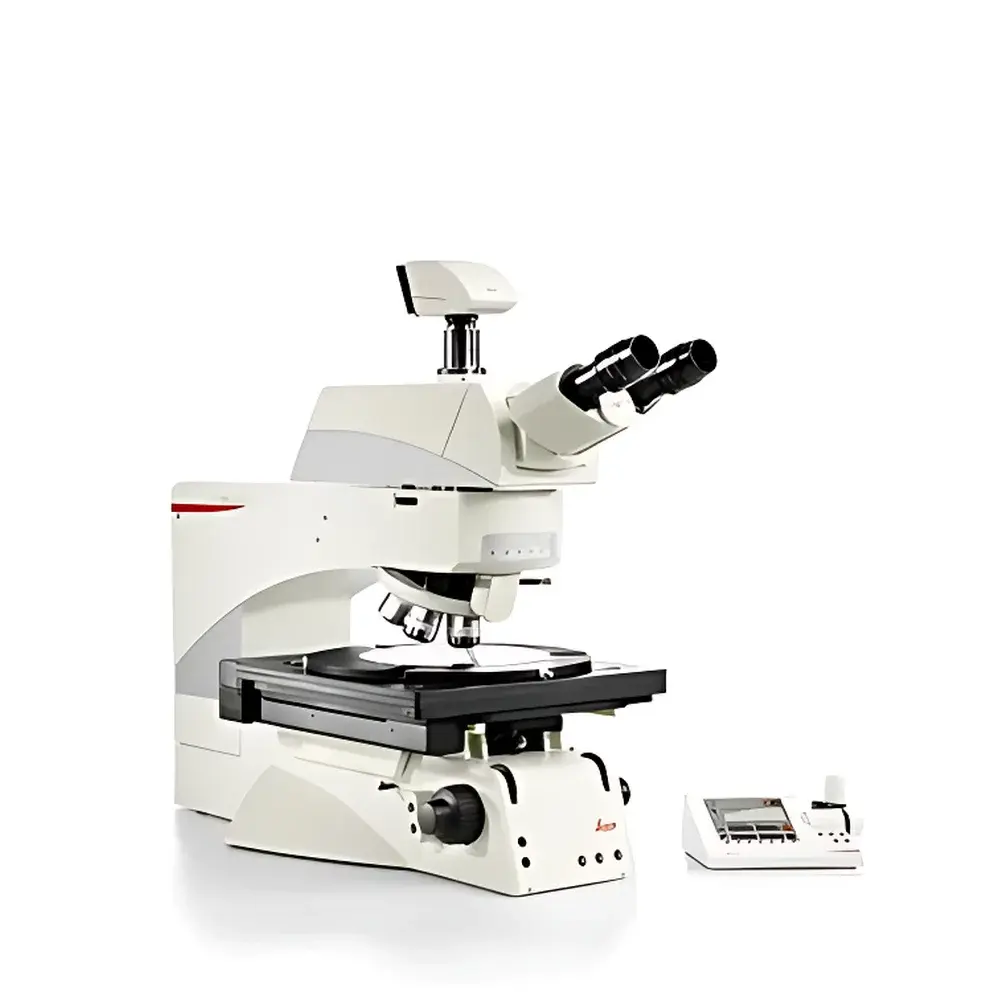
Leica DM8000M Advanced Materials Metallurgical Microscope
| Brand | Leica |
|---|---|
| Origin | Germany |
| Model | DM8000M |
| Illumination | Integrated High-Efficiency LED (Reflected & Transmitted) |
| Sample Stage | 200 mm × 200 mm (8″ compatible) |
| Objective Turret | Motorized 6-position |
| Macro Objective | 0.7× with 25 mm field of view |
| Optical Path | Achromatic-Corrected, 25 mm FOV Field Number |
| Observation Modes | Brightfield, Darkfield, Polarization, Differential Interference Contrast (DIC), Oblique Illumination, UV & OUV (Oblique UV) |
| UV Source | High-Power LED-based UV (365 nm), OUV-capable |
| Focus System | Motorized or Manual Coaxial Focus |
| Software Integration | Leica Application Suite (LAS X), Supports ASTM E112, ISO 9276, ISO 4497, USP <788>, and GLP/GMP-compliant metadata logging |
| Compliance | CE, ISO 13485–compatible design, FDA 21 CFR Part 11–ready audit trail (with LAS X Security Pack) |
Overview
The Leica DM8000M is a high-precision upright metallurgical microscope engineered for advanced materials characterization in industrial R&D, quality control, and failure analysis laboratories. It employs a fully corrected achromatic optical path optimized for a 25 mm field number, supporting high-fidelity imaging across reflective, trans-reflective, and UV-enhanced modalities. Its core architecture integrates coaxial motorized focusing, a 6-position motorized objective turret accommodating 32 mm-diameter long-working-distance industrial objectives, and a dedicated 0.7× macro objective enabling rapid wafer-level inspection over an 8-inch (200 mm) sample area. The system’s illumination platform features dual-integrated LED sources — one for reflected-light observation (including brightfield, darkfield, polarization, DIC, and oblique illumination), and another for transmitted-light applications — both thermally decoupled to minimize thermal drift during extended acquisition sessions. Critically, the DM8000M incorporates Oblique Ultraviolet (OUV) illumination, combining 365 nm LED-based UV excitation with controlled angular incidence to enhance edge contrast and sub-micron structural resolution without requiring vacuum or conductive coating — particularly advantageous for semiconductor metrology, ceramic grain boundary analysis, and polymer phase morphology studies.
Key Features
- 200 mm × 200 mm motorized mechanical stage with precision 8″ wafer alignment capability and optional robotic interface for automated wafer handling systems
- Dual-path LED illumination: independently controllable reflected and transmitted channels with intelligent intensity compensation across magnifications
- 0.7× macro objective delivering >4× wider field of view versus conventional scanning objectives — enabling rapid defect screening across full wafers or large-area composites
- OUV mode: calibrated 365 nm LED source with adjustable oblique angle (±15°) to maximize diffraction-limited resolution on non-planar or low-contrast surfaces
- Motorized 6-position objective turret with auto-recognition and preset configuration recall for magnification, aperture, condenser position, and illumination mode
- Color temperature stabilization system maintaining consistent white balance (6500 K ± 100 K) across all light intensities and exposure durations
- Ergonomic modular frame with height-adjustable eyepiece tube, tilting binocular head (0–35°), and touch-sensitive base controls for hands-free operation
- Full compatibility with Leica LAS X software, including calibration traceability, scale bar embedding per objective/mode, and automated report generation per ISO/IEC 17025 requirements
Sample Compatibility & Compliance
The DM8000M accommodates rigid and semi-rigid specimens up to 80 mm in height and 200 mm in diameter, including silicon wafers, metallographic mounts, sintered ceramics, PCB assemblies, and composite laminates. Its non-contact OUV and oblique illumination modes eliminate surface charging artifacts common in SEM-compatible samples, while its long-working-distance objectives support in-situ observation of components mounted on hot stages (up to 200 °C) or cathodoluminescence stages. The system conforms to ISO 10934-1 (microscopy terminology), ISO 9276-2 (particle size analysis), ASTM E112 (grain size determination), and USP (particulate matter testing). When configured with LAS X Security Pack, it supports 21 CFR Part 11 compliance via electronic signatures, audit trails, and role-based access control — meeting GLP and GMP documentation standards for regulated environments.
Software & Data Management
Leica LAS X serves as the central acquisition and analysis platform, offering real-time image optimization, multi-channel overlay (e.g., BF + polarized + UV), and batch measurement workflows compliant with ISO 4497 (metal inclusion rating) and ISO 13322-2 (static image analysis). All hardware parameters — magnification, NA, illumination intensity, aperture diaphragm setting, condenser height, and OUV angle — are automatically embedded into TIFF or JPEG metadata. LAS X supports DIC quantitative phase retrieval, grain boundary detection using trainable AI classifiers, and automated cleanliness classification per VDA 19.2 and ISO 16232. Raw data export is available in open formats (OME-TIFF, CSV), and integration with LIMS or MES platforms is enabled via RESTful API and OPC UA protocols.
Applications
- Semiconductor manufacturing: Defect mapping on 200 mm/300 mm wafers, lithography residue inspection, bond pad integrity verification
- Metallurgy & heat treatment: Grain size distribution (ASTM E112), inclusion rating (ISO 4967), phase identification (ferrite/austenite ratio), carbide network analysis
- Electronics reliability: Solder joint voiding assessment, delamination detection in BGA packages, conformal coating uniformity evaluation
- Advanced ceramics & composites: Pore structure quantification, fiber orientation mapping, interfacial debonding analysis
- Pharmaceutical particulates: Excipient crystal habit analysis, foreign particle identification per USP , filter membrane challenge testing
- Forensic materials science: Paint layer stratigraphy, gunshot residue morphology, fiber cross-section characterization
FAQ
Does the DM8000M support automated multi-field-of-view stitching for large-area analysis?
Yes — when paired with Leica’s motorized scanning stage and LAS X Tile Scan module, the system performs fully automated mosaic acquisition across user-defined grids, with sub-pixel registration and seam correction.
Can OUV mode be used with standard glass objectives?
No — OUV requires UV-transmitting objectives (e.g., Leica HCX PL FLUOTAR 5×/0.15 UV) and UV-grade condensers; standard visible-light objectives absorb below 380 nm.
Is the integrated LED illumination suitable for photometric quantification?
Yes — intensity stability is ±0.5% over 8 hours (measured at 100% output), and each LED channel is factory-calibrated against NIST-traceable photodiodes.
What safety certifications apply to the DM8000M in cleanroom environments?
The instrument meets ISO 14644-1 Class 5 (Fed Std 209E Class 100) particulate emission limits and carries UL 61010-1 and IEC 61000-6-3 EMC certification.
How is focus reproducibility maintained across thermal cycles?
The optical column uses low-expansion Zerodur® spacer elements and a dual-sensor closed-loop focus drive, achieving ≤0.1 µm repeatability over ambient fluctuations from 18–28 °C.





