
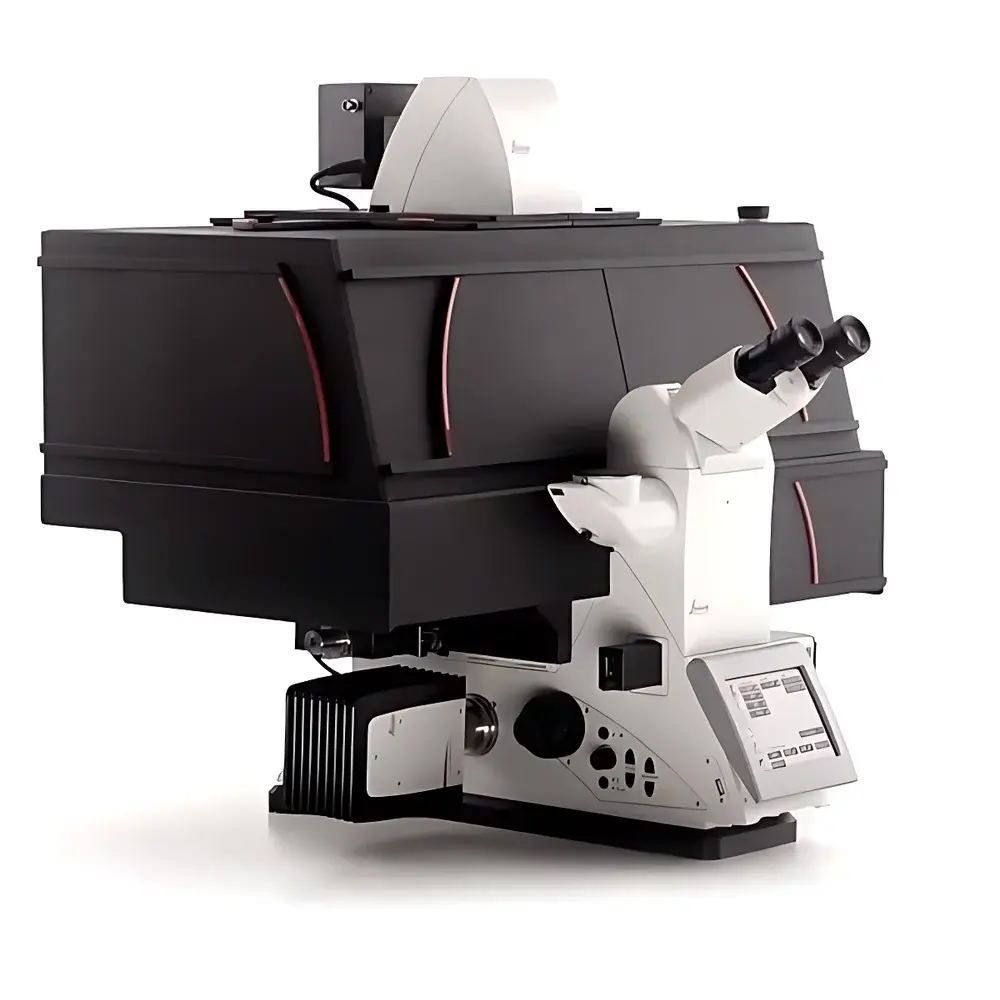
Leica DMi8 Automated Universal Inverted Microscope
| Brand | Leica |
|---|---|
| Origin | Germany |
| Model | DMi8 |
| Type | Inverted Microscope |
| Category | Life Science Instrument / Biological Microscope / Live-Cell Imaging System |
| Regulatory Compliance | CE, ISO 13485 (for medical device components), Designed for GLP/GMP-aligned workflows |
Overview
The Leica DMi8 Automated Universal Inverted Microscope is a modular, research-grade platform engineered for high-fidelity live-cell imaging and quantitative biological analysis. Built upon the foundational DMi8 S architecture, it integrates precision optics, motorized automation, environmental control compatibility, and multi-modal detection capabilities into a unified system. Its inverted optical design positions the objective below the specimen—enabling stable observation of adherent cells in standard culture vessels (e.g., Petri dishes, multi-well plates, chambered coverslips) without mechanical interference from stage-mounted accessories. The system operates on principles of Köhler illumination, fluorescence excitation/emission filtering, differential interference contrast (DIC), and phase contrast—supporting simultaneous or sequential multimodal acquisition across x–y–z spatial dimensions, time (t), wavelength (λ), and multiple specimens (n). Designed for long-term experiments, the DMi8 platform supports integration with incubation chambers (temperature, CO₂, humidity control), piezo-driven Z-stages (<10 nm step resolution), and low-phototoxicity LED illumination sources to preserve physiological relevance during time-lapse studies.
Key Features
- Modular optical architecture with interchangeable objectives (1.25× to 100×, including high-NA oil/water immersion lenses) and filter turret supporting up to 6 fluorescence channels
- Motorized focus, XY stage, filter wheel, shutter, and transmitted light condenser—all controllable via software or hardware interface
- Integrated LAS X software suite enabling automated acquisition protocols, multi-dimensional experiment scheduling, and real-time image processing pipelines
- Compatibility with third-party environmental chambers (e.g., OKO Labs, Tokai Hit) for precise regulation of temperature (20–40 °C ±0.1 °C), CO₂ (0–20%), and relative humidity (≥95%)
- Support for micromanipulation modules—including hydraulic or pneumatic microinjectors, motorized micromanipulators (e.g., Luigs & Neumann MM33), and ICSI-compatible configurations for oocyte handling and subcellular injection
- Optimized optical path for quantitative fluorescence techniques: ratiometric imaging, FRET, FLIM-ready configuration, and spectral unmixing with tunable emission filters
Sample Compatibility & Compliance
The DMi8 accommodates a broad range of biological samples—from monolayer cultures and 3D spheroids to zebrafish embryos, C. elegans, and primary neuronal co-cultures. Its large working distance objectives (up to 8.5 mm) facilitate imaging through thick-bottomed dishes and glass-bottom plates (0.17 mm coverslip standard). All optical components comply with ISO 10934-1 (microscopy terminology) and ISO 19012-1 (objective lens specifications). The system’s firmware and LAS X software support audit trails, electronic signatures, and user-access controls aligned with FDA 21 CFR Part 11 requirements when deployed in regulated environments. Documentation packages include IQ/OQ protocols compliant with ISO/IEC 17025 for laboratory accreditation readiness.
Software & Data Management
LAS X is the native acquisition and analysis environment for the DMi8, offering scriptable workflows (Python API), batch processing, and metadata-rich TIFF export (OME-TIFF compliant). It enables synchronized control of external devices—including cameras (sCMOS, EMCCD), spectrometers, and environmental controllers—via TTL and serial interfaces. Data management includes automatic project tagging, hierarchical folder structuring, and integration with institutional LIMS or ELN systems via RESTful APIs. Quantitative modules support intensity calibration, background subtraction, colocalization analysis (Manders’ coefficients), and kinetic profiling of fluorescent reporters over time. Raw data integrity is preserved through non-destructive processing layers and versioned analysis histories.
Applications
- Long-term live-cell tracking of mitosis, migration, and organelle dynamics under physiologically relevant conditions
- High-content screening (HCS) in drug discovery workflows using multi-well plate compatibility and automated focus mapping
- FRET-based biosensor validation for intracellular calcium, cAMP, or kinase activity assays
- Assisted reproductive technology (ART): oocyte enucleation, sperm injection (ICSI), and blastomere biopsy with integrated micromanipulation
- Stem cell differentiation monitoring via label-free phase contrast combined with lineage-specific fluorescent reporters
- 3D tissue model imaging—spheroids, organoids, and ex vivo explants—with Z-stack reconstruction and deconvolution support
FAQ
Is the DMi8 compatible with super-resolution techniques such as STED or SIM?
The DMi8 platform supports STED and SIM configurations when equipped with appropriate laser combiners, depletion lasers, and high-speed resonant scanners—but these require dedicated hardware add-ons and are not part of the base system.
Can LAS X software be validated for use in GxP-regulated laboratories?
Yes—Leica provides documented validation templates, IQ/OQ protocols, and 21 CFR Part 11 compliance packages for LAS X v3.6 and later, subject to site-specific risk assessment and configuration control.
What camera interfaces does the DMi8 support?
It natively supports USB 3.0, Camera Link, and PCIe-based scientific cameras via standardized DCAM, GenICam, or Leica-specific drivers.
Does the system support automated focus maintenance during time-lapse experiments?
Yes—hardware-based autofocus (e.g., Leica Adaptive Focus Control or third-party infrared-based systems) can be integrated and triggered at user-defined intervals or per Z-stack acquisition.
Are service contracts and extended warranties available internationally?
Leica Microsystems offers global service agreements with response-time SLAs, preventive maintenance schedules, and remote diagnostics support through authorized service centers in over 40 countries.



