
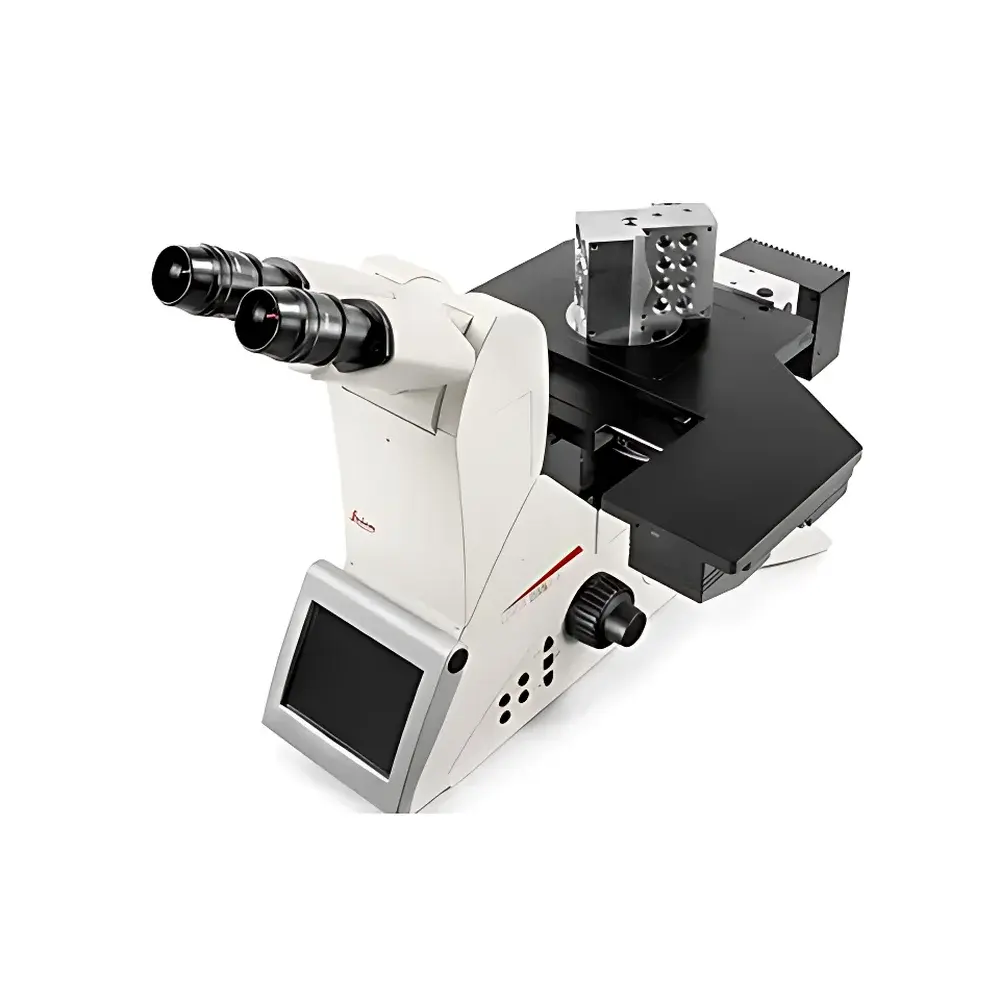
Leica DMi8 Inverted Industrial Metallurgical Microscope
| Brand | Leica |
|---|---|
| Origin | Germany |
| Model | DMi8 |
| Configuration | Inverted |
| Image Analysis System | Integrated |
| Total Magnification Range | 50×–600× |
| Eyepiece | 10× |
| Objective Lenses | 5×/0.1, 10×/0.25, 50×/0.7 |
| Macro Mode Field of View | 35.7 mm at 0.7× |
| Optional Magnifications | 0.7×, 5×, 10×, 20×, 50×, 100× |
| UC-3D Contrast Illumination | Standard |
| Focus Drive | 3-Position Adjustable Precision Drive |
| Maximum Sample Weight Capacity | 30 kg |
| Software Platform | Leica Application Suite (LAS) with Steel Expert, Phase Expert, Grain Expert modules |
| Compliance | Designed for ISO 9001-aligned QA/QC environments |
Overview
The Leica DMi8 Inverted Industrial Metallurgical Microscope is an engineered solution for high-precision microstructural analysis in demanding industrial environments—including metallography, medical device manufacturing, semiconductor packaging, and advanced materials R&D. Its inverted optical architecture positions objective lenses beneath the stage, enabling direct observation of large, heavy, or irregularly shaped specimens—up to 30 kg—without repositioning or risk of objective collision. This configuration eliminates the need for repeated refocusing across magnifications after initial surface alignment, significantly reducing inspection cycle time. The system employs Leica’s proprietary Plan Apochromat and HCX objective optics, delivering diffraction-limited resolution, flat-field imaging, and chromatic aberration correction across the visible spectrum. Core contrast modalities—including Brightfield (BF), Differential Interference Contrast (DIC), and High Definition Fluorescence (HDF)—are mechanically encoded and synchronized with magnification changes, ensuring consistent illumination geometry and quantitative repeatability. The DMi8 is not a fixed platform but a modular foundation: users select from manual, encoded, or motorized configurations, integrating only the functionality required for current applications while preserving upgrade paths for future automation or compliance needs.
Key Features
- Inverted optical design optimized for metallurgical and industrial sample handling—supports specimens up to 30 kg with unrestricted top access
- Macro-to-nano zoom capability: seamless transition from overview imaging (35.7 mm FOV at 0.7×) to high-resolution detail (200 nm resolution at 100× with oil immersion)
- UC-3D (Ultra Contrast 3D) illumination system: multi-angle LED-based directional lighting that enhances surface topography contrast without polarizers or mechanical adjustments
- Three-position precision focus drive: independently calibrated for low-, medium-, and high-magnification regimes to maintain optimal focus sensitivity and parfocality
- Fully encoded hardware platform: objectives, turret position, illumination intensity, and contrast mode are digitally registered—enabling automated protocol recall and traceable measurement conditions
- Modular expansion support: compatibility with motorized Z-drive, XY stage controllers, environmental chambers, and external spectroscopy interfaces
Sample Compatibility & Compliance
The DMi8 accommodates a broad range of industrial specimen formats—from bulk castings and welded joints to polished wafers, MEMS devices, and coated biomedical implants. Its large-stage clearance (≥120 mm vertical working distance at lowest magnification) permits integration of custom fixtures, tensile stages, or thermal platforms. The system meets mechanical and optical stability requirements defined in ASTM E3–22 (Standard Guide for Preparation of Metallographic Specimens) and ISO 4520:2021 (Metallic coatings—Microscopical examination). When configured with LAS software and enabled audit-trail logging, the platform supports documentation integrity per FDA 21 CFR Part 11 for regulated manufacturing environments. All optical components comply with RoHS directives and CE marking requirements for laboratory instrumentation.
Software & Data Management
Leica Application Suite (LAS) serves as the central interface for acquisition, annotation, measurement, and reporting. Version 4.13+ includes domain-specific expert modules validated for industrial metrology: Steel Expert automates ferrite/pearlite quantification per ISO 643; Phase Expert applies threshold-based segmentation for multi-phase alloy analysis; and Grain Expert performs ASTM E112-compliant grain size determination using linear intercept or planimetric methods. LAS enforces role-based user permissions, electronic signatures, and timestamped audit trails—essential for GLP/GMP audits. Image metadata (magnification, objective ID, illumination settings, calibration status) is embedded in TIFF and OME-TIFF files, ensuring full traceability. Remote collaboration is supported via secure HTTPS-based LAS X Live streaming and cloud-synced project repositories.
Applications
- Metallographic quality control: inclusion rating (ASTM E45), decarburization depth measurement, weld fusion zone analysis
- Failure analysis: crack propagation mapping, fatigue striation counting, intergranular corrosion assessment
- Microelectronics: solder joint voiding evaluation, wire bond integrity inspection, die attach uniformity verification
- Medical device validation: surface roughness correlation (Ra/Rz), coating delamination detection, laser-marking legibility assessment
- Advanced materials development: ceramic grain boundary characterization, composite fiber orientation analysis, additive manufacturing porosity quantification
FAQ
Can the DMi8 be integrated into automated production line inspection systems?
Yes—via TTL-triggered camera synchronization, RS-232/USB-C serial control, and SDK-supported API access to LAS, the DMi8 supports integration with PLCs and MES platforms for inline or offline QA stations.
Is UC-3D illumination compatible with all contrast modes?
UC-3D is fully functional in BF, DIC, and HDF modes; its directional lighting enhances edge definition in BF and reinforces relief perception in DIC without altering polarization state.
Does LAS software support automated report generation compliant with ISO/IEC 17025?
Yes—LAS includes customizable report templates with embedded calibration certificates, uncertainty budgets, and operator authentication fields aligned with ISO/IEC 17025 clause 7.8.
What is the maximum usable numerical aperture (NA) achievable with the DMi8 optical train?
The system achieves NA 0.85 with the 50×/0.7 objective in oil immersion configuration; dry objectives are corrected for coverslip thickness variation (0–1.2 mm) to accommodate industrial sample preparation variability.
How does the DMi8 handle thermal drift during extended imaging sessions?
The microscope frame features a low-coefficient-of-thermal-expansion (CTE) aluminum-silicon alloy baseplate, and all optical mounts use kinematic design principles to minimize focus shift under ambient temperature fluctuations of ±5°C.





