
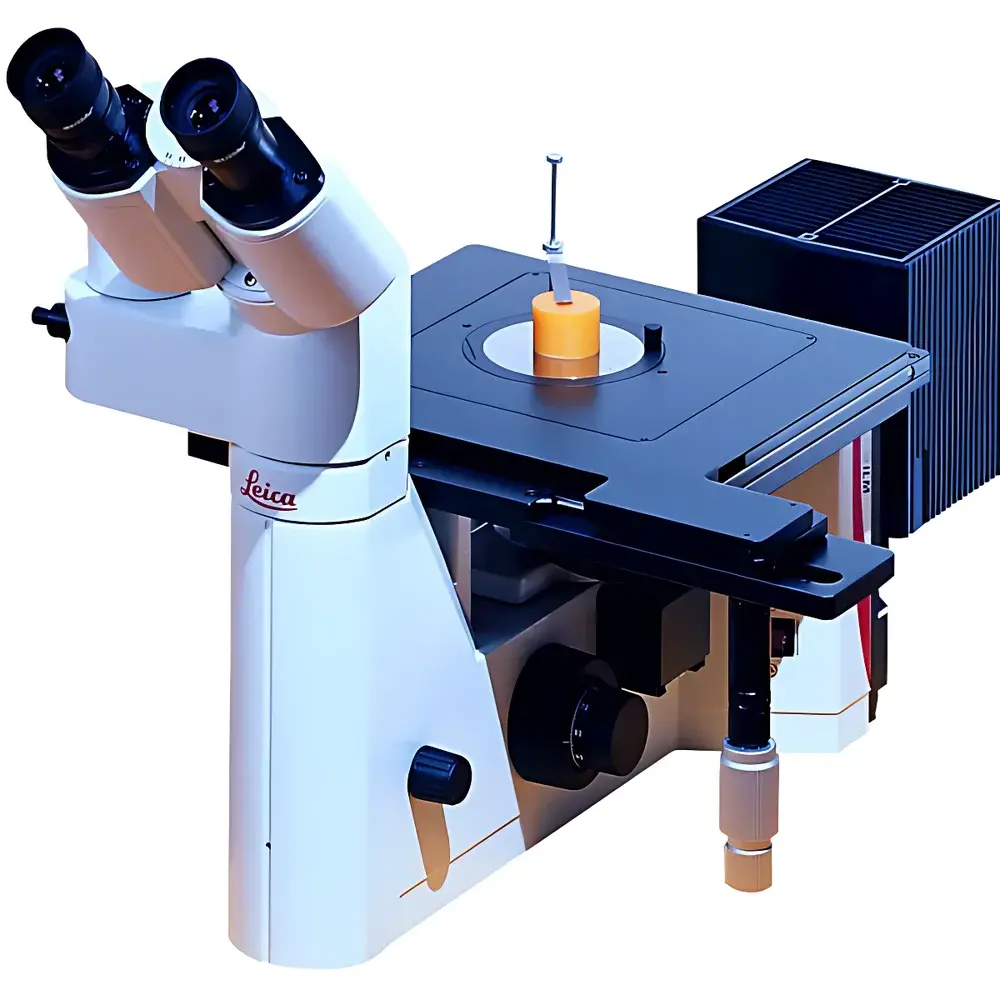
Leica DMIL M Inverted Metallurgical Microscope
| Brand | Leica |
|---|---|
| Origin | Germany |
| Model | DMIL M |
| Configuration | Inverted |
| Image Analysis System | Included |
| Total Magnification | 600× |
| Eyepieces | 6× |
| Objectives | 100× |
| Illumination | Integrated 6 V / 35 W Halogen Lamp |
| Ergonomic Viewing Tube Options | 6 Types (including Ergotube with 0°–35° tilt adjustment) |
Overview
The Leica DMIL M Inverted Metallurgical Microscope is an engineered solution for routine industrial metallographic inspection, designed to deliver high-fidelity optical performance in demanding quality control, failure analysis, and materials research environments. Its inverted optical architecture positions the objective lenses beneath the specimen stage—enabling unobstructed access to large, heavy, or irregularly shaped samples such as castings, weldments, machined components, and heat-treated sections without repositioning or sectioning. The system operates on Köhler illumination principles with precision-corrected optics optimized for reflected-light contrast techniques: brightfield, darkfield, polarized light, and fluorescence. This enables consistent, high-contrast visualization of microstructural features—including grain boundaries, phase distributions, inclusion morphology, etching patterns, and coating integrity—across a total magnification range up to 600×. The instrument’s modular design supports seamless integration into production-floor workflows and laboratory-based metallurgical characterization pipelines.
Key Features
- Inverted configuration with reinforced mechanical stage accommodating specimens up to 150 mm × 150 mm and weighing up to 5 kg—ideal for bulk industrial parts and cross-sectioned samples.
- High-transmission, apochromatically corrected optical path delivering diffraction-limited resolution and chromatic fidelity across visible wavelengths (400–700 nm).
- Integrated 6 V / 35 W halogen illumination system with continuous intensity control and built-in heat-absorbing filter—ensuring stable photometric output and extended lamp life without external power units.
- Six interchangeable viewing tube options, including the Leica Ergotube with continuously adjustable tilt (0°–35°), supporting ergonomic observation postures compliant with ISO 9241-5 and EN 61000-3-2 standards for prolonged operator use.
- Modular contrast module compatibility: Brightfield, polarized light (with rotatable analyzer and strain-free objectives), and optional fluorescence modules (e.g., FITC/TRITC/Cy5 excitation filters) for advanced phase identification.
- Standardized DIN 29500 mechanical interface for third-party motorization, automated stage control, and digital camera coupling (C-mount and F-mount adapters available).
Sample Compatibility & Compliance
The DMIL M accommodates standard metallurgical sample formats—including 25 mm, 30 mm, and 50 mm diameter mounted specimens—as well as unmounted billets, rolled sheets, and forged components secured via adjustable clamping fixtures. Its low-profile stage and vertical clearance (≥80 mm) permit direct imaging of vertically oriented samples without section removal. All optical components comply with ISO 10934-1 (microscope nomenclature), ISO 8578 (magnification calibration), and DIN EN ISO/IEC 17025 requirements for accredited testing laboratories. When paired with Leica Application Suite (LAS X) software, the system supports audit-trail-enabled documentation aligned with FDA 21 CFR Part 11 and GLP/GMP data integrity guidelines.
Software & Data Management
The microscope ships with Leica LAS X Core software, providing calibrated image acquisition, multi-channel overlay, geometric measurement (length, area, angle, particle count), and ASTM E112-compliant grain size analysis. Raw image metadata—including objective ID, magnification, exposure time, illumination mode, and timestamp—is embedded in TIFF and JPEG files per Exif 2.31 specifications. Export formats include CSV (for statistical reporting), PDF (annotated reports), and DICOM (for cross-platform archival). Optional LAS X Advanced modules enable automated focus mapping, stitching of large-area composites (>100×100 mm), and batch processing of serial samples—reducing manual intervention in high-throughput QC environments.
Applications
- Quality assurance of ferrous and non-ferrous alloys in foundry, forging, and additive manufacturing facilities.
- Failure analysis of fractured surfaces, fatigue striations, and stress-corrosion cracking in aerospace and energy-sector components.
- Coating thickness verification and interfacial adhesion assessment in thermal spray, PVD, and electroplating processes.
- Microstructure quantification per ASTM E3, E112, E1245, and ISO 643 standards—including ferrite/pearlite ratio, inclusion rating (ASTM E45), and delta-ferrite content.
- Educational instruction in materials science curricula, supporting standardized lab protocols for undergraduate and graduate metallurgy courses.
FAQ
What is the maximum specimen height the DMIL M can accommodate?
The instrument provides ≥80 mm vertical working distance above the stage surface, allowing direct imaging of tall or vertically mounted samples.
Is the halogen illumination compatible with digital camera systems requiring stable color temperature?
Yes—the integrated 6 V / 35 W halogen source maintains a consistent 3200 K color temperature across its dimming range; optional IR-cut and color-balancing filters are available for spectral optimization.
Can the DMIL M be upgraded to support motorized focusing or automated stage navigation?
Yes—via Leica’s Z-drive motorization kit and programmable XY stage controllers, both fully integrated into LAS X software for repeatable positioning and z-stack acquisition.
Does the system meet regulatory requirements for ISO/IEC 17025-accredited laboratories?
Yes—when used with traceable calibration standards (e.g., NIST-traceable stage micrometers) and validated LAS X workflows, the DMIL M satisfies metrological traceability and documentation requirements outlined in ISO/IEC 17025:2017 Clause 7.7.
Are replacement objectives and eyepieces supplied with calibration certificates?
All Leica HCX PL Fluotar and EC Epiplan objectives include individual optical certification reports; eyepieces are supplied with DIN-compliant magnification verification documentation.



