
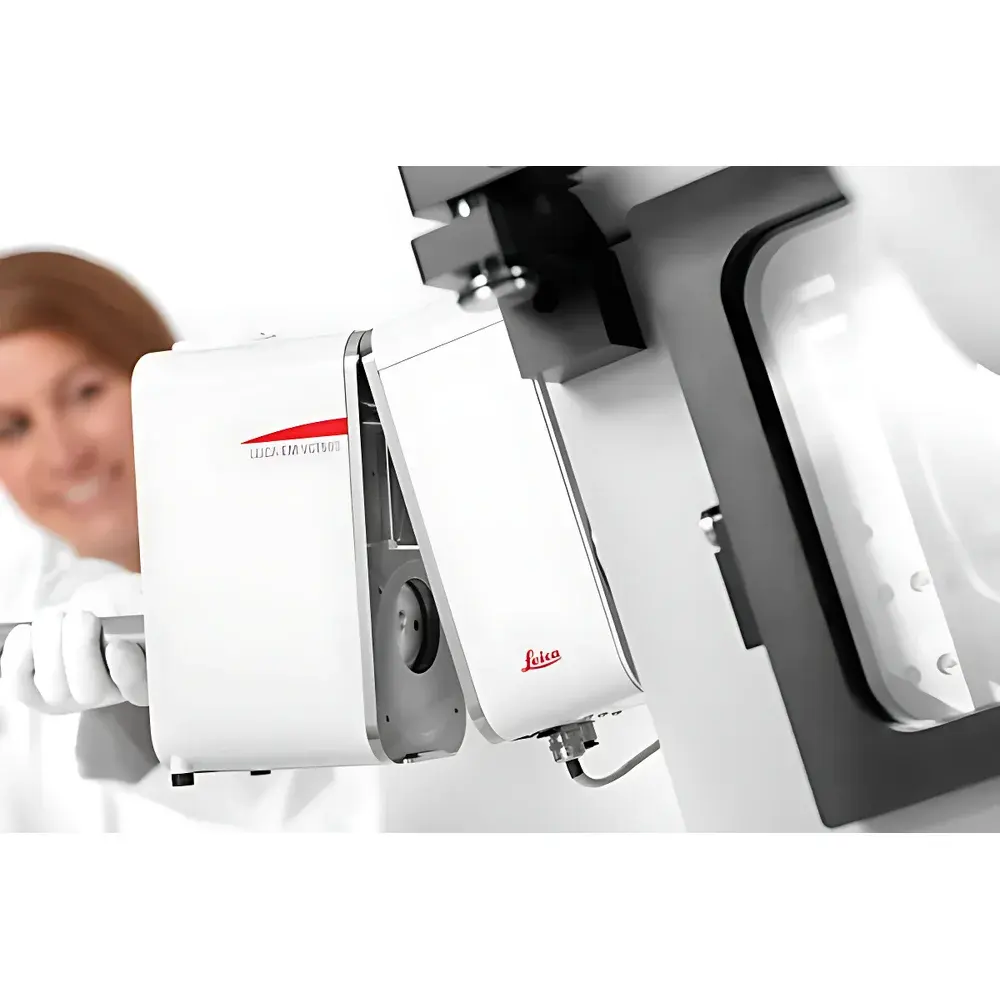
Leica EM ACE900 Cryo-Fracture and Freeze-Etching System
| Brand | Leica |
|---|---|
| Origin | Austria |
| Model | EM ACE900 |
| Application | Cryo-SEM & TEM Sample Preparation |
| Cooling Medium | Liquid Nitrogen (LN₂) |
| Vacuum System | Dual-chamber with Load-Lock Transfer |
| Coating | Electron Beam Evaporation for Carbon/Metal Replicas |
| Compatibility | Integrated with Leica EM VCT500 Cryo-Transfer System |
| Environmental Certification | DIN EN ISO 14001 |
Overview
The Leica EM ACE900 is a high-precision, fully integrated cryo-preparation system engineered for ultrastructural analysis via transmission electron microscopy (TEM) and cryo-scanning electron microscopy (cryo-SEM). It combines three critical sample preparation steps—cryo-fracturing, freeze-etching, and electron-beam (e-beam) coating—within a single, continuously evacuated platform. The system operates under deep cryogenic conditions (typically ≤ −140 °C), preserving native hydrated structures by vitrification and preventing ice crystal artifacts. Its core principle relies on controlled brittle fracture of frozen-hydrated specimens under vacuum, followed by sublimation of surface ice (freeze-etching) to reveal topographical and compositional details of internal membranes, macromolecular complexes, and phase-separated domains. This enables high-fidelity replication for TEM or direct cryo-SEM imaging—particularly when coupled with the Leica EM VCT500 vacuum transfer system.
Key Features
- Integrated cryo-fracture, freeze-etching, and e-beam coating in one vacuum-sealed workflow—eliminating air exposure and thermal drift between steps.
- Redesigned cryo-cooling architecture reducing liquid nitrogen consumption by ~87% during cooldown and ~58% per hour of operation versus prior-generation systems.
- Dual-load-lock vacuum transfer chambers for simultaneous handling of samples, knives, and substrates—ensuring rapid (<60 s) exchange without breaking main chamber vacuum.
- Rotating cryo-stage with precise angular control (±0.1°) for directional shadowing during carbon/metal replica deposition (e.g., Pt/C, Cr/C, or Au/Pd).
- Modular e-beam sources with individual gate valves—enabling independent activation, cleaning, and source lifetime monitoring.
- Large-diameter cold shield (≥120 mm inner diameter) minimizing radiative heating and condensation on fractured surfaces during etching.
- Touch-enabled graphical user interface with full parameter logging—including temperature history, vacuum pressure profiles, etch duration, coating thickness estimates, and stage positioning.
Sample Compatibility & Compliance
The EM ACE900 accommodates a broad range of biological and materials science specimens: intact cells, bacterial colonies, isolated organelles, purified protein complexes, polymer blends, colloidal dispersions, lyotropic liquid crystals, and pharmaceutical amorphous solid dispersions. All workflows adhere to established cryo-EM best practices defined in ISO/IEC 17025-accredited laboratories and support GLP-compliant documentation requirements. The system’s vacuum integrity (<1×10⁻⁶ mbar base pressure) and thermal stability meet ASTM E2933–22 guidelines for cryo-fracture reproducibility. When interfaced with the Leica EM VCT500, it satisfies the end-to-end chain-of-custody criteria required for FDA-regulated biologics characterization under 21 CFR Part 11-compliant data management protocols.
Software & Data Management
Leica’s proprietary ACE900 Control Software provides real-time monitoring of LN₂ level, stage temperature (via calibrated Pt100 sensors), chamber pressure (capacitance manometer), and e-beam current. Every preparation run generates a timestamped metadata file containing all operational parameters, enabling full traceability for audit purposes. Export formats include CSV and XML for integration into LIMS or ELN platforms. Optional software modules support automated recipe sequencing, interlock validation (e.g., temperature-vacuum interdependence), and electronic signature capture aligned with 21 CFR Part 11 Annex 11 requirements.
Applications
- Cell biology: Membrane topology mapping, lipid raft visualization, cytoskeletal organization in vitrified sections.
- Microbiology: Surface architecture of Gram-positive/negative bacteria, biofilm matrix ultrastructure, viral envelope morphology.
- Pharmaceuticals: Phase separation in amorphous solid dispersions, crystallization onset in frozen formulations, nanoparticle dispersion homogeneity.
- Materials science: Nanoscale domain segregation in block copolymers, filler-matrix interfaces in composites, grain boundary behavior in metallic glasses.
- Food & cosmetics: Fat crystal network formation, emulsion droplet coalescence pathways, surfactant monolayer continuity at oil-water interfaces.
FAQ
What is the minimum achievable sample temperature during fracturing?
The system achieves stable operating temperatures down to –185 °C using liquid nitrogen cooling; actual fracturing occurs between –140 °C and –165 °C depending on specimen thermal mass and desired fracture plane orientation.
Can the EM ACE900 be used for platinum-carbon double-tilt replication?
Yes—the rotating cryo-stage supports programmable tilt angles up to ±60°, enabling sequential Pt evaporation at two distinct angles followed by carbon overcoating for high-fidelity TEM replicas.
Is remote diagnostics supported?
Leica offers optional Remote Service Access (RSA) with encrypted TLS tunneling, allowing authorized service engineers to perform firmware updates, calibration verification, and fault log analysis without onsite visits.
How does the system ensure knife cleanliness between cuts?
Each fracture uses a fresh, disposable cryo-knife mounted in a vacuum-isolated knife holder; the load-lock mechanism prevents cross-contamination and eliminates manual handling.
Does the EM ACE900 comply with environmental standards beyond ISO 14001?
Yes—it meets EU Ecodesign Directive 2009/125/EC energy efficiency benchmarks and carries the Austrian Eco-Label (Umweltzeichen) for low-resource-consumption laboratory instrumentation.




