
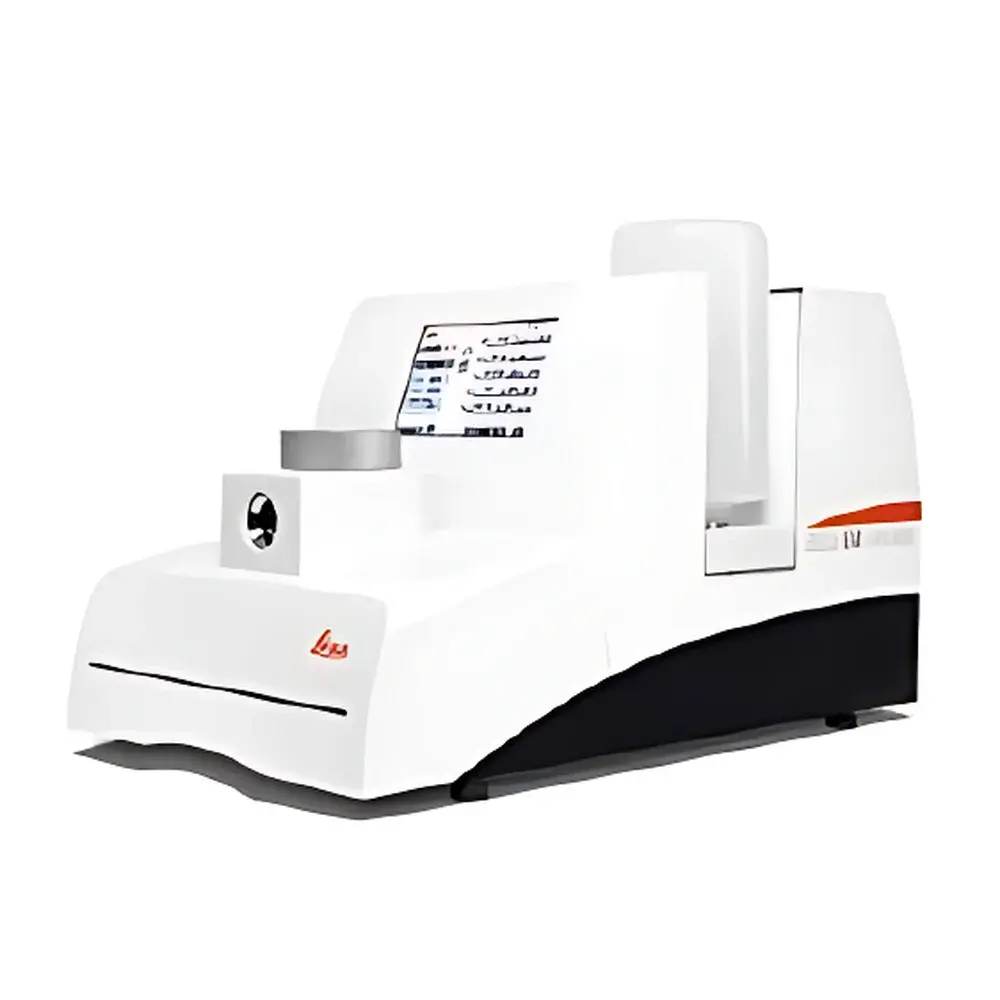
Leica EM CPD300 Automated Critical Point Dryer
| Brand | Leica |
|---|---|
| Origin | Austria |
| Model | EM CPD300 |
| Sample Chamber Volume | 175 mL |
| Control Interface | Touchscreen |
| CO₂ Consumption | Reduced via proprietary filler material |
| Safety Features | Integrated waste liquid separation, software-controlled venting interlock |
| Automation Level | Fully automated critical point drying cycle |
| Compliance | Designed for GLP-compliant SEM sample preparation workflows |
Overview
The Leica EM CPD300 is a fully automated critical point dryer engineered specifically for high-fidelity sample preparation in scanning electron microscopy (SEM). It operates on the physical principle of supercritical fluid transition—replacing aqueous or ethanol-based solvents with liquid CO₂, then heating and pressurizing the chamber to exceed CO₂’s critical point (31.1 °C, 73.8 bar), where the distinction between liquid and gas phases vanishes. This eliminates capillary forces and surface tension-induced collapse during drying—preserving nanoscale ultrastructure of delicate biological and microfabricated specimens. As the first commercially available fully automated CPD system, the EM CPD300 replaces historically labor-intensive, operator-dependent protocols with reproducible, time-optimized sequences governed by embedded process logic and real-time pressure/temperature feedback.
Key Features
- Fully automated drying protocol: Pre-programmed, multi-stage sequence—including solvent exchange, CO₂ infiltration, heating, supercritical transition, controlled depressurization, and venting—executed without manual intervention.
- Proprietary filler material integration: A patented chamber insert reduces CO₂ consumption by up to 40% compared to conventional CPD systems, while accelerating solvent displacement kinetics and shortening total cycle time by ~25%.
- 175 mL stainless-steel sample chamber: Accommodates standard SEM stubs, multi-well carriers, and custom baskets; optimized for throughput without compromising thermal or pressure uniformity.
- Intuitive 7-inch capacitive touchscreen interface: Graphical workflow navigation, real-time parameter display (pressure, temperature, elapsed time), and user-accessible method storage (up to 20 protocols).
- Dual-safety architecture: Hardware-level pressure relief valve combined with software-enforced venting interlocks—preventing premature depressurization until full phase equilibration is confirmed.
- Integrated waste liquid separation module: Condensate and residual solvent are passively segregated into a sealed collection reservoir, minimizing operator exposure and enabling compliant disposal per IEC 61000-6-3 and local hazardous waste regulations.
Sample Compatibility & Compliance
The EM CPD300 supports diverse specimen classes requiring structural integrity preservation: hydrated biological tissues (e.g., plant epidermis, insect cuticle, pollen grains), cryofixed or chemically fixed cell monolayers, hydrogel-based scaffolds, and MEMS/NEMS devices with sub-micron movable elements. Its process repeatability meets ISO 16700:2016 requirements for SEM sample preparation validation. The system’s audit trail functionality—including timestamped method execution logs, parameter deviation alerts, and operator ID tagging—supports compliance with FDA 21 CFR Part 11 when integrated into validated laboratory information management systems (LIMS). All wetted components comply with USP Class VI biocompatibility standards.
Software & Data Management
The embedded control firmware provides deterministic state-machine operation with non-volatile memory retention of calibration constants and user-defined methods. Process data—including pressure ramp rates, hold durations, and final venting profiles—is exportable via USB 2.0 as CSV files for traceability and statistical process control (SPC) analysis. Optional Leica EM Connect software enables remote monitoring, centralized method distribution across multiple CPD units, and integration with ELN platforms via RESTful API. Audit trails record all parameter modifications, user logins, and emergency stop events—fully aligned with GLP and GMP documentation expectations.
Applications
- High-resolution SEM imaging of botanical specimens, including trichomes, stomatal complexes, and seed coat micropatterns.
- Preparation of neural tissue sections and vascular networks for 3D reconstruction via focused ion beam–SEM (FIB-SEM).
- Drying of microfluidic chips and cantilever arrays without stiction-induced deformation.
- Stabilization of collagen-based biomaterials and decellularized extracellular matrix scaffolds prior to pore architecture analysis.
- Routine quality control of photolithographically patterned silicon wafers in semiconductor R&D labs.
FAQ
What solvent exchange protocols does the EM CPD300 support?
Standard workflows include graded ethanol dehydration (30–100%) followed by transitional acetone or HMDS steps; optional third-party solvent modules enable direct hexamethyldisilazane (HMDS) processing.
Is CO₂ refilling performed manually or automatically?
CO₂ is supplied from an external high-pressure cylinder connected via ISO 8573-1 Class 2 certified filtration; the system monitors fill level via pressure transducer feedback but requires manual cylinder replacement.
Can the EM CPD300 be integrated into a cleanroom environment?
Yes—the unit meets ISO 14644-1 Class 5 particulate limits when operated with HEPA-filtered compressed air supply and installed on vibration-damped optical tables.
Does the system provide validation documentation for IQ/OQ/PQ protocols?
Leica supplies factory-verified calibration certificates for pressure and temperature sensors, along with template test protocols for Installation Qualification (IQ) and Operational Qualification (OQ); Performance Qualification (PQ) must be executed per site-specific SOPs.
What maintenance intervals are recommended?
Quarterly O-ring inspection and annual pressure sensor recalibration are advised; the waste separator reservoir requires emptying after every 15–20 cycles depending on sample load and solvent type.




