
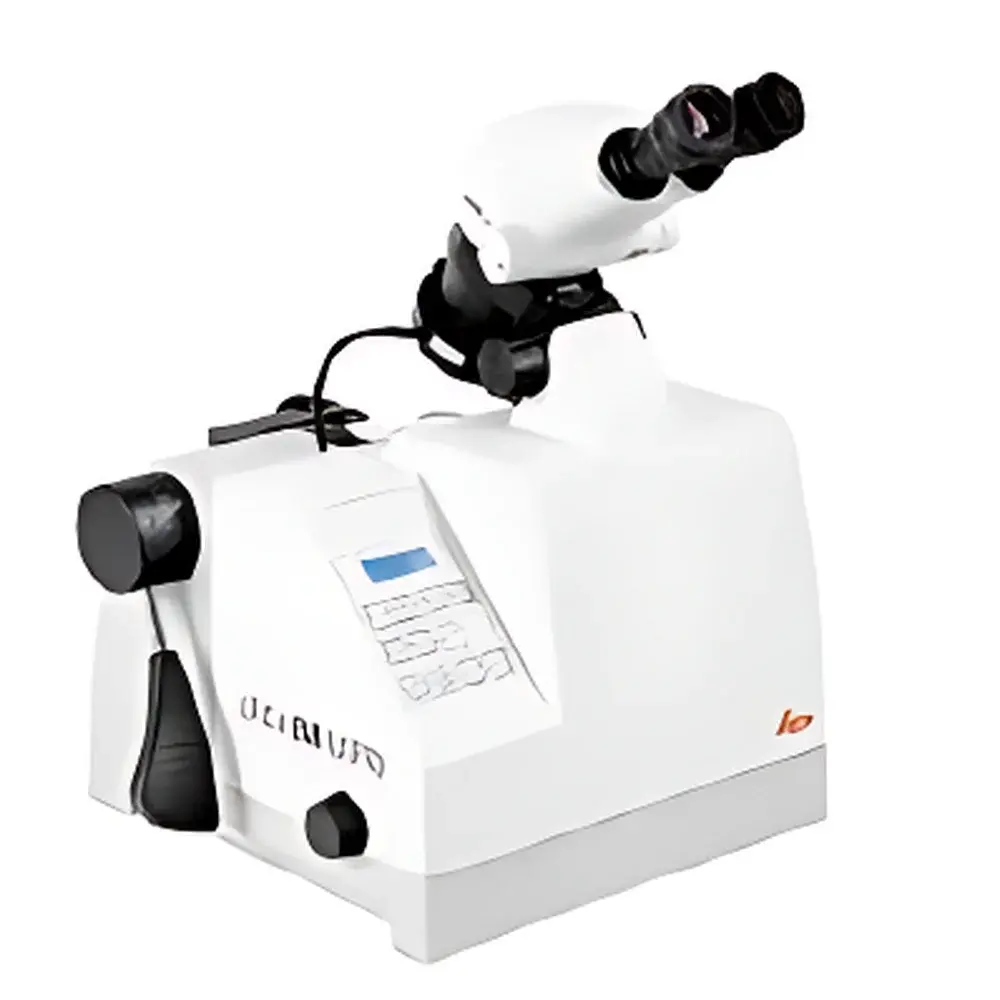
Leica EM RAPID Precision Tablet Milling System for Electron Microscopy Sample Preparation
| Brand | Leica |
|---|---|
| Origin | Austria |
| Model | EM RAPID |
| Milling Step Resolution | 0.5, 1, 10, 100 µm |
| Spindle Speed Range | 300–20,000 rpm |
| Illumination | Long-life LED ring light |
| Display | Integrated LCD control panel |
| Dust Extraction | Built-in vacuum-compatible dust removal system |
| Sample Holder Options | Single-sample stage and multi-sample stage |
Overview
The Leica EM RAPID is a precision-engineered tablet milling system designed specifically for ultrastructural sample preparation in pharmaceutical electron microscopy workflows. Unlike conventional grinding or sectioning tools, the EM RAPID employs controlled, layer-by-layer material removal via high-precision rotary milling—based on deterministic mechanical ablation rather than thermal or vibrational energy transfer. This principle ensures minimal mechanical deformation, no heat-induced phase transitions, and absence of smearing or tailing artifacts at coating–core interfaces—critical for accurate spatial mapping of active pharmaceutical ingredients (APIs) and excipients using SEM-EDS, FIB-SEM, or correlative light-electron microscopy (CLEM). The system operates under ambient conditions and integrates seamlessly into GLP-compliant lab environments where traceability, repeatability, and contamination control are mandatory.
Key Features
- Motorized spindle with digitally regulated speed control from 300 to 20,000 rpm, enabling optimal tool engagement across diverse tablet formulations—from brittle sugar-coated tablets to plasticized polymer matrices.
- Sub-micrometer depth resolution: adjustable milling increments of 0.5 µm, 1 µm, 10 µm, and 100 µm allow precise stratified exposure of layered dosage forms without over-milling or subsurface damage.
- Dedicated tooling compatibility with tungsten carbide and polycrystalline diamond (PCD) end mills—certified for non-reactive interaction with organic APIs and low-metal leaching profiles.
- Integrated LED ring illumination with uniform intensity distribution (>95% homogeneity) facilitates real-time visual monitoring of milling progression and surface topography during operation.
- LCD-based human-machine interface (HMI) with tactile keypad provides direct access to all operational parameters—including depth per pass, total milling depth, spindle speed, dwell time, and tool wear compensation settings.
- Built-in dust extraction port compliant with ISO 14644-1 Class 5 cleanroom vacuum standards; compatible with external HEPA-filtered vacuum systems to prevent airborne particulate dispersion and cross-contamination between samples.
Sample Compatibility & Compliance
The EM RAPID accommodates standard pharmaceutical solid dosage forms including immediate-release tablets, enteric-coated tablets, bilayer tablets, and osmotic pump systems (e.g., OROS®). Its modular stage design supports both single-sample alignment for high-resolution serial milling and multi-position trays for batch-mode processing of up to 12 identically formulated tablets—enabling statistical evaluation of intra-batch API heterogeneity. All contact surfaces are constructed from electropolished stainless steel (AISI 316L), meeting USP requirements for extractables and leachables testing. The system conforms to ICH Q5C stability guidelines for structural integrity assessment and supports audit-ready documentation per FDA 21 CFR Part 11 when paired with Leica’s optional EM SampleTrack software module.
Software & Data Management
While the EM RAPID operates as a standalone hardware platform, its control firmware supports RS-232 and USB-C connectivity for integration into centralized laboratory information management systems (LIMS). Parameter logs—including timestamped milling depth, rotational speed, cumulative tool runtime, and stage position—are exportable in CSV format for QA/QC review. Optional firmware upgrades enable GMP-aligned electronic signatures, user-level access control (admin/operator/technician tiers), and automatic generation of instrument usage reports aligned with Annex 11 and ISO/IEC 17025:2017 clause 7.7.2.
Applications
- Quantitative layer-by-layer elemental mapping of coated tablets via SEM-EDS or WDS to verify coating thickness uniformity and detect delamination.
- Preparation of planar cross-sections for TEM lamella lift-out in drug delivery nanocarrier studies (e.g., liposomes embedded in matrix tablets).
- Correlative analysis of dissolution behavior by correlating mill-depth-resolved morphology with in vitro release kinetics (IVRT).
- Failure analysis of blister-packaged tablets exposed to humidity or temperature stress—exposing internal microcracks and excipient migration pathways.
- Supporting regulatory submissions requiring morphological evidence of content uniformity (e.g., FDA ANDA Module 3.2.P.3.2).
FAQ
Is the EM RAPID suitable for milling hygroscopic or thermolabile drug substances?
Yes—the cold milling process generates negligible localized heating (<2°C rise at interface), preserving crystallinity and preventing polymorphic transformation in sensitive compounds such as amorphous solid dispersions.
Can the system be validated for use in regulated GMP environments?
Yes—Leica provides IQ/OQ documentation templates, calibration certificates traceable to NIST standards, and tool wear validation protocols aligned with ASTM E2921-22 for pharmaceutical milling equipment qualification.
What maintenance intervals are recommended for the spindle and drive electronics?
Spindle bearing inspection every 1,000 hours of cumulative operation; firmware updates recommended quarterly; LED illumination lifetime exceeds 50,000 hours with no degradation in color rendering index (CRI >90).




