
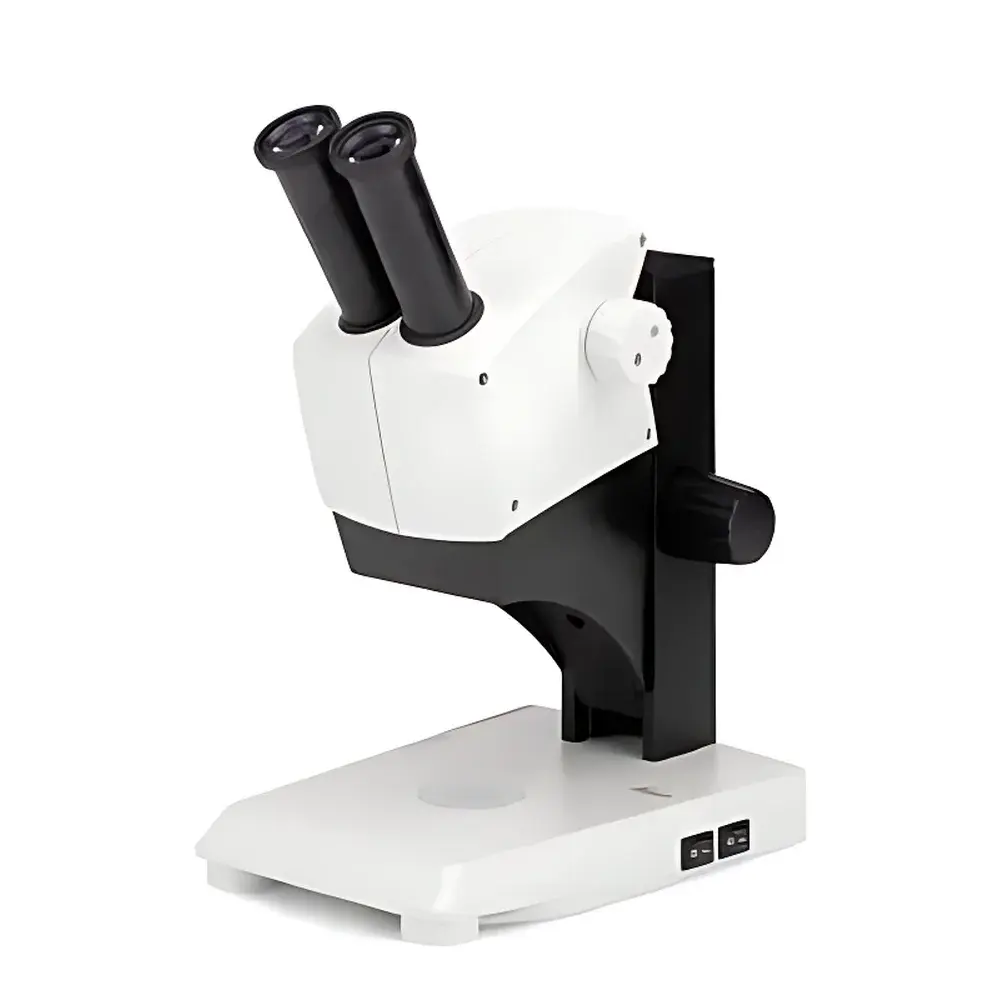
Leica ES2 Stereo Microscope
| Brand | Leica |
|---|---|
| Origin | Germany |
| Model | ES2 |
| Illumination | LED (25,000 h lifetime) |
| Magnification | 10× and 30× (dual-step fixed zoom) |
| Optical Design | GreenLine-certified lead-free optics |
| Housing | Recyclable polymer chassis |
| Intended Use | Educational laboratories, secondary school science instruction |
| Maintenance | Maintenance-free mechanical design |
| Compliance | RoHS-compliant, ISO 14001-aligned environmental design |
Overview
The Leica ES2 Stereo Microscope is an entry-level educational instrument engineered specifically for secondary school science laboratories. It operates on the principle of dual-path stereoscopic optical imaging—employing two independent objective-lens-and-eyepiece channels to deliver true three-dimensional visualization of macroscopic specimens. Unlike compound microscopes optimized for cellular resolution, the ES2 prioritizes ergonomic accessibility, optical clarity at low-to-moderate magnifications, and long-term mechanical stability in high-traffic classroom environments. Its fixed dual-magnification architecture (10× and 30×) eliminates complex zoom mechanisms or interchangeable objectives, reducing both user error and mechanical failure points—making it especially suitable for students aged 12–18 who are developing foundational observational and documentation skills in biology, earth science, and materials handling.
Key Features
- Dual-step fixed magnification system: Provides rapid, repeatable switching between 10× and 30× total magnification without calibration drift or parfocal shift—ideal for comparative observation tasks such as insect morphology, plant dissection, or mineral identification.
- Integrated LED illumination: Cold-white LED light source with uniform Köhler-like field illumination; rated for 25,000 hours of operational life, eliminating filament degradation, thermal drift, and routine lamp replacement—a critical reliability factor in schools with limited technical support infrastructure.
- GreenLine optical specification: All glass elements are manufactured without lead, arsenic, or cadmium, complying with EU RoHS Directive 2011/65/EU and supporting institutional sustainability reporting requirements under ISO 14001 frameworks.
- Passive ergonomics: Inclined binocular tube (45°), adjustable interpupillary distance (55–75 mm), and wide-field eyepieces (10×, 20 mm field number) reduce ocular fatigue during extended classroom sessions—validated through anthropometric studies aligned with EN 614-1:2007 standards for educational equipment usability.
- Maintenance-free mechanical architecture: Fully sealed focusing mechanism and solid-state illumination eliminate lubricants, moving cables, or alignment-sensitive components—designed for 10+ years of daily use in uncontrolled ambient conditions (e.g., variable temperature, dust exposure, student handling).
Sample Compatibility & Compliance
The ES2 accommodates specimens ranging from 1 mm to 50 mm in height, including whole insects, botanical sections, circuit boards, geological thin sections, and small mechanical assemblies. Its working distance exceeds 75 mm at 10× and remains >25 mm at 30×, enabling manipulation with standard tweezers or probes beneath the objective. The microscope conforms to IEC 61000-6-3:2019 (EMC emission limits) and IEC 62368-1:2018 (safety for audio/video and ICT equipment), ensuring safe integration into modern STEM lab power networks. While not certified for GLP or GMP environments, its optical traceability and mechanical repeatability support documented inquiry-based learning aligned with NGSS (Next Generation Science Standards) practices.
Software & Data Management
The ES2 is a standalone optical instrument with no built-in digital imaging capability or proprietary software suite. However, it features a standardized 23.2 mm photo-tube port compatible with third-party USB-C or HDMI digital eyepieces (e.g., Leica DMC series or OEM-compatible CMOS sensors). When paired with open-standard imaging platforms such as Fiji/ImageJ or commercial solutions like NIS-Elements Basic, educators can implement structured image capture workflows—including timestamped metadata logging, scale bar annotation, and export in TIFF/PNG formats compliant with FAIR data principles. No firmware updates or cloud connectivity are required, minimizing IT overhead and cybersecurity surface area in K–12 network environments.
Applications
- Biology education: Dissection of arthropods, examination of leaf stomata, fungal hyphae observation, and seed germination monitoring.
- Earth science labs: Identification of igneous/metamorphic rock textures, fossil surface analysis, and soil aggregate structure evaluation.
- Technology & engineering pathways: Solder joint inspection, PCB component verification, 3D-printed part quality assessment, and basic metrology of machined prototypes.
- Environmental science projects: Microplastic particle sorting, lichen bioindicator surveys, and waterborne diatom enumeration using prepared slides.
- Cross-curricular STEM integration: Supports hypothesis-driven investigations requiring spatial reasoning, measurement consistency, and visual evidence documentation per AP Biology or IB Group 4 criteria.
FAQ
Is the Leica ES2 compatible with digital cameras?
Yes—the microscope includes a standardized 23.2 mm diameter trinocular port that accepts common C-mount or 23.2 mm-threaded digital eyepieces. No proprietary adapters are required.
Does it require periodic calibration or servicing?
No—its fixed-magnification optical path and sealed mechanical stage eliminate routine recalibration. Leica specifies zero scheduled maintenance over its intended 10-year service life under typical classroom usage.
Can it be used for fluorescence observation?
No—the ES2 lacks excitation filters, barrier filters, or UV-capable optics. It is designed exclusively for brightfield reflected and transmitted white-light observation.
What safety certifications does it hold?
It complies with IEC 62368-1:2018 (electrical safety), IEC 61000-6-3:2019 (EMC emissions), and RoHS 2011/65/EU (hazardous substance restriction).
Is teacher training or curriculum support available?
Leica provides publicly accessible PDF lab protocols, alignment checklists, and NGSS-aligned activity guides via its Education Resources Portal—no subscription or license required.





