
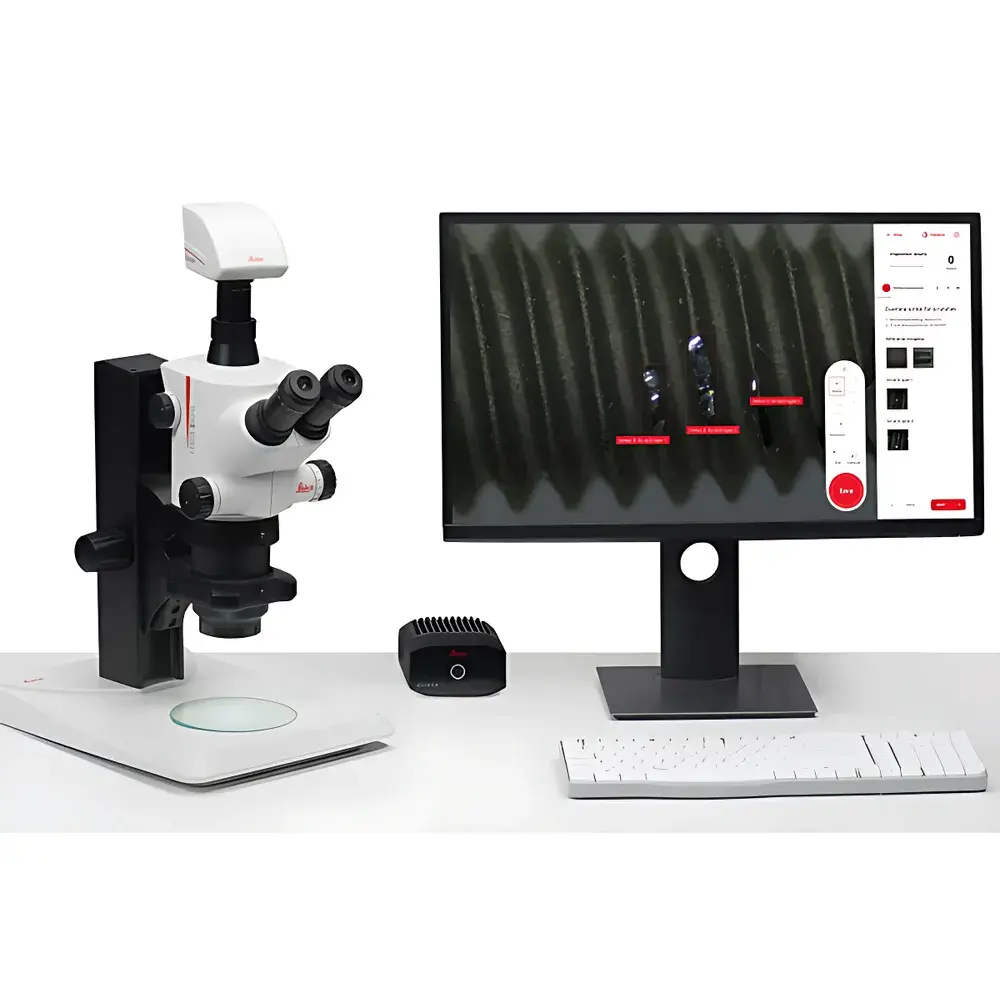
Leica Exalta Intelligent Traceable Microscopy System
| Brand | Leica |
|---|---|
| Origin | Germany |
| Manufacturer Type | Authorized Distributor |
| Origin Category | Imported |
| Model | Exalta |
| Price Range | USD 13,500 – 27,000 |
Overview
The Leica Exalta Intelligent Traceable Microscopy System is a purpose-built digital microscopy platform engineered for regulated optical inspection in medical device manufacturing and quality control laboratories. Unlike conventional manual microscopy workflows, Exalta integrates hardware, guided software protocols, and audit-ready electronic record management into a single cohesive system—designed specifically to address the traceability, consistency, and compliance challenges inherent in visual inspection of implantable and Class III medical devices. Its core architecture implements standardized visual assessment protocols grounded in ISO 13485 and aligned with FDA expectations for objective, operator-independent evaluation. The system operates on a calibrated optical path compatible with standard Leica upright and inverted microscope stands (e.g., DMi8, DM6 B), enabling seamless integration into existing GMP-compliant laboratory infrastructure. Exalta does not perform automated defect detection via AI or image analysis algorithms; rather, it enforces procedural fidelity through step-by-step digital work instructions, reference image anchoring, and real-time documentation—ensuring that every inspection event is reproducible, attributable, and fully auditable.
Key Features
- Guided inspection workflow with dynamic, version-controlled work instructions—configurable by QA managers and deployable across multiple stations via network synchronization
- Dual-reference imaging interface: simultaneous display of live sample view and pre-approved “golden standard” reference images for side-by-side visual comparison
- Overlay-based pass/fail decision support: semi-transparent image registration enables rapid spatial alignment and qualitative defect evaluation against defined acceptance criteria
- Integrated barcode scanning for automatic sample identification, lot/serial number capture, and metadata binding to inspection records
- Electronic signature-capable reporting engine compliant with 21 CFR Part 11 requirements—including role-based user authentication, biometric or token-based signing, and immutable audit trails
- Centralized database architecture supporting SQL Server or network file share deployment, with TLS-encrypted data transmission and configurable backup policies
- Full revision history tracking for all work instructions, inspection reports, and system configuration changes—with granular user-level attribution and timestamping
Sample Compatibility & Compliance
Exalta supports visual inspection of metallic, polymeric, and ceramic components used in cardiovascular stents, orthopedic implants, neurovascular devices, and other high-risk medical products. It accommodates standard microscope slide formats, petri dishes, and custom fixtures compatible with Leica’s modular stage systems. All inspection protocols are structured to align with ISO 10993-12 (sample preparation), ISO 15223-1 (labeling), and ASTM F2652 (standard guide for visual inspection of medical devices). The system satisfies essential elements of GxP (GLP, GMP, GDP) frameworks, particularly those governing electronic records (21 CFR Part 11 Subpart B), data integrity (ALCOA+ principles), and personnel training verification. Audit trails include full chronology of user logins, instruction modifications, report generation events, and electronic signature actions—retained for minimum 10 years per internal retention policy guidelines.
Software & Data Management
The Exalta software suite runs on Windows 10/11 (64-bit) and requires no third-party runtime dependencies. Configuration, protocol authoring, and user administration occur via a dedicated Manager Console with RBAC (Role-Based Access Control) enforcement. Inspection sessions generate encrypted .exr (Exalta Report) files containing embedded metadata: operator ID, instrument serial number, timestamp (with NTP sync), microscope magnification settings, lighting parameters, and annotated screenshots. Reports export natively to PDF/A-2b for long-term archival and integrate with common QMS platforms (e.g., Veeva Vault QMS, MasterControl) via RESTful API or secure SFTP. All data resides within the customer’s controlled IT environment—no cloud storage or external telemetry is enabled by default. Software validation documentation (IQ/OQ/PQ templates) and CSV import/export utilities for batch instruction deployment are provided as part of the installation package.
Applications
- Final release inspection of sterile-packaged implantables prior to distribution
- In-process checks during precision machining, laser marking, and surface finishing operations
- Root cause analysis documentation for nonconforming material investigations (NCMR)
- Supplier qualification audits requiring objective evidence of visual inspection rigor
- Regulatory submission support—generating inspection evidence packages for FDA 510(k), PMA, or MDR CE Technical Documentation
- Training validation for new operators using standardized, version-tracked inspection scenarios
FAQ
Does Exalta perform automated defect recognition using AI or machine learning?
No. Exalta is a procedural enforcement and documentation system—not an automated vision inspection tool. It ensures consistent human-led evaluation through structured guidance, reference anchoring, and traceable decision logging.
Can Exalta be integrated with our existing LIMS or MES?
Yes. Native API endpoints support bidirectional exchange of sample IDs, inspection status, and report URLs. Pre-built connectors are available for LabVantage, Thermo Fisher SampleManager, and Siemens Opcenter Quality.
Is 21 CFR Part 11 compliance validated out-of-the-box?
The system ships with a comprehensive validation toolkit—including risk assessments, test scripts, and summary reports—but site-specific IQ/OQ execution remains the customer’s responsibility per FDA guidance.
What microscope models are officially supported?
Leica DMi8, DM6 B, DM2700 M, and DM4 B platforms with motorized Z-drive and digital camera interfaces (Leica DFC9000 GT or equivalent). Custom integration with non-Leica microscopes is possible via SDK but requires engineering consultation.
How is user access managed across multiple shifts and departments?
Through centralized Active Directory synchronization or local credential stores with configurable session timeouts, password complexity rules, and forced re-authentication for critical actions (e.g., protocol modification, report finalization).




