
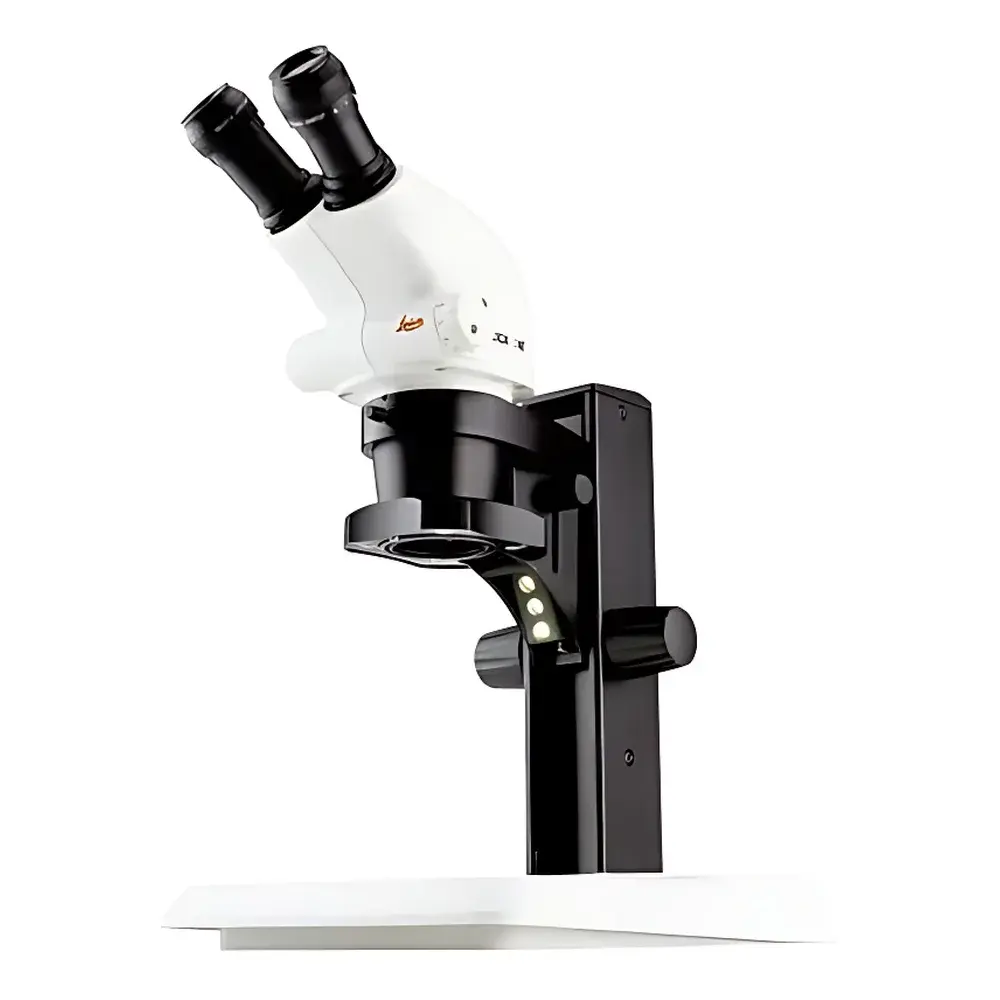
Leica LED2500 Illumination Stand for Stereo Microscopes
| Brand | Leica |
|---|---|
| Origin | Germany |
| Model | LED2500 |
| Light Source | High-Efficiency White LEDs |
| Lifetime | >25,000 hours |
| Illumination Modes | Incident (reflected) and Transmitted Light, Independently Controllable |
| Preset Illumination Sequences | 4 factory-configured incident-light routines |
| Control Interface | Integrated capacitive touchscreen light manager |
| Compatibility | Leica S4 E, S6, and M80 stereo microscope systems |
| Form Factor | Compact integrated stand with built-in incident and transmitted illumination modules |
| Power Supply | External 100–240 V AC adapter |
Overview
The Leica LED2500 Illumination Stand is an engineered optical support system designed exclusively for integration with Leica’s S4 E, S6, and M80 series stereo microscopes. It implements a dual-path illumination architecture—combining high-luminance, spectrally stable white LEDs for both incident (reflected) and transmitted light pathways—within a single, space-optimized mechanical housing. Unlike traditional halogen or fiber-optic illumination solutions, the LED2500 delivers consistent color temperature (~5,700 K), minimal thermal load on specimens, and zero warm-up delay. Its solid-state design eliminates filament degradation and intensity drift over time, ensuring long-term photometric stability required for comparative morphological analysis, quality control documentation, and routine inspection workflows in regulated environments.
Key Features
- Integrated dual-mode illumination: Simultaneous or independent control of incident and transmitted LED light paths via dedicated soft-touch sliders on the front panel.
- Four factory-preset incident-light sequences: Optimized for common contrast enhancement techniques—including oblique, ring, directional, and diffuse illumination—enabling rapid reconfiguration without manual repositioning of external light guides or filters.
- Four-quadrant top-mounted LED array: Delivers uniform, shadow-minimized incident illumination across the entire field of view, supporting high-fidelity surface texture assessment and low-angle feature discrimination.
- Capacitive touchscreen light manager: Provides intuitive, tactile-free brightness adjustment (0–100% intensity), real-time power consumption feedback, and sequence selection—all accessible without requiring software installation or PC connectivity.
- Compact monoblock construction: Combines structural support, optical path alignment, and illumination electronics into a single 120 mm × 120 mm × 230 mm (W × D × H) unit, reducing benchtop footprint by up to 60% versus modular lamp-and-stand configurations.
- Thermally managed LED driver architecture: Maintains constant current regulation and active heat dissipation, preserving luminous flux stability across ambient temperatures from 15 °C to 35 °C per ISO 10934-1 calibration conditions.
Sample Compatibility & Compliance
The LED2500 is mechanically and optically aligned to Leica’s standardized stereo microscope mounting interface (M80/S6/S4 E dovetail and screw-hole pattern), ensuring repeatable positioning and parfocal consistency. Its non-ionizing, low-UV emission profile (IEC 62471 Risk Group 1) makes it suitable for live biological specimens, polymer samples, electronic assemblies, and archival materials where photobleaching or thermal deformation must be avoided. While not a standalone medical device, the system complies with EN 61326-1 (EMC for laboratory equipment) and meets essential requirements of the EU Machinery Directive 2006/42/EC when used as an accessory to CE-marked Leica stereo microscopes. No recalibration is required between instrument service intervals, supporting GLP-aligned documentation practices.
Software & Data Management
The LED2500 operates as a fully autonomous hardware subsystem—no drivers, firmware updates, or host software dependencies are required. All operational parameters (intensity levels, active preset, elapsed operating hours) are stored in non-volatile memory and accessible via the onboard display. For laboratories maintaining audit trails under FDA 21 CFR Part 11 or ISO/IEC 17025, the unit’s deterministic behavior—i.e., identical output for identical input settings across units and time—enables traceable illumination configuration recording within microscope acquisition logs or LIMS entries. Optional integration with Leica Application Suite (LAS X) v3.7+ permits synchronized illumination state logging alongside image metadata.
Applications
- Electronics manufacturing: Inspection of solder joint integrity, PCB trace continuity, and component placement accuracy under controlled directional lighting.
- Materials science: Characterization of fracture surfaces, coating uniformity, and particle morphology using multi-angle incident illumination sequences.
- Forensic document examination: Differentiation of ink layers, erasure detection, and indented writing visualization through optimized oblique lighting presets.
- Entomology and botany: Non-destructive observation of delicate arthropod exoskeletons or leaf venation patterns with minimal thermal stress.
- Quality assurance labs: Standardized visual inspection protocols compliant with ASTM E2912 (Standard Guide for Visual Inspection of Metallic Surfaces) and ISO 10934-2 (Stereo microscope performance testing).
FAQ
Is the LED2500 compatible with Leica M125 or M205 stereo microscopes?
No—the LED2500 is mechanically and electronically designed only for the S4 E, S6, and M80 platforms. Mounting interfaces and power signaling protocols differ across Leica’s stereo microscope generations.
Can the preset illumination sequences be customized or renamed?
No—preset sequences are fixed at firmware level to ensure reproducibility across installations; however, intensity levels within each sequence remain fully adjustable via the touchscreen interface.
Does the LED2500 require periodic lamp replacement or recalibration?
No—LED modules are rated for >25,000 hours at nominal output; no consumables or optical recalibration are specified in the maintenance schedule per Leica Service Bulletin SB-LED2500-2023.
What safety certifications does the unit hold?
It carries CE marking per Directive 2014/30/EU (EMC) and 2014/35/EU (LVD), and conforms to IEC 61000-6-3 (emissions) and IEC 61000-6-2 (immunity) for laboratory environments.
Is the transmitted light path compatible with Leica’s optional polarizing or filter trays?
Yes—the base module includes a standard 32 mm filter slot beneath the stage, accepting Leica’s catalog of polarization, neutral density, and color correction filters without modification.






